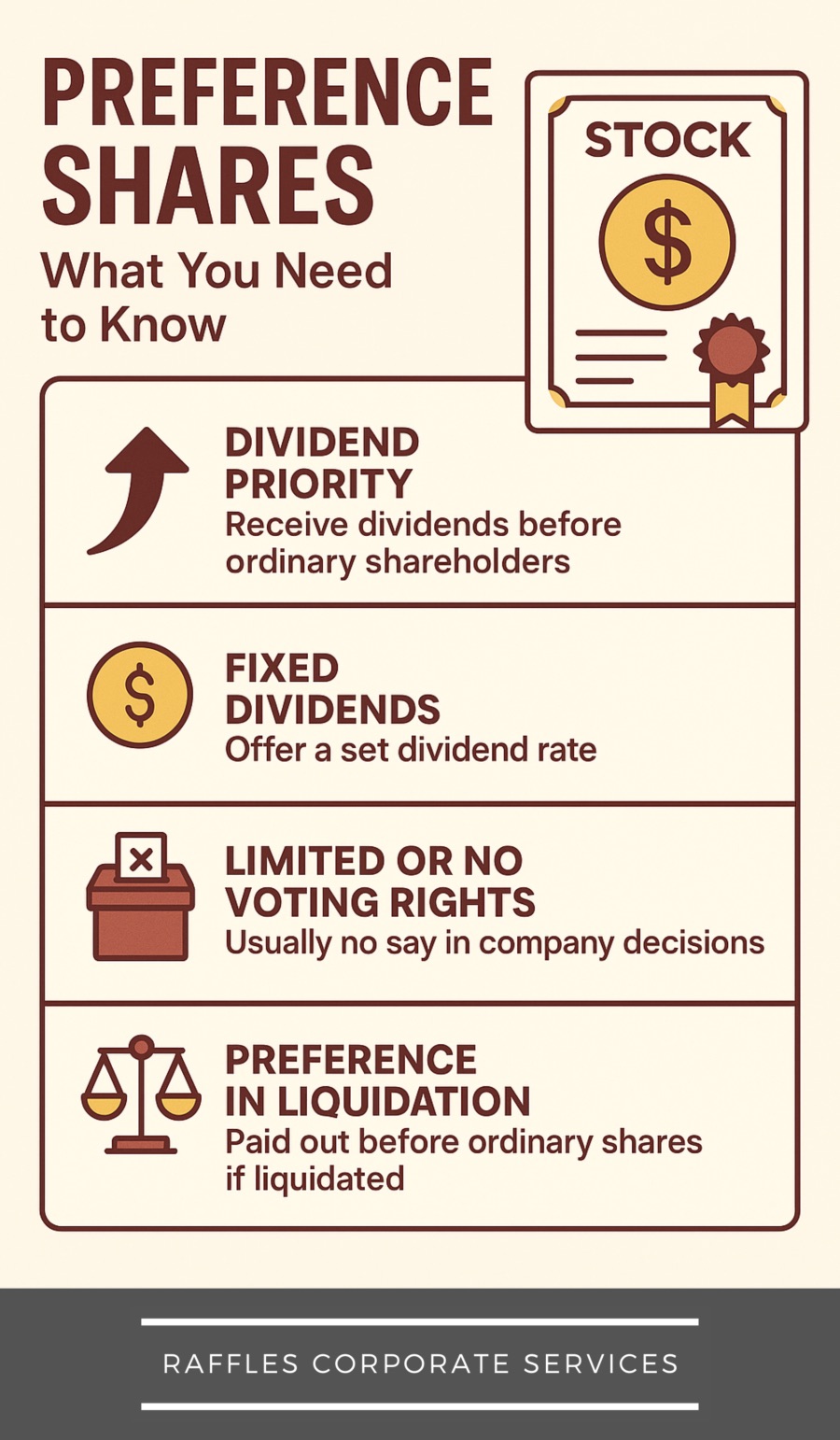
Preference shares are a type of share issued by Singapore-incorporated companies that provide shareholders with preferential rights over ordinary shareholders, especially in respect of dividends and asset distribution during liquidation.
Definition and Key Features
-
Priority in Dividends: Preference shareholders receive dividends before any dividends are paid to ordinary shareholders. These dividends are often fixed or set at a preferential rate, providing a more stable income stream.
-
Priority on Capital Repayment: In the event of company liquidation or winding up, preference shareholders have a higher claim on the company’s assets before ordinary shareholders.
-
Limited or No Voting Rights: Typically, preference shares carry no voting rights or limited voting rights in company decisions, differentiating them from ordinary shares which normally confer voting power.
-
Types of Preference Shares in Singapore:
-
Cumulative Pref. Shares: Unpaid dividends accumulate and must be paid out in the future before any dividends to ordinary shareholders.
-
Non-cumulative Pref. Shares: Unpaid dividends do not accumulate.
-
Convertible Pref. Shares: Shareholders may convert these shares into ordinary shares under specific terms.
-
Non-convertible Pref. Shares: These shares cannot be converted.
-
Redeemable Pref. Shares: Shares that the company can buy back at a predetermined price and time.
-
Implications for Stakeholders
-
For Investors:
-
Preference shares offer a more secure income through fixed or preferential dividends, which is attractive to risk-averse investors seeking stable returns.
-
Preference shareholders have greater protection in case of insolvency due to priority on assets.
-
They usually do not have a say in company management decisions due to limited voting rights, which may limit influence but reduces exposure to company risks associated with governance.
-
-
For Companies:
-
Issuing preference shares helps raise equity capital without diluting control because preference shares generally lack voting rights.
-
It’s a flexible financing tool useful for balancing shareholder interests and capital structure management.
-
Companies can tailor the terms of such shares (e.g., dividend rates, convertibility) to meet specific investment or strategic needs.
-
-
Tax Treatment:
-
In Singapore, preference shares are generally treated like ordinary shares for tax purposes; dividend payments to shareholders do not affect company tax but provide income to shareholders.
-
Regulatory Context in Singapore
-
Preference shares and their rights are governed by the Singapore Companies Act and the company’s Constitution, which lays out the specific rights attached to these shares.
-
Issuers must comply with disclosure and regulatory requirements set by the Monetary Authority of Singapore (MAS) and Accounting and Corporate Regulatory Authority (ACRA) to ensure transparency and investor protection.
Preference shares are a vital part of the capital structure for many Singapore companies, providing a balance between risk and return for investors while helping companies manage equity financing without affecting voting control.