
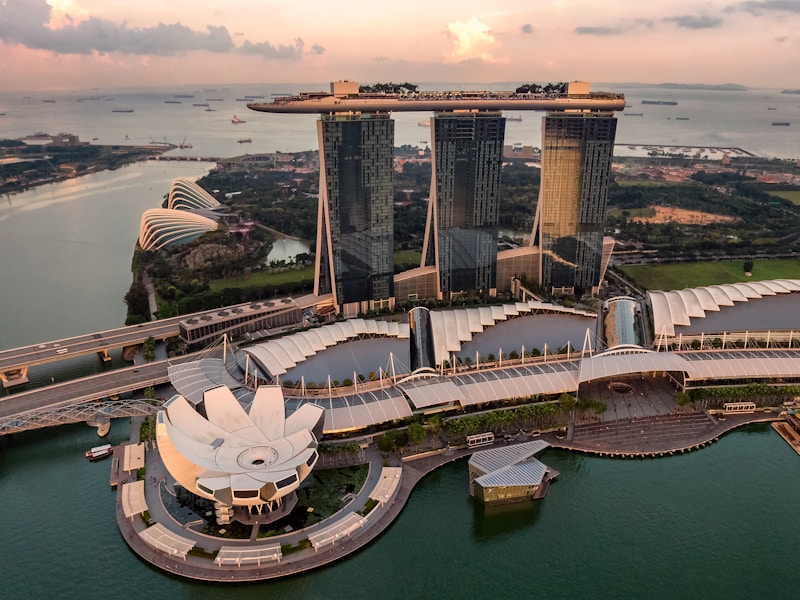
Singapore has spent the last decade quietly becoming one of the world’s most attractive destinations for high net worth individuals. The combination of political stability, English-language administration, world-class private banking, a tax regime that does not tax foreign-source income for individuals, and rule-of-law confidence has made it the preferred relocation jurisdiction for entrepreneurs and family heads from across Asia, the Middle East and Europe. The flip side of that popularity is genuine selectivity: Singapore does not offer a passive “golden visa”, and every HNW pathway carries real economic-substance and source-of-wealth scrutiny.
Raffles Corporate Services works with a panel of experienced Singapore law firms who offer cost-effective and efficient legal service and advice. This article is general information only and is not legal advice.
This guide maps the full menu of HNW relocation routes in 2026 — the Global Investor Programme, the Single Family Office route, the Overseas Networks & Expertise (ONE) Pass, the Personalised Employment Pass, the EntrePass, and ordinary Employment Pass relocation through a wholly owned business — with the eligibility, capital and substance tests for each. It is intended as a starting point for individuals comparing options, and for advisers running discovery conversations with new clients.
The HNW relocation menu at a glance
For a typical HNW or UHNW individual, the workable Singapore routes fall into five buckets, each with very different economic and lifestyle implications:
- Global Investor Programme (GIP) — direct PR for substantial business or fund investment.
- Single Family Office under Section 13O or 13U — Employment Pass plus a clear path to PR through a Singapore-based family office.
- ONE Pass — five-year flexible work pass for top earners and proven achievers.
- Personalised Employment Pass (PEP) — three-year non-renewable pass for high-earning professionals not tied to one employer.
- EntrePass — pass tied to founding an innovative or VC-backed Singapore business.
Each route has its own profile of capital required, time horizon, family coverage and likelihood of conversion to permanent residency. Below we go through each in turn.
1. Global Investor Programme (GIP)
The GIP is the only Singapore programme that grants Permanent Residency directly on approval, without first requiring the applicant to live and work in Singapore. It is administered by the Singapore Economic Development Board (EDB) and is reviewed by an inter-agency panel that looks at the applicant’s business track record, source of wealth, and the proposed Singapore investment.
The 2026 investment options are unchanged in concept but stricter on substance: invest at least S$10 million in a new or existing Singapore-based business and create local jobs; invest at least S$25 million in a GIP-approved fund; or establish a Singapore-based Single Family Office with global AUM of at least S$200 million, of which at least S$50 million must be deployed in Singapore-allowable investments. PR renewal at the end of year five depends on actual job creation, business growth and family residency in Singapore.
Our deep-dive on the Global Investor Programme walks through the full requirements, common rejection grounds and the typical 9–12 month timeline.
2. Single Family Office (Section 13O / 13U)
For families whose wealth is structured for inter-generational management, the Single Family Office (SFO) route has become the dominant relocation pattern. The SFO is incorporated as a Singapore Pte Ltd or Variable Capital Company, applies to MAS for Section 13O or 13U fund tax exemption, and serves as the employer that sponsors Employment Passes for the family principal and key team members.
Section 13O requires a fund of at least S$20 million committed and invested through the SFO, two investment professionals (one of whom may be a family member) and a minimum local business spend tier. Section 13U is the institutional-tier scheme: at least S$50 million in committed AUM, three investment professionals (one of whom must be non-related), and higher local business spend. Our side-by-side comparison of Section 13O vs 13U goes through the numbers.
The SFO route does not deliver PR on day one — the family principal lives in Singapore on an Employment Pass, then applies for PR after demonstrating economic contribution, residency and family ties (typically 18–36 months in). For families considering whether to start with a private investment company before scaling to a full SFO, our note on family investment companies in Singapore sets out the trade-offs.
3. Overseas Networks & Expertise (ONE) Pass
The ONE Pass was introduced in 2023 to attract top global talent and has become a popular HNW pathway for entrepreneurs and senior executives who do not want to be tied to one employer. It is a five-year, renewable pass that allows the holder to concurrently work for multiple companies, start their own business, and bring family members on Dependant’s Passes.
Eligibility runs through one of two doors: a salary track requiring fixed monthly earnings of at least S$30,000 in the last year (or expected in the next year if joining a Singapore-listed company with substantial market cap), or an achievements track for individuals with outstanding accomplishments in arts, sports, science and technology, academia or research. Crucially, the ONE Pass is not screened through the COMPASS framework, removing one of the more uncertain elements of an Employment Pass application. Our 2026 guide to the Tech.Pass covers an adjacent route for tech leaders.
4. Personalised Employment Pass (PEP)
The PEP is a non-renewable, employer-untied work pass for very high earners. It is open to existing Employment Pass holders earning a fixed monthly salary of at least S$22,500, and to overseas applicants earning at least S$22,500 in their last drawn fixed monthly salary. The PEP is valid for three years and cannot be renewed, so it is best understood as a three-year window in which to relocate, set up a business or family office, and then transition into a more permanent structure (typically EP via a Singapore company or PR).
Our background note on the Personalised Employment Pass covers the salary tests, dependants policy, and what happens at the end of the three-year term.
5. EntrePass
The EntrePass is the relocation pathway for a HNW individual who is also a serial entrepreneur and wants to anchor a new venture in Singapore. It is pass-not-PR, tied to a Singapore-incorporated company that is no more than six months old at the time of application, and conditional on the applicant holding at least 30% of the company.
To qualify, the business must satisfy one of three innovation tracks: third-party funding of at least S$100,000 from a recognised investor, business incubated by a Government-recognised incubator, or holding of intellectual property registered with an approved IP institution. Read our full primer on the EntrePass in 2026 for eligibility detail and renewal benchmarks.
6. Employment Pass via a wholly owned Singapore business
The most common and underrated HNW route is the simplest: incorporate a Singapore Pte Ltd, capitalise it appropriately, build a business plan with substance, then sponsor your own Employment Pass through that company. With the COMPASS framework now applying to almost every EP, the application is more rigorous than it was five years ago, but it remains the path with the lowest minimum capital requirement for someone who genuinely intends to operate a business onshore.
The trap to avoid is treating the EP route as a paper-only exercise. MOM and IRAS both run substance reviews, and an EP-sponsoring company that books revenue but employs no one in Singapore is an audit risk. For a clean view of how to do this properly, see our note on incorporating a Singapore company while on an Employment Pass.
From pass to PR: the conversion question
For most HNW individuals, the relocation journey does not end at the work pass — the long-term goal is Permanent Residency, and ultimately, optionality on Singapore citizenship. Other than the GIP, no Singapore relocation pathway grants PR on day one. The conversion timeline depends on (a) the applicant’s economic contribution measured in income tax, CPF where applicable, and demonstrable Singapore-based business activity, (b) family residency in Singapore, including children’s schooling, and (c) the applicant’s overall sector relevance to Singapore’s strategic priorities.
For a fuller treatment of the PR application itself, the documents ICA wants to see, and the timeline, our Singapore PR Application 2026 guide is the single most-read article on this site for a reason.
Tax positioning for the first 24 months
Tax residency in Singapore turns on physical presence: 183 days or more in a calendar year, or in some scheduled-employment cases over a continuous 24-month period. Once tax-resident, the individual is taxed at progressive rates from 0% on the first S$20,000 to 24% on income above S$1 million; foreign-source income that is not received in Singapore is generally not taxed in the hands of an individual.
HNW relocators frequently underestimate two things: (1) the home-country exit tax or trailing-tax exposure on departure, and (2) the year-of-arrival rules in Singapore that can leave an individual non-resident for the first part of the calendar year. Both deserve specialist tax advice before the pass is filed. Our overview of Withholding Tax in Singapore covers the corporate side; on the personal side, we recommend a tailored opinion from IRAS for any non-trivial multi-jurisdiction position.
Choosing between the routes — a simple matrix
If the priority is direct PR with capital deployment and the applicant has S$10m+ ready, the GIP is the cleanest pathway. If the priority is multi-generational wealth management with eventual PR, the Single Family Office under 13O or 13U is usually the better answer. If the priority is professional flexibility on a five-year horizon, the ONE Pass dominates. If the priority is launching one specific innovative business, the EntrePass is purpose-built. If the priority is speed to land in Singapore on a serious salary while exploring options, the PEP buys three years. And if the priority is to operate a real business with the lowest capital threshold, EP-via-own-company remains the workhorse route.
How Raffles Corporate Services helps
Selecting the right HNW relocation pathway is rarely about visa mechanics alone — it is about how the relocation interacts with corporate structure, family wealth, tax residency in the home jurisdiction, and the family’s medium-term plans for Singapore. Raffles Corporate Services works with families and their existing advisers (lawyers, tax counsel, private bankers) to scope the right structure, prepare the relocation file, and execute the corporate, MAS and ICA workstreams in parallel. Talk to our team for a discovery conversation, under NDA where appropriate.
— The Editorial Team, Raffles Corporate Services
How Raffles Corporate Services can help
If you would like to enquire about our corporate secretarial, accounting or tax services, email [email protected] or WhatsApp +65 8501 7133.
Our team and tax advisers can assist with your business requirements. Where legal advice is needed, advisers from our associated law firms can assist.