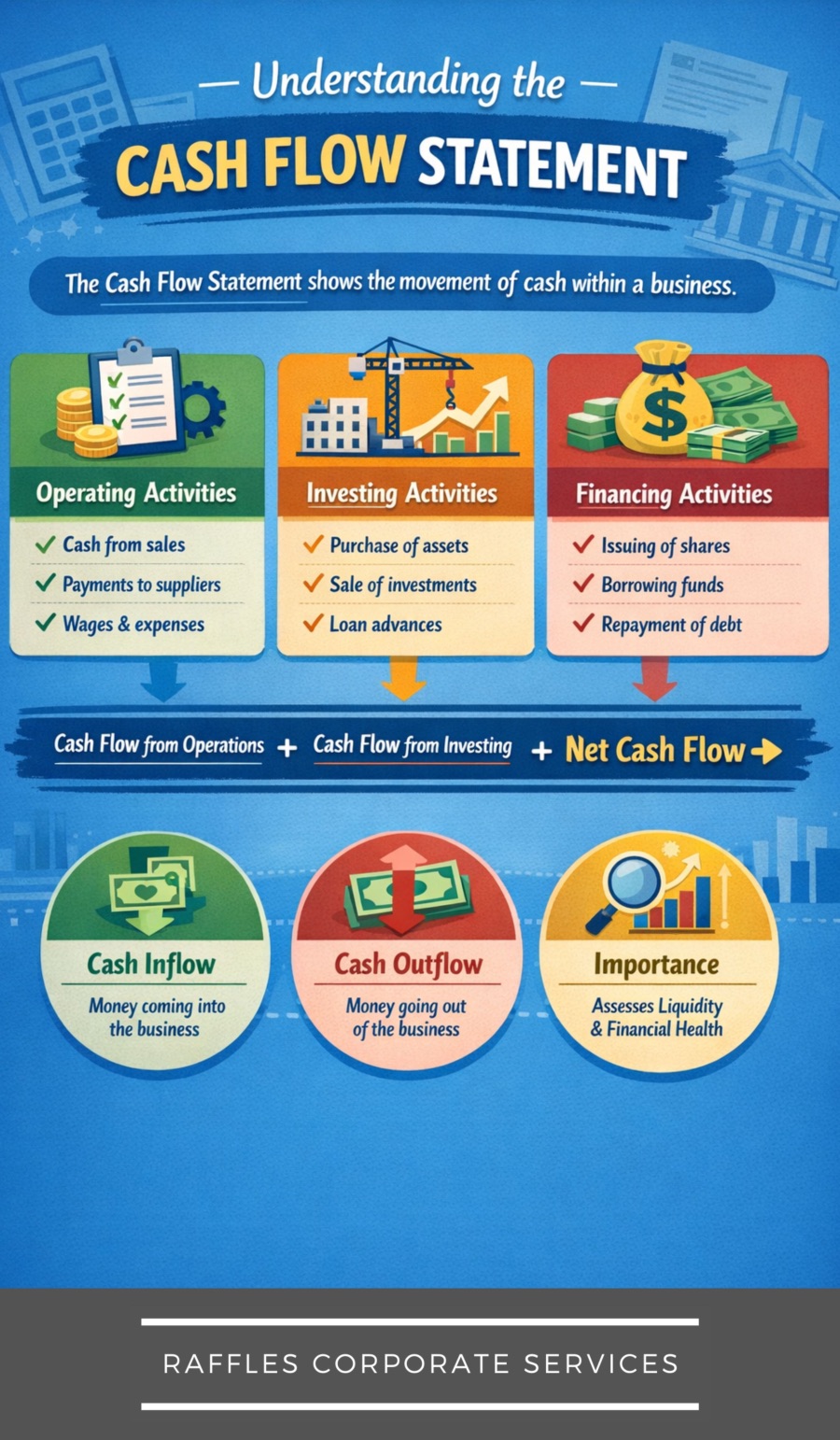
The cash flow statement shows how a Singapore company generates and uses cash during a financial period. Unlike the profit and loss statement, it tracks actual cash movements, not accounting profits. As a result, directors, investors, and lenders use it to assess liquidity, solvency, and the company’s ability to meet short-term obligations.
When it matters
-
For statutory financial statements filed with ACRA, unless the company qualifies for simplified reporting.
-
When banks assess loan applications or credit facilities.
-
When directors evaluate whether the business can pay salaries, suppliers, and taxes on time.
-
During cash planning, especially for startups and growing SMEs in Singapore.
Therefore, even profitable companies must review the cash flow statement closely.
Key components of a cash flow statement (Singapore)
Operating activities
This section reflects cash generated from the company’s core business activities.
For example, it includes cash received from customers and cash paid to suppliers, employees, and IRAS.
Investing activities
This section shows cash used for or generated from long-term assets.
For example, it includes purchases of equipment, disposal of fixed assets, or investments in subsidiaries.
Financing activities
This section records cash movements related to funding.
For example, it includes bank loans, repayment of borrowings, issuance of shares, and dividend payments.
Consequently, these three sections explain why cash increased or decreased during the year.
Key requirements & process (Singapore)
-
Prepare the cash flow statement as part of a complete set of financial statements.
-
Follow Singapore Financial Reporting Standards (SFRS or SFRS for Small Entities, where applicable).
-
Ensure consistency with the profit and loss statement and balance sheet.
-
File the financial statements with ACRA via BizFile+ after approval at the Annual General Meeting (AGM), if required.
Meanwhile, directors must ensure the statement gives a true and fair view of the company’s cash position.
Worked example (SG context)
A Singapore trading company reports a net profit of S$120,000 for the year. However, customers delay payments, increasing trade receivables by S$80,000. As a result, cash from operating activities is only S$40,000. Meanwhile, the company buys new equipment for S$50,000, leading to an overall cash decrease despite being profitable.
Common pitfalls & tips
-
Confusing profit with cash flow, especially in accrual accounting.
-
Ignoring changes in working capital, such as inventory and receivables.
-
Misclassifying loan repayments between operating and financing activities.
-
Overlooking non-cash items like depreciation adjustments.
Therefore, directors should review cash flow trends regularly, not just year-end figures.
FAQs
Q1. Is a cash flow statement mandatory for all Singapore companies?
A1. Not all. Some small companies using simplified reporting may be exempt, but most companies must prepare one under SFRS.
Q2. How is a cash flow statement different from a profit and loss statement?
A2. The profit and loss statement measures accounting profit, while the cash flow statement tracks actual cash movements.
Q3. Why do profitable companies still face cash flow problems?
A3. Because revenue may be unpaid, expenses may be prepaid, or funds may be tied up in inventory or assets.
Q4. Does IRAS use the cash flow statement for tax assessment?
A4. IRAS focuses on taxable income, but the cash flow statement supports overall financial consistency and audit reviews.