
Starting a Company
No Results Found
The page you requested could not be found. Try refining your search, or use the navigation above to locate the post.
Running a Company
How to Add or Remove a Director in Singapore (2026): ACRA Process, Statutory Rules and Housekeeping
Singapore 2026 — how to appoint or remove a director under the Companies Act 1967, Section 152 removal, Form 45 consent, ACRA 14-day lodgement, statutory housekeeping.
Fraudulent Trading by Singapore Directors (2026): Criminal and Civil Consequences Under Section 238 IRDA
Fraudulent trading Singapore 2026 — Section 238 IRDA civil and criminal liability, intent to defraud, who is caught, defences, timeline, costs and consequences.
Unfair Preference Payments by Singapore Directors Before Winding Up (2026): Section 225 IRDA Guide
Unfair preference Singapore 2026 — Section 225 IRDA, connected-party 2-year look-back, liquidator applications, evidence, defences, court remedies and clawback.
How to Change Your Singapore Company Name (2026): ACRA Process, Fees and Compliance
Change your Singapore company name 2026 — Section 27 & 28 Companies Act, special resolution, BizFile+ lodgement, bank and regulator updates, statutory checklist.
After Your Grant Is Approved (2026): Claims, Compliance and Audit Guide for Singapore Businesses
Singapore grant compliance 2026 — Letter of Offer obligations, BGP claims, Independent Auditor’s Report, manpower claims, post-disbursement compliance and clawback risks.

Preparing Your Company for an Exit: Secretarial and Governance Housekeeping
A practical Singapore guide to secretarial and governance housekeeping before a company exit — ACRA, Companies Act, IRAS, CPF, filings and compliance checklist.
AGM Requirements for Singapore Companies (2026): A Practical Guide
Every Singapore private company must, in general, hold an Annual General Meeting (AGM) each calendar year — but the actual rules are more nuanced than most directors realise. Since the 2017 amendments to the Companies Act 1967, dormant companies and private companies...
Singapore Payroll and CPF Guide 2026: Rates, Deadlines and Employer Obligations
Payroll in Singapore looks simple on paper — a single national social-security scheme (CPF), a well-documented set of statutory contributions, and a mature tax-reporting infrastructure — but employers routinely trip up on the details. Wrong CPF ceilings, missed IR8A...
Directors’ Duties in Singapore When a Company Is Insolvent or Near Insolvency (2026)
When a Singapore company is solvent, the director's fiduciary duty is straightforward: act in the best interests of the company (a body of law that in practice means the shareholders as a whole). But as a company approaches insolvency, that duty shifts. Directors must...
Ratification of Director Breach in Singapore (2026): Can Shareholders Forgive It?
When a Singapore company director breaches a fiduciary duty — takes a secret profit, self-deals, or diverts an opportunity — the company has a right of action against the director. But that right of action belongs to the company, not to individual shareholders. The...
Growing a Company
No Results Found
The page you requested could not be found. Try refining your search, or use the navigation above to locate the post.
Taxes and GST
Withholding Tax in Singapore: A Complete Guide for Businesses (2026)
If your Singapore company pays a foreign supplier, overseas consultant, non-resident director, or a licensor of intellectual property, you almost certainly have a withholding tax (WHT) obligation. Withholding tax is one of the most commonly misunderstood — and...
Carbon Tax Singapore 2026: What Every Business Needs to Know
Singapore introduced its carbon tax in 2019 as part of its commitment to the Paris Agreement and its nationally determined contribution to reduce greenhouse gas emissions intensity by 45% from 2005 levels by 2030. The carbon tax regime has since been significantly...
Running an E-Commerce Business in Singapore: Tax & Compliance Guide (2026)
Singapore is one of Southeast Asia's most digitally advanced economies, with e-commerce penetration consistently ranking among the highest in the region. Whether you are selling physical goods, digital products, or services online, running an e-commerce business in...
GST Audit Singapore 2026: What Triggers an IRAS Investigation & How to Prepare
An IRAS GST audit is one of the most disruptive events a Singapore business can face. Yet most audits are triggered by entirely preventable errors — systematic miscoding, missing output tax, or incomplete record-keeping that signals risk to the Inland Revenue...

Tax on Employee Benefits in Singapore 2026: Employer’s Guide to Appendix 8A
Most Singapore employers know they must report employee salaries to IRAS — but many overlook the equally important obligation to report benefits-in-kind. Whether you provide company housing, a car, club membership, or subsidised school fees, these perquisites are...

Form C-S vs Form C vs Form C-S Lite: Which IRAS Tax Return Does Your Company File?
Every year, Singapore-incorporated companies must file a corporate income tax return with the Inland Revenue Authority of Singapore (IRAS). But which form applies to your company? The answer depends on your annual revenue, whether you claim capital allowances, and...
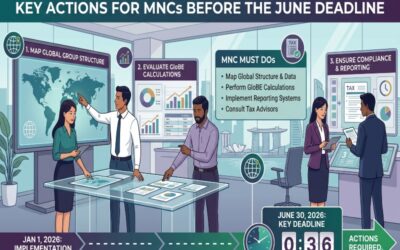
Singapore’s Global Minimum Tax (Pillar 2) 2026: What MNCs Must Do Before the June Deadline
Singapore has quietly enacted one of the most significant shifts in its corporate tax landscape in decades. The Multinational Enterprise (Minimum Tax) Act 2024 (MMT Act) — Singapore's implementation of the OECD's Pillar Two Global Anti-Base Erosion (GloBE) rules —...
Singapore Double Tax Agreements (DTAs) 2026: How to Claim Treaty Benefits and Reduce Withholding Tax
A comprehensive guide to Singapore’s Double Tax Agreements — how DTAs reduce withholding tax on dividends, interest, and royalties, how to obtain a Certificate of Residence from IRAS, and the key conditions for claiming treaty benefits in 2026.
R&D Tax Deductions in Singapore: Section 14C, 14D and the Enterprise Innovation Scheme (2026)
A detailed guide to Singapore R&D tax deductions under Section 14C, Section 14D, and the Enterprise Innovation Scheme (EIS) — including qualifying expenditure, documentation requirements, and the 400% EIS deduction for YA2024–2028.

Singapore’s Global Minimum Tax (Pillar 2) 2026: What MNCs Must Do Before the June Deadline
Singapore has quietly enacted one of the most significant shifts in its corporate tax landscape in decades. The Multinational Enterprise (Minimum Tax) Act 2024 (MMT Act) — Singapore's implementation of the OECD's Pillar Two Global Anti-Base Erosion (GloBE) rules —...
Bookkeeping
No Results Found
The page you requested could not be found. Try refining your search, or use the navigation above to locate the post.
News
No Results Found
The page you requested could not be found. Try refining your search, or use the navigation above to locate the post.