
Singapore offers five business structures: sole proprietorship, partnership, limited partnership, limited liability partnership and private limited company. For most businesses that will hire people, sign real contracts or raise money, the private limited company is the right answer.
Raffles Corporate Services works with a panel of experienced Singapore law firms who offer cost-effective and efficient legal service and advice. This article is general information only and is not legal advice.
The other four exist for good reasons, and a small number of businesses genuinely belong in them. But the choice is made badly far more often than it is made well, usually because the person deciding is looking at the registration fee rather than at what happens if something goes wrong.
This article compares all five on the things that actually matter. Parts 2, 3 and 4 of this series then take the sole proprietorship, the LLP and the private limited company apart in detail.
What the five structures actually are
A sole proprietorship is one person carrying on business under a registered business name. There is no separate entity. The business and the owner are the same legal person, and the registration under the Business Names Registration Act 2014 is a name registration, not the creation of anything.
A partnership is two or more people (up to 20, under section 17(3) of the Companies Act 1967, with an exception in section 17(4) for regulated professions) carrying on business in common with a view of profit. Again there is no separate entity: the partners simply agree, and the Partnership Act 1890 supplies the default terms where they have not.
A limited partnership (LP) splits the partners into two classes. Under section 3 of the Limited Partnerships Act 2008, an LP must have at least one general partner, liable for all the debts of the LP, and at least one limited partner, who is not liable beyond their agreed contribution provided they stay out of management. Take part in management and section 6(2) makes them liable as if they were a general partner.
A limited liability partnership (LLP) is different in kind. Section 4 of the Limited Liability Partnerships Act 2005 makes it a body corporate with legal personality separate from its partners and with perpetual succession. It is a partnership in name and in feel, but a company in structure.
A private limited company is incorporated under the Companies Act 1967. Section 19(5) makes the members a body corporate with perpetual succession, capable of suing and being sued in its own name, with member liability limited to what is unpaid on their shares. Section 18 makes it “private” by restricting share transfers and capping members at 50.
The five structures compared
| Sole proprietorship | Partnership | Limited partnership (LP) | LLP | Private limited company | |
|---|---|---|---|---|---|
| Separate legal entity | No | No | No | Yes | Yes |
| Owner liability | Unlimited, personal | Unlimited, joint (and several for wrongs) | Unlimited for the general partner; capped for the limited partner | Limited, but each partner stays liable for their own wrongful act | Limited to unpaid share capital |
| Can it own property and sue in its own name | No | No | No | Yes | Yes |
| Survives a change of owners | No | No | No | Yes | Yes |
| How profits are taxed | Owner’s personal rates | Each partner’s own rates | Each partner’s own rates | Each partner’s own rates | Corporate rate of 17%, with exemptions |
| Number of owners | 1 | 2 to 20 | At least 1 general and 1 limited | At least 2 | 1 to 50 |
| Local presence required | Owner or authorised representative | Partner or authorised representative | Local manager where required | At least one manager ordinarily resident in Singapore | At least one director ordinarily resident in Singapore |
| Main ongoing ACRA obligation | Renew registration before expiry | Renew registration before expiry | Renew registration before expiry | Annual declaration of solvency | Annual general meeting and annual return |
| Statutory audit possible | No | No | No | No | Yes, unless it qualifies as a small company |
| Realistic for outside investment | No | Rarely | For fund-style structures | Rarely | Yes |
| Governing statute | Business Names Registration Act 2014 | Partnership Act 1890 | Limited Partnerships Act 2008 | Limited Liability Partnerships Act 2005 | Companies Act 1967 |
Which one fits you?
The decision is shorter than the table suggests. Two questions do most of the work: how many owners are there, and is anyone’s personal money genuinely at risk.
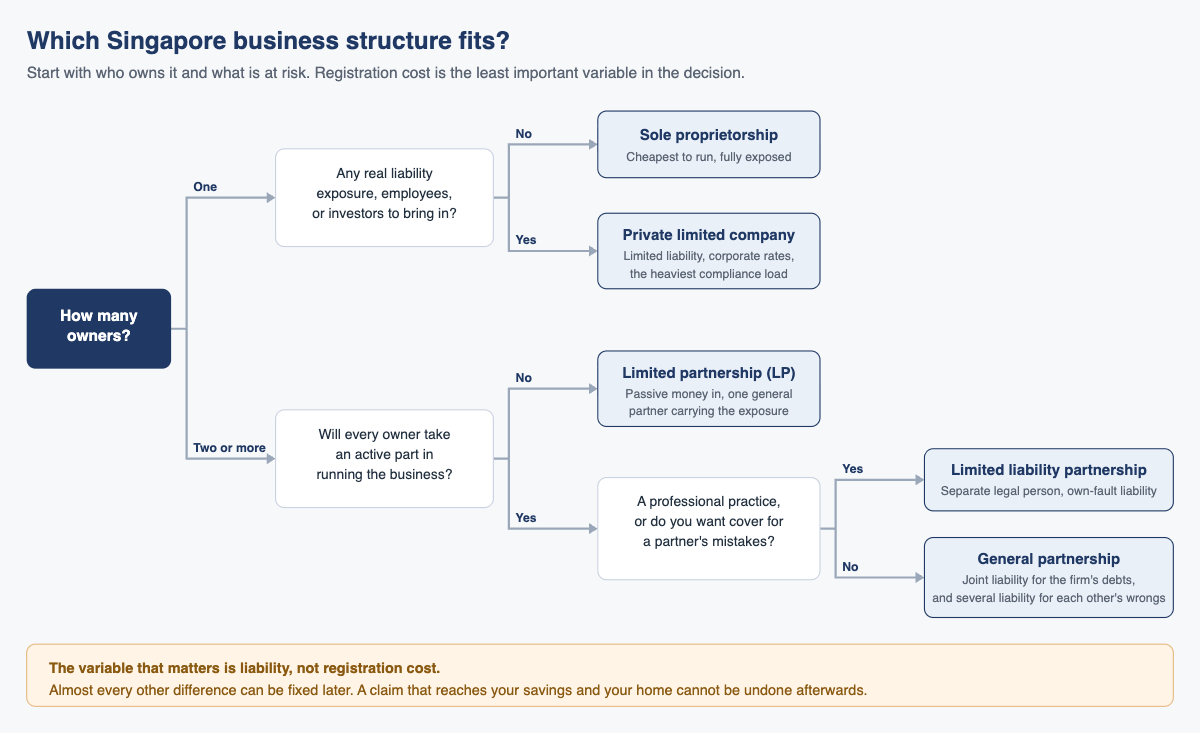
Liability: the only difference that can bankrupt you
Everything else on that table is an inconvenience. This one is not.
If you trade as a sole proprietor and the business owes money it cannot pay, the creditor comes after you. Not a company you own, not a business bank account: you. Your savings, your car, your share of the flat. There is no separating line, because there is no separate legal person to draw it around.
In a general partnership it is worse, because you carry your partners as well. Section 9 of the Partnership Act 1890 makes every partner jointly liable for all debts of the firm incurred while they are a partner. Section 10 makes the firm liable for a partner’s wrongful acts in the ordinary course of business, and section 12 then makes every partner jointly and severally liable for those, meaning a claimant can pursue any one partner for the whole amount and leave that partner to chase the others. Section 17(2) adds the part people forget: retiring does not discharge you from liabilities incurred before you left.
An LLP fixes most of this. Under section 12 of the LLP Act, an obligation of the LLP is solely the obligation of the LLP, and a partner is not personally liable for it merely by being a partner. What survives is section 12(3): a partner remains personally liable in tort for their own wrongful act or omission, though not for another partner’s.
A private limited company goes furthest. The company owes its own debts, and a shareholder’s exposure is limited to what remains unpaid on their shares. Directors’ duties, personal guarantees and insolvent trading are separate topics, and they matter, but the default position is protection.
Tax: personal rates against the corporate rate
Sole proprietorships, partnerships, LPs and LLPs are all tax transparent. The entity does not pay tax; the owners do, on their share, at their own rate. For an individual that means the resident individual income tax rates, which are nil on the first $20,000 of chargeable income and rise in steps to 24% on income above $1,000,000.
A company pays tax in its own right at the corporate rate of 17%, with the start-up and partial tax exemptions reducing the effective rate substantially at low levels of chargeable income. Our note on tax incentives and exemptions for new startups sets out who qualifies.
The practical read is simple. At low profits, tax transparency is usually fine and sometimes better, because personal reliefs and the nil band do real work. As profits climb, the personal rates overtake 17% and the company becomes cheaper. That crossover is a reason to convert, not a reason to start as a company, and it is only one input among several.
GST is structure-blind. Any of the five must register once taxable turnover crosses the $1 million threshold, on either the retrospective or prospective test set out by IRAS.
Cost, credibility and the compliance you are signing up for
A sole proprietorship or partnership is registered for a fixed term, one year or three years, and must be renewed before it expires. Changes in registered particulars must be lodged within 14 days under section 20 of the Business Names Registration Act 2014. That is close to the whole of it.
An LLP has no renewal, but it must lodge an annual declaration of solvency signed by one of its managers, under section 30 of the LLP Act. It must keep accounting records sufficient to give a true and fair view, and keep them for at least five years, under section 31.
A private limited company carries the heaviest load: a company secretary under section 171, at least one locally resident director under section 145, an annual general meeting under section 175, an annual return under section 197, and financial statements. Audit applies unless the company meets the small company criteria in the Thirteenth Schedule. Our Companies Act 1967 deep-dive FAQ covers the everyday mechanics, and preparing for a first statutory audit covers the moment audit arrives.
On credibility, the difference is real but often overstated in the wrong direction. Procurement teams, commercial landlords and credit committees all read the structure, and a company is easier for them to approve. But the thing that actually loses deals is being unable to produce clean accounts, which is a bookkeeping problem and applies to all five.
On raising money, there is no contest. Equity investors buy shares, and convertible instruments, option pools and employee share plans all assume a share register. If external investment is anywhere in the plan, start with a company or accept that you will convert later, under time pressure, during a fundraise.
What goes wrong: choosing on setup cost
The failure mode is almost always the same. Someone registers a sole proprietorship because it was quick and cheap, trades for two or three years, and by then has employees, a lease, supplier credit and a customer who is unhappy about something. Only at that point does anyone look at the liability position.
Converting is possible, and worth doing, but it is not a form. You incorporate a new company and transfer the business into it: novating contracts, reassigning the lease, moving the bank accounts and the GST registration, transferring employees, retitling assets, and dealing with the tax consequences. Every counterparty gets a say, and some will use the moment to renegotiate.
Doing that in year one costs a morning. Doing it in year four, with a live dispute in the background, costs considerably more, and the liability you accrued in years one to three does not transfer away from you. Our note on accounting considerations when restructuring or selling a business covers the numbers side.
The second failure mode is choosing an LLP because the phrase “limited liability” was reassuring, without reading section 12(3). Professionals who are personally negligent remain personally liable. The LLP protects you from your partners, not from yourself. Part 3 of this series goes through that in detail.
Frequently asked questions
What is the cheapest business structure to register in Singapore?
A sole proprietorship is the cheapest to register and to maintain, because it has no company secretary, no annual return, no audit and no financial statements. It is also the only structure that puts your personal assets directly at risk for every debt the business incurs, so the saving is not free.
Can I convert my sole proprietorship into a private limited company later?
Yes, and many businesses do. It is not a conversion in the legal sense: you incorporate a new company and transfer the business to it, which means novating contracts, moving the bank accounts, transferring employees and dealing with the tax and GST consequences. It is far simpler in year one than in year five.
Is an LLP the same as a limited partnership?
No. An LLP is a body corporate with separate legal personality under section 4 of the Limited Liability Partnerships Act 2005. A limited partnership is not a separate legal entity: it is a partnership with at least one general partner who carries unlimited liability and at least one limited partner whose exposure is capped while they stay out of management.
Do sole proprietors pay corporate tax in Singapore?
No. A sole proprietorship is tax transparent, so the profits are taxed as the owner’s own income at the resident individual rates. A private limited company pays tax in its own right at the corporate rate of 17%, before applying the start-up or partial tax exemptions.
How many owners can a partnership have?
Up to 20. Section 17(3) of the Companies Act 1967 prohibits forming a partnership of more than 20 persons for the purpose of gain unless it registers as a company, and section 17(4) exempts partnerships formed mainly to carry on a regulated profession.
Which structure do I need if I want to bring in an investor?
A private limited company, in nearly every case. Equity investment is done by issuing shares, and the whole apparatus of investment (share classes, convertible notes, option pools, drag and tag rights) assumes a share register. The other structures can take loans, but not shareholders.
Getting the choice right the first time
The structure you pick in week one sets your liability, your tax and your credibility for as long as you keep it, and the cost of changing it rises every year you leave it.
If you want a straight answer for your own situation rather than a general comparison, Raffles Corporate Services incorporates and administers companies, LLPs and business registrations across Singapore, and we will tell you when the simpler structure is genuinely the better one. That advice is often the cheaper conversation.
Next in this series: the sole proprietorship and partnership in depth, then the limited liability partnership in depth, and finally the private limited company, which is forthcoming. You can also read more on Singapore corporate secretarial practice at Singapore Secretary Services.
The Editorial Team, Raffles Corporate Services
Need help with this?
Raffles Corporate Services can handle the ACRA filings, compliance documentation and records for you, and where court proceedings or legal advice are needed, we work with a panel of experienced Singapore law firms who offer cost-effective and efficient legal service and advice.
Email: [email protected]
Call, SMS or WhatsApp: +65 8501 7133