
Most serious Singapore businesses end up as a private limited company because incorporation creates a separate legal person that owns the business, carries its debts and outlives its owners. The price is a permanent compliance calendar.
Raffles Corporate Services works with a panel of experienced Singapore law firms who offer cost-effective and efficient legal service and advice. This article is general information only and is not legal advice.
That trade is the entire decision. Everything else people argue about, the setup fee, the paperwork, whether it looks more professional, is noise beside it.
This is part 4 of our series on choosing a business structure in Singapore, following the sole proprietorship and general partnership, where the owner and the business are the same legal person, and the limited liability partnership, which is a body corporate with a partnership’s internal flexibility.
What incorporation actually does
Section 19(5) of the Companies Act 1967 states the effect plainly. On and from the date of incorporation, the subscribers to the constitution together with anyone who later becomes a member are a body corporate, capable immediately of exercising all the functions of an incorporated company, of suing and being sued, with perpetual succession and power to hold land, and with such liability on the part of members to contribute to the assets of the company on a winding up as the Act provides.
Unpack that and four things follow.
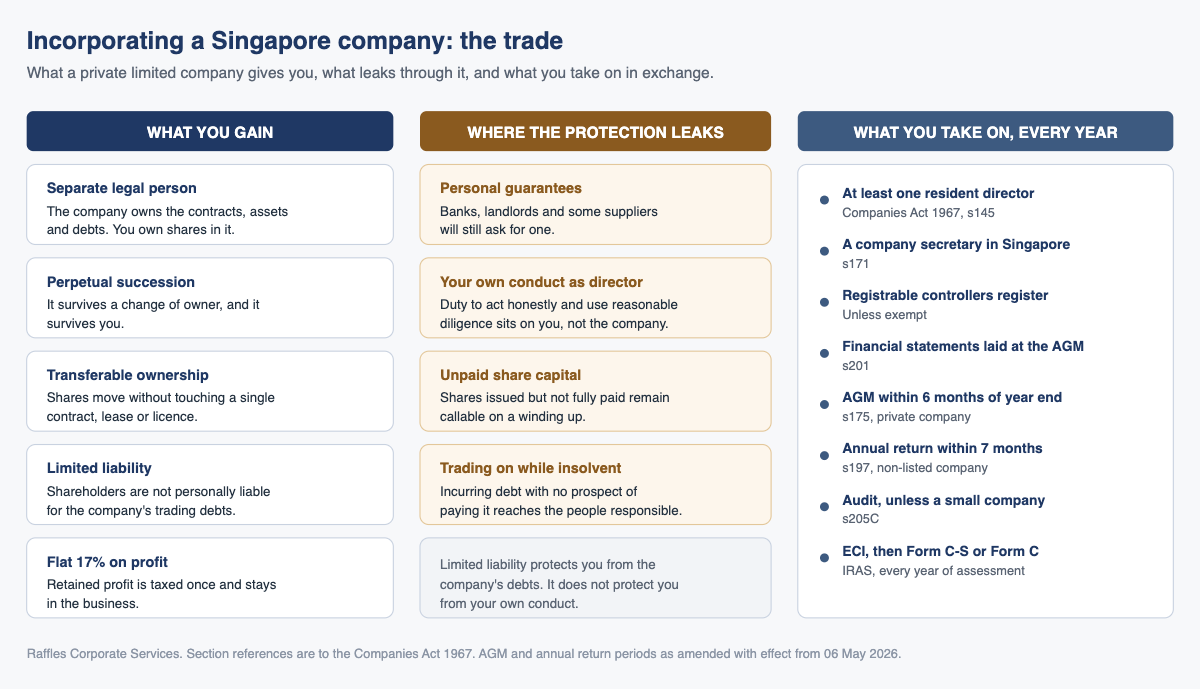
The company owns the business, not you. Contracts, the bank account, the lease, the equipment, the customer list and the intellectual property sit in the company’s name. You own shares in the company. Those are two different assets.
It does not die when you do. Perpetual succession means the entity continues regardless of who the members are. A sole proprietorship exists only while its owner is alive and chooses to continue it.
Ownership can move without moving the business. A share transfer changes who owns the company without touching a single contract, licence or employment agreement. In an unincorporated business there is nothing to transfer except assets, one at a time.
Someone else can invest. Investors buy shares, which is why a serious funding conversation almost always begins with a request that you incorporate first.
For a private company, the register of members is not a book in your office. Section 196A requires the Registrar to keep and maintain an electronic register of members for every private company, so the entry in ACRA’s system is what establishes legal title to shares.
Limited liability, and the four places it leaks
Shareholders are not personally responsible for the company’s debts. That is genuinely the position, and it is the single best reason to incorporate. It is also routinely oversold.
Four things get through it.
Personal guarantees
This is the big one, and it is not a legal loophole, it is a commercial reality. Banks lending to a young company will want a director’s personal guarantee. So will many landlords, some equipment lessors and the occasional large supplier. Every guarantee you sign puts your personal assets back on the hook for that specific debt.
Incorporating does not stop a lender asking. It means the exposure is itemised, negotiable and capable of being released, instead of automatic and total.
Your own conduct as a director
Section 157 of the Companies Act 1967 requires a director at all times to act honestly and to use reasonable diligence in discharging the duties of the office. Limited liability protects shareholders from company debts. It does not protect a director from the consequences of their own breach of duty, and the two roles are usually the same person in a small company.
Unpaid share capital
Section 19(5) preserves the liability of members to contribute to the assets of the company on a winding up as provided by the Act. If shares were issued but never fully paid up, the unpaid portion is a real liability that a liquidator can call.
Continuing to trade when you should have stopped
Trading on while insolvent, and incurring debts with no reasonable prospect of paying them, exposes those responsible to personal liability under the Insolvency, Restructuring and Dissolution Act 2018. Directors who keep a failing company going on supplier credit while hoping for a turnaround are the classic case.
Tax: the flat rate and the exemptions that sit under it
A company pays corporate income tax at a flat 17% of chargeable income, per IRAS. An unincorporated business does not pay tax at all: the profits are taxed on the owners at personal rates, which are progressive and currently top out at 24%.
Comparing 17% with 24% is the wrong comparison, because the exemption schemes matter more than the headline rate for most SMEs.
A qualifying new company gets, for its first three consecutive Years of Assessment, a 75% exemption on the first $100,000 of normal chargeable income and a further 50% on the next $100,000. That is up to $125,000 of chargeable income exempted each year. To qualify, the company must be incorporated in Singapore, be tax resident for that YA, and have its total share capital beneficially held directly by no more than 20 shareholders, all of them individuals, or with at least one individual holding at least 10% of the issued ordinary shares. Investment holding companies and companies undertaking property development are excluded.
After the first three YAs, partial tax exemption takes over: 75% on the first $10,000 of normal chargeable income and a further 50% on the next $190,000, up to $102,500 exempted per year.
Then there is the second layer. Dividends paid by a Singapore resident company under the one-tier system are not taxable in the shareholder’s hands, because the tax the company paid is final. So profit taken out as dividend is taxed once, at company level. Salary you draw is deductible to the company and taxable on you.
Where the crossover sits
| Annual profit taken by one owner | Unincorporated (personal rates) | Company (17%, before exemptions) |
|---|---|---|
| Up to about $80,000 | Marginal rate 7% to 11.5%, usually cheaper | 17% flat, but start-up exemption often wipes most of it |
| $80,000 to $160,000 | Marginal rate 11.5% to 15% | Broadly comparable once exemptions are applied |
| Above $160,000 | Marginal rate 18% and rising to 24% | 17% flat, and the gap widens from here |
| Profit you want to retain in the business | Taxed on you personally whether you draw it or not | Taxed once at company level, then sits in the company |
That last row is the one owners underestimate. In an unincorporated business, profit is taxed on you the moment it is earned, whether you take it or leave it in. In a company, retained profit is taxed once at 17% and stays in the business for working capital. If you are reinvesting, that difference compounds.
The compliance you take on in exchange
This is the honest side of the ledger. A company has statutory obligations that an unincorporated business simply does not have, and most of them are annual, so they do not go away.
| Obligation | Requirement | Where it comes from |
|---|---|---|
| Director | At least one director ordinarily resident in Singapore, a natural person, at least 18 and of full legal capacity | Section 145, Companies Act 1967 |
| Company secretary | At least one, a natural person whose principal or only place of residence is in Singapore | Section 171 |
| Register of members | Kept electronically by the Registrar for private companies | Section 196A |
| Register of Registrable Controllers | Maintained unless exempt, and lodged centrally with ACRA | Companies Act 1967 |
| Financial statements | Directors must lay financial statements before the AGM | Section 201 |
| Annual general meeting | Within 6 months after financial year end for a private company | Section 175 |
| Annual return to ACRA | Within 7 months after financial year end for a non-listed company | Section 197 |
| Audit | Required unless the company qualifies as a small company | Section 205C |
| Corporate tax | Estimated chargeable income, then Form C-S or Form C to IRAS | Income Tax Act 1947 |
The AGM and annual return deadlines in that table reflect the position as amended with effect from 6 May 2026. If you are working from an older internal checklist, check it.
Most small Singapore companies escape the audit requirement through the small company regime in section 205C, and that is worth checking rather than assuming: see our guide to audit exemption for small companies under section 205C. Controllers are a separate and frequently missed obligation, covered in our Register of Registrable Controllers guide.
On cost, ACRA’s published set-up fee for a local company is $315, made up of a $15 name application fee and a $300 incorporation fee, against $115 for a one-year sole proprietorship or partnership. The setup difference is trivial. The annual running cost, once you add a company secretary, financial statements and a tax computation, is not, and that is the number to budget against.
When converting from a sole proprietorship or LLP is worth it
There is no statutory conversion from a sole proprietorship or general partnership into a company. What actually happens is that you incorporate a new company and transfer the business into it: assets are transferred, contracts are novated or reassigned, employees move across, the company applies for its own licences and GST registration where relevant, and you then cease the old registration under the Business Names Registration Act 2014. The new entity gets a new UEN. Our guide to closing a sole proprietorship or partnership covers the cessation side.
The Limited Liability Partnerships Act 2005 does provide statutory conversion routes, but in the other direction: section 26 converts a firm into an LLP and section 27 converts a private company into an LLP. Going from an LLP to a company is, again, a transfer rather than a conversion.
Five triggers that usually mean it is time:
- Someone wants to invest. Equity requires shares. Shares require a company.
- You have taken on real liability. Employees, a premises lease, physical products, client money, professional advice, anything where a single bad outcome exceeds what you can personally absorb.
- Your customers require it. Government procurement, larger corporate buyers and some regulated sectors will not contract with an unincorporated business.
- Profit has passed the crossover. Once your marginal personal rate is above 17% and you are retaining profit in the business, the tax case becomes straightforward.
- You want to be able to sell or step back. A business you cannot transfer is a job, not an asset.
If none of the five apply, incorporating early buys you a compliance calendar you do not yet need.
What goes wrong: incorporating and then running it like a sole trader
The most common failure is not choosing wrongly. It is incorporating and then behaving as though nothing changed.
Personal expenses go through the company account. Money is drawn without any decision recorded as to whether it is salary, dividend or a loan. Section 162 of the Companies Act 1967 restricts loans and quasi-loans to directors and related credit transactions, so an undocumented director’s current account is not neutral housekeeping. Nothing is minuted. There is no AGM. The annual return is filed late, or not at all.
The consequences arrive in layers. Late filings attract ACRA’s late lodgement penalties, which apply per late transaction. Disallowed expenses raise your tax bill. And under section 155, a person persistently in default in delivering documents to the Registrar, which can be conclusively proved by three or more relevant offences within five years, commits an offence by continuing to act as a director or taking part in the management of a company without the Court’s permission.
The separate legal person only protects you if you treat it as separate. Our Companies Act 1967 deep-dive FAQ works through the everyday version of this problem.
Frequently asked questions
Is a private limited company always better than a sole proprietorship?
No. It is better when you have liability exposure, want outside investment, need to transfer ownership, or are retaining profit at a marginal personal rate above 17%. If none of those apply, you are paying for a compliance calendar you do not yet need.
Can one person own and run a private limited company?
Yes. A company needs at least one shareholder and at least one director ordinarily resident in Singapore, and where the company has only one member that sole director may also be the sole member. You will still need a separate company secretary.
Does limited liability mean I can never lose my own money?
No. Personal guarantees you sign, breaches of your duties as a director, unpaid share capital on your shares, and continuing to trade when the company cannot pay its debts all reach through. Limited liability protects you from the company’s ordinary trading debts, not from your own conduct.
How much tax does a new Singapore company actually pay?
The rate is a flat 17% of chargeable income. A qualifying new company gets 75% exemption on its first $100,000 of normal chargeable income and a further 50% on the next $100,000, for its first three Years of Assessment. After that, partial tax exemption applies instead.
Do I have to audit my company’s accounts?
Not if it qualifies as a small company under section 205C of the Companies Act 1967. Most owner-managed Singapore companies do. You still have to prepare proper financial statements, lay them before the annual general meeting and file a tax computation.
Can I convert my existing sole proprietorship into a company?
Not by a single filing. You incorporate a new company, transfer the business and its contracts across, then cease the old registration. Plan the handover date around your licences, GST position, bank account and employment contracts rather than doing it piecemeal.
Choosing the structure once, properly
Most owners ask the structure question once, at the start, when the business is smallest and the answer matters least, and then never revisit it as the business grows into a shape the original choice no longer fits.
That is the review we do. Raffles Corporate Services incorporates Singapore companies, handles the transfer when a sole proprietorship or LLP has outgrown itself, and keeps the company secretarial calendar running so the AGM, the annual return and the controllers register are not things you have to remember.
You can reach us through Raffles Corporate Services, or read more on Singapore corporate secretarial practice at Singapore Secretary Services.
— The Editorial Team, Raffles Corporate Services
Need help with this?
Raffles Corporate Services can handle the ACRA filings, compliance documentation and records for you, and where court proceedings or legal advice are needed, we work with a panel of experienced Singapore law firms who offer cost-effective and efficient legal service and advice.
Email: [email protected]
Call, SMS or WhatsApp: +65 8501 7133