

You can incorporate a Singapore company with $1 of share capital, and thousands of people do exactly that. There is no statutory minimum beyond that single dollar. Whether you should is an entirely different question, and it is one almost nobody asks at the right moment.
Raffles Corporate Services works with a panel of experienced Singapore law firms who offer cost-effective and efficient legal service and advice. This article is general information only and is not legal advice.
The figure you declare at incorporation does not stay private. It sits on your company’s ACRA profile, and it is the first number a bank, a landlord, a government agency or a potential customer sees when they pull that profile. Getting it wrong in either direction is fixable, but the fix costs money and creates filings that need not have existed. Here is what share capital actually is, what the share types are for, and how to pick a number you will not resent in eighteen months.
What share capital actually is
Share capital is the amount the shareholders have committed to put into the company in exchange for their shares. It is not a fee, not a deposit lodged with ACRA, and emphatically not the company’s cash balance. A company with $100,000 of share capital can have $12 in the bank on any given Tuesday.
The commitment matters because of what limited liability actually means. Section 22(3) of the Companies Act 1967 says that where a company’s constitution states that the liability of members is limited, that liability is limited to the amount, if any, unpaid on the shares respectively held by them. Not to zero. To the unpaid amount. That sentence is the whole subject in miniature, and we will come back to it.
Shares in Singapore have no par value
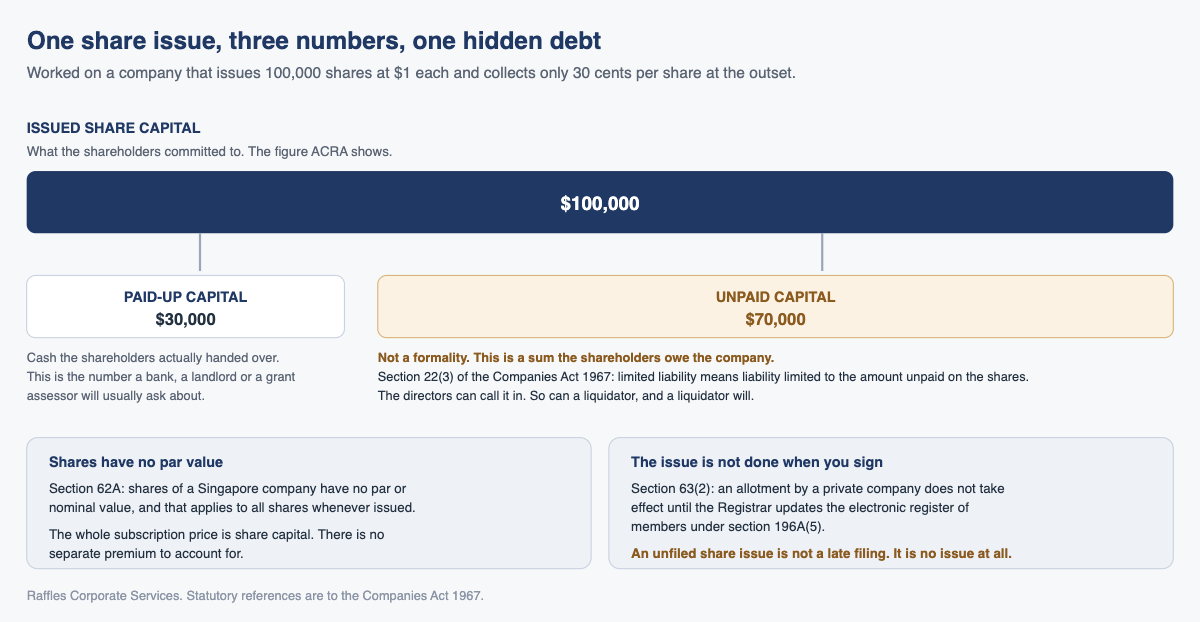
Section 62A abolished par value. Shares of a Singapore company have no par or nominal value, and that applies to all shares whether issued before, on or after 30 January 2006.
The practical effect is that the entire subscription price is share capital. Issue a share for $5 and the company’s share capital increases by $5. There is no $1 nominal amount and $4 of premium sitting in a separate account under special rules. Older constitutions still carry language about shares “of $1 each”, which is harmless but meaningless. Our note on the accounting treatment of share capital, share premium and reserves works through how this lands in the financial statements.
Issued, paid-up and unpaid: the three numbers
These get used interchangeably in conversation and they are not the same thing.
| Term | What it means | Where it bites |
|---|---|---|
| Issued share capital | The total subscription price of all shares allotted to shareholders | The headline figure on your ACRA profile |
| Paid-up share capital | The portion of that price the shareholders have actually paid | What banks, landlords and grant assessors usually ask for |
| Unpaid share capital | Issued less paid-up | A debt owed by the shareholder to the company |
The last row is the one that surprises people. If a company issues 100,000 shares at $1 each and the shareholders pay 30 cents per share, the issued capital is $100,000, the paid-up capital is $30,000, and $70,000 is outstanding. That $70,000 is not a bookkeeping footnote. It is a sum the directors can call in, and a sum a liquidator will call in without hesitation if the company fails. We have seen founders declare a large issued capital to look substantial, pay in almost none of it, and discover during a liquidation or a due diligence exercise that they personally owe the difference.
One more thing about issuing shares. Section 63(1) requires a private company to lodge a return of allotment, and section 63(2) goes further: an allotment does not take effect until the electronic register of members is updated by the Registrar under section 196A(5). An unlodged share issue is not a late filing. It is not an issue at all, and the person who paid for the shares is not a member.
Can I use a currency other than Singapore dollars?
Yes. A Singapore company may denominate its shares in a foreign currency, and may have share capital in more than one currency, subject to its constitution. For a company whose investors and revenue sit in a single foreign currency, that can be sensible. Be deliberate about it, though: capital spread across two or three currencies makes the figure on your profile hard to read, and every bank, landlord and agency that asks for your paid-up capital will want a Singapore dollar answer you then have to explain.
The share types you will actually be offered
Most private companies only ever need ordinary shares. The rest exist for specific jobs.
| Share type | What it does | The catch |
|---|---|---|
| Ordinary shares | The default. Votes, dividends if declared, whatever is left on a winding up | No right to demand a dividend |
| Preference shares | A fixed dividend paid ahead of ordinary shareholders, and capital returned ahead of them on a winding up. Often non-voting | Once issued, the rights become class rights protected by section 74 |
| Redeemable preference shares | The company can buy them back later on agreed terms | Section 70 requires authority in the constitution, the shares must be fully paid, and redemption out of capital needs a solvency statement from all the directors lodged with the Registrar |
| Convertible preference shares | Fixed return for a period, then convertible into ordinary shares | The conversion terms must be written down before you need them |
| Treasury shares | Ordinary shares the company has bought back and holds itself | Section 76J: no votes, no dividends. Section 76I caps the holding at 10% of the class, with any excess cancelled or disposed of within six months |
Our guides to redemption of preference shares under section 70 and to the variation of class rights under section 74 go into the mechanics. ACRA’s own shares and share information pages set out the filings.
Voting rights, and the “management shares” question
The default is in section 64(1): a share confers on its holder the right to one vote on a poll, on any resolution. Section 64(3) lets a company’s constitution negate, alter or add to that right, and section 64(6) confirms that a private company may issue shares of different classes, including shares with limited, conditional or no voting rights, subject to its constitution. Public companies face the stricter regime in section 64A.
There is a floor: under section 64(4) the holder of an otherwise non-voting share keeps at least one vote on a resolution to wind the company up voluntarily, and on a resolution to vary a right attached to that share.
People ask about “management shares” or “founder shares”. Neither is a statutory category in Singapore. They are labels for a class of ordinary shares carrying weighted votes, a right to appoint a director, or both. If you want them, they must be created as a class in the constitution with the rights spelled out, which is a drafting job rather than a tick box.
So what number should you actually pick?
There is no right answer, but there is a sensible process.
- Start with what the company genuinely needs to trade for six to twelve months. If the founders are putting in $80,000 to get going, issue and pay up $80,000. Capital that reflects reality never needs explaining.
- Choose a share count that leaves room to divide. One share held by one founder is legally sufficient and practically awkward. Issue 10,000 or 100,000 shares, so a future 7.5% allocation to a key hire does not require a share split first.
- Pay up what you issue. Unpaid capital is a liability dressed up as a balance sheet decoration.
- Check the $500,000 line before you cross it. Under section 5(1)(a) of the Singapore Business Federation Act 2001, a local company with paid-up share capital of or above $500,000 becomes a member of the Singapore Business Federation automatically, without electing or applying, and section 12 makes an annual subscription payable, capped at $1,500 in any calendar year by section 12(3). Most companies discover this when the invoice arrives.
- Confirm the figure against the constitution you are adopting. See our companion guide on what a company constitution actually does.
What goes wrong with the $1 company
The dollar itself is not the problem. The problem is what a $1 paid-up capital signals to everyone who reads your profile, and what it costs you to change it later.
Bank account opening. Singapore banks run their own onboarding assessment on new companies. A $1 paid-up capital does not prohibit an account, but it invites questions about substance that a $50,000 paid-up capital simply does not generate.
Work pass applications. The Ministry of Manpower assesses the employer, not just the candidate. A company with nominal capital, no track record and one $1 share applying to sponsor a foreign professional is a harder case than the same company capitalised in line with the salary it proposes to pay.
Leases, tenders, grants and trade credit. Landlords, procurement officers, grant assessors and suppliers all pull the company profile, and several of them apply financial criteria. What they see is the maximum the shareholders were willing to stand behind.
And fixing it is not free. Increasing capital later means a directors’ resolution, shareholders’ approval under section 161 (directors must not exercise the power to issue shares without the prior approval of the company in general meeting), a return of allotment under section 63, and the wait for the Registrar to update the electronic register. None of it is difficult. All of it is avoidable.
The mirror-image failure is worth naming: the founder who declares $250,000 of issued capital to impress, pays in $1,000, and carries a $249,000 personal exposure they have never once thought about. Before issuing shares to new people, read our note on the corporate secretarial considerations when admitting new investors, and where shares will be held for someone else, our guide to nominee shareholder arrangements.
Frequently asked questions
What is the minimum share capital for a Singapore private limited company?
One dollar. A company required to have share capital needs at least $1 to be incorporated, and there is no higher statutory minimum for an ordinary private company. Licensed activities are different: some regulators impose their own minimum capital as a condition of the licence, so check that before settling the figure.
What is the difference between issued and paid-up share capital?
Issued capital is what shareholders committed to pay for their shares. Paid-up capital is what they have actually paid. The difference is unpaid capital, and it is a debt the shareholder owes the company. Under section 22(3) of the Companies Act 1967, a member’s liability in a company limited by shares is limited to that unpaid amount.
Do Singapore shares have a par value?
No. Section 62A provides that shares of a Singapore company have no par or nominal value, and that applies to all shares whenever issued. The whole price paid for a share counts as share capital, and there is no separate share premium account. Constitutions still referring to shares “of $1 each” are using obsolete wording.
Can I increase my company’s share capital after incorporation?
Yes, and it is routine. The directors need the prior approval of the company in general meeting under section 161, the company lodges a return of allotment under section 63, and the new shares do not take effect until the Registrar updates the electronic register of members under section 196A(5).
Should I issue preference shares at incorporation?
Usually not. They solve a specific problem, normally an investor wanting a fixed return and priority on a winding up. Issuing them speculatively creates class rights that section 74 protects, so you need that class’s consent to change them later.
Choosing the number once, properly
Share capital is one of the few incorporation decisions that is genuinely strategic rather than administrative. It sets what your company looks like to every institution that will ever assess it, and it determines what the founders are personally standing behind.
Raffles Corporate Services sizes share capital against what the company will actually need in its first year, structures the share classes so a future investor or employee scheme does not require a restructuring first, and handles the allotments, returns and register updates that follow. If you are about to incorporate with $1 because it was the default on the form, that is worth a conversation before you file.
You can reach us through Raffles Corporate Services, or read more on Singapore corporate secretarial practice at Singapore Secretary Services.
— The Editorial Team, Raffles Corporate Services
Need help with corporate secretarial or compliance matters?
If you would like help with your company's corporate secretarial, governance or compliance requirements, email [email protected] or WhatsApp +65 8501 7133.
Our team can assist with corporate secretarial, accounting and tax matters. Where legal advice is needed, advisers from our associated law firms can assist.