
Your company’s constitution is a contract. Section 39(1) of the Companies Act 1967 makes it binding on the company and on every member as if each member had personally signed and sealed it. It is not a registration formality, and it is not a document you can quietly ignore when it becomes inconvenient.
Most directors could not tell you what is in theirs. That is understandable: for the overwhelming majority of Singapore companies the constitution was adopted in about four seconds during incorporation and never opened again. It surfaces only when two shareholders disagree, when an investor’s lawyer asks for it, or when somebody wants to do something the document does not allow.
This is the first of two guides. Here we cover what a constitution is, what it binds, and the clauses that genuinely do work. The second, on the Model Constitution versus a tailored one, covers which kind your company should have.
What happened to the memorandum and articles of association?
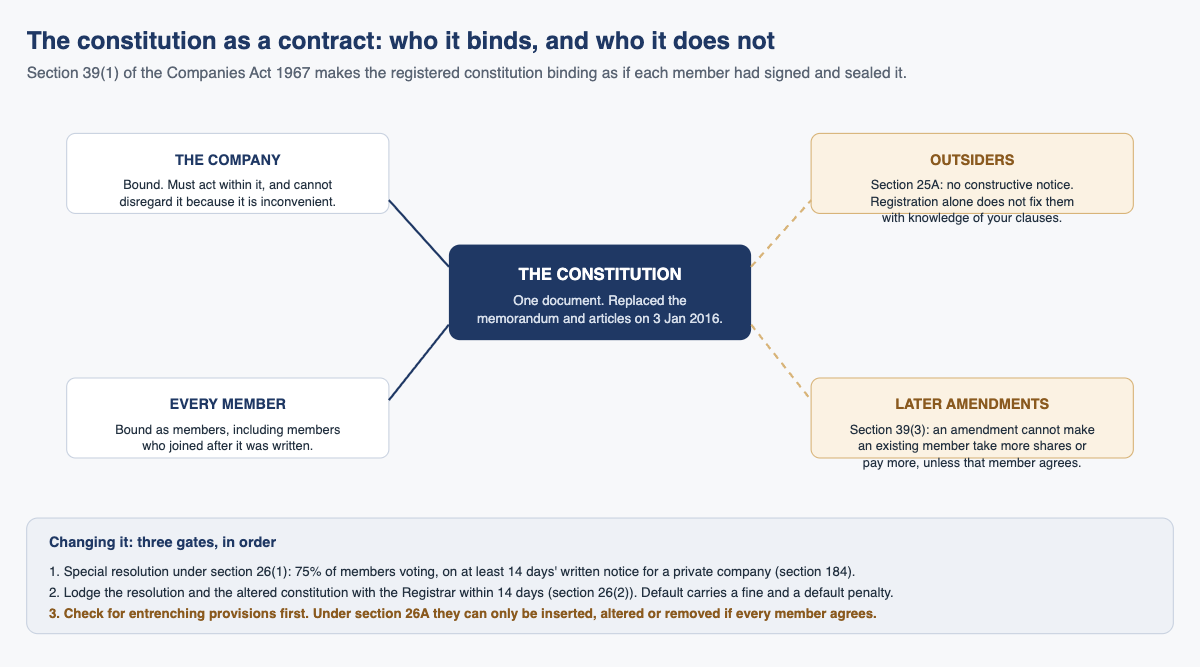
They were merged. Singapore companies used to have two constitutional documents: a memorandum of association, dealing with external identity, and articles of association, dealing with internal governance. Since 3 January 2016 the Companies Act 1967 refers to a single document, the constitution.
If your company was incorporated before that date, nothing was lost. Section 35(3) deems regulations in force for the company immediately before 3 January 2016, whether in its registered articles or applying by operation of the old provisions, to be the regulations contained in its constitution until amended. Your old memorandum and articles simply became your constitution by operation of law.
Which is convenient, and also the reason a great many Singapore constitutions are still governed by drafting from the 1980s.
What the Act requires it to contain
Section 22(1) sets the floor. The constitution must be dated and must state, among other things, the name of the company; for a company limited by shares, that the liability of the members is limited; and the subscribers’ full names, addresses and occupations, with the number of shares each agrees to take. Section 22(4) requires a signed copy to be kept at the registered office, and section 35(1) requires the constitution to contain the regulations for the company.
One thing it must not contain any more. Section 22(1A) deemed deleted, on 30 January 2006, any provision stating the amount of authorised share capital or the division of capital into shares of a fixed amount. Authorised capital no longer exists in Singapore, and neither does par value. See our companion piece on deciding share capital and share types.
Who the constitution binds, and who it does not
This is where the document earns its keep.
It binds the company and its members. Under section 39(1) the registered constitution binds the company and the members as if each had signed and sealed it and covenanted to observe every provision. A shareholder who joined last month is bound by a clause written fifteen years before they arrived, and under section 39(2) all money payable by a member under the constitution is a debt due to the company.
But an amendment cannot increase what a member must put in. Under section 39(3), no member is bound by an alteration made after they became a member so far as it requires them to take more shares than they held at that date, or otherwise increases their liability to contribute to the share capital or pay money to the company, unless they agree in writing.
And outsiders are not deemed to know what is in it. Section 25A abolished constructive notice: a person is not affected by, or deemed to have notice of, the contents of your constitution merely because it has been registered or is available for inspection at your registered office. A restriction buried in clause 47 does not, by itself, protect the company against a counterparty who never read it.
The clauses that actually matter
Most of a constitution is machinery that will never be argued about. A handful of clauses do almost all the work. Our broader overview of what a Singapore company constitution should contain walks the whole document; what follows is the short list that decides arguments.
| Clause | What it controls | Why it matters |
|---|---|---|
| Objects | Whether the company’s capacity is restricted at all | Section 23(1) gives full capacity by default. Sections 23(1A) and 23(1B) permit objects and restrictions, but you must opt in |
| Share classes and rights | What each class of share is entitled to | Once issued, class rights are protected by section 74 and cannot be changed by ordinary majority |
| Transfer restrictions | Who may become a shareholder | Section 18(1) requires every private company’s constitution to restrict the right to transfer its shares |
| Pre-emption on new issues | Whether existing shareholders must be offered new shares first | Without it, a majority can dilute a minority through a fresh issue |
| Director appointment and removal | Who controls the board, and on what majority | Determines whether a minority shareholder keeps a seat at the table |
| Meeting mechanics | Quorum, notice, casting votes, written resolutions | Decides who wins a tie, and whether a shareholder can stall a meeting by staying away |
A note on the first row. Because section 23(1) already gives a company full capacity, an objects clause can only narrow what the company may lawfully do, and altering one later is slower than an ordinary amendment: section 33 requires a special resolution on 21 days’ written notice and lets holders of 5% of the shares apply to the Court to cancel the alteration. Most operating companies should not have objects at all.
Transfer restrictions are not optional
Section 18(1) says a company having a share capital may be incorporated as a private company if its constitution restricts the right to transfer its shares and limits the number of members to not more than 50. That restriction is the price of being private. Section 18(2) supplies a default for older companies whose constitutions omitted it, deeming the restriction included and deeming it to prohibit transfers except to a person approved by the directors.
Note what the usual restriction actually is: a directors’ discretion to refuse. That is not the same as a right of first refusal for the other shareholders, and the distinction has ended more friendships than any other clause in Singapore company law. A departing shareholder can still sell to a buyer the directors approve, and the remaining shareholders get no automatic opportunity to buy first.
Share rights, and the powers the Act makes conditional on the constitution
Several things a company might one day want to do are only available if the constitution says so. Section 70(1) permits redeemable preference shares only if the company is so authorised by its constitution. Section 71(1) allows it to consolidate, subdivide, convert into stock or cancel unissued shares only if so authorised. Section 76B(1) permits a buyback only if expressly permitted by the constitution.
Section 74 then protects rights already attached to a class of shares. Where the constitution provides a variation mechanism, that mechanism must be used; where it is silent, class rights may be varied only by a resolution of the holders of not less than 75% of the shares of that class. Our guide to varying class rights under section 74 sets out the procedure.
One power the constitution cannot hand to the board. Section 161(1) provides that despite anything in a company’s constitution, the directors must not exercise any power to issue shares without the prior approval of the company in general meeting. ACRA keeps a landing page for the Companies Act and its subsidiary legislation if you want the current consolidated text.
How to amend a constitution, in order
- Check for entrenching provisions first. Section 26A allows a constitution to require a majority greater than 75%, or other specified conditions, before particular clauses can be altered. An entrenching provision can only be inserted after formation, or removed or altered, if all members agree. Skipping this check is the fastest way to pass a resolution that does nothing.
- Check whether the amendment touches class rights. If it does, section 74 applies on top of the ordinary procedure, and section 74(7) treats an alteration to the variation mechanism itself as a variation of those class rights.
- Give proper notice and pass a special resolution. Section 26(1) allows alteration by special resolution. Section 184 defines that as not less than three quarters of the members voting, on at least 14 days’ written notice for a private company, the notice specifying the intention to propose it as a special resolution. Shorter notice is possible where a majority in number holding at least 95% of the voting rights agree.
- Lodge within 14 days. Section 26(2) requires the resolution and a copy of the constitution as altered to be lodged with the Registrar within 14 days. Section 26(2A) makes default an offence carrying a fine not exceeding $1,000 and a default penalty.
- Reissue copies correctly. Section 40(2) prohibits issuing a copy after an alteration unless it reflects the alteration, or a copy of the resolution is annexed with the affected clauses indicated.
The amendment takes effect from the date of the resolution, or a later date specified in it, and is then deemed to form part of the original constitution under section 26(1AA). Our step-by-step guide to altering a company constitution covers the paperwork.
What goes wrong
Nobody knows which version is current. A company amends its constitution in year three, lodges the resolution, then keeps emailing the original 2016 PDF to banks and investors for six years. Section 40(2) exists precisely because this happens.
The signed copy does not exist. Section 22(4) requires a copy signed by the subscribers to be kept at the registered office. In due diligence its absence is a finding.
The constitution and the shareholders’ agreement say different things. A shareholders’ agreement binds the people who signed it. The constitution binds the company and every member, including future ones. Where the two conflict you have a problem that costs real money to unpick. Our note on a shareholders’ agreement versus a company constitution explains what belongs where.
Somebody relied on a clause against an outsider. Section 25A means a supplier, lender or buyer is not deemed to know your internal restrictions. If a limit on the board’s authority matters commercially, it belongs in the contract with that counterparty, not only in the constitution.
Frequently asked questions
What is a company constitution in Singapore?
It is the single document setting out the rules by which a company is run, including shareholder rights and directors’ powers. Since 3 January 2016 it has replaced the separate memorandum and articles of association. Under section 39(1) of the Companies Act 1967 it binds the company and every member as if each member had signed it.
Is a company constitution legally binding on shareholders?
Yes. Section 39(1) makes the registered constitution binding on the company and its members as if each had signed and sealed it and covenanted to observe every provision. Section 39(2) makes money payable by a member under it a debt due to the company. A shareholder who bought in years later is bound by clauses written long before they arrived.
Do I still need a memorandum and articles of association?
No. Singapore merged the two into a single constitution with effect from 3 January 2016. For a company incorporated earlier, section 35(3) deems the existing articles and regulations to be the regulations contained in its constitution, so no action was required.
How do I change my company’s constitution?
Pass a special resolution under section 26(1), needing 75% of the members voting and at least 14 days’ written notice for a private company under section 184. Then lodge the resolution and the altered constitution with the Registrar within 14 days under section 26(2). Check first for entrenching provisions under section 26A and class rights protected by section 74.
Does my company need an objects clause?
Almost certainly not. Section 23(1) gives a Singapore company full capacity to carry on any business or enter into any transaction. Sections 23(1A) and 23(1B) allow objects and restrictions if you want them, but they can only narrow what the company may lawfully do, and altering them later requires the slower procedure in section 33.
Reading your own constitution before somebody else does
The constitution is the one governance document that will be pulled by every investor, every acquirer, every bank running enhanced due diligence and every lawyer advising the shareholder you have fallen out with. Better to know what yours says first.
Raffles Corporate Services reviews constitutions against what the company has actually become, drafts and files the amendments, and keeps a current signed copy where section 22(4) says it should be. If you are not sure which version of yours is live, that is a quick check with a definite answer.
Next in this series: the Model Constitution versus a tailored constitution.
You can reach us through Raffles Corporate Services, or read more on Singapore corporate secretarial practice at Singapore Secretary Services.
— The Editorial Team, Raffles Corporate Services