
The Model Constitution is free, instant and perfectly adequate for a company with one shareholder who is also the only director. It stops being adequate the moment two people own unequal shares, or somebody owns shares without sitting on the board. That is the whole answer, and most companies get it wrong in the same direction.
The reason is not laziness. The Model Constitution is well drafted for what it was designed to do, and nothing in the incorporation process prompts you to ask what it does not do. You tick a box, the company is registered, and the gaps stay invisible until the year somebody wants out.
This is part two. Part one covers what a company constitution actually does. Here we look at what the model leaves out, and what closing those gaps costs later.
What the Model Constitution actually is
It is subsidiary legislation, not a template somebody at ACRA drafted. Section 36(1) of the Companies Act 1967 empowers the Minister to prescribe model constitutions for private companies and for companies limited by guarantee, and the Companies (Model Constitutions) Regulations 2015 did so with effect from 3 January 2016. The First Schedule holds the model for a private company limited by shares; the Second Schedule holds the one for a company limited by guarantee.
Under section 37 a company may adopt the whole or any part of the model, and may adopt the whole of it by reference to its title without reproducing the text. Section 37(4) then requires a copy of the constitution to be submitted to the Registrar where the company adopts only part, adds provisions of its own, or includes objects clauses.
The choice nobody explains: at a point in time, or from time to time
Section 37(3) offers two bases for adopting the whole model, and at incorporation you will be asked to pick one. The question is usually answered in under a second, by somebody who has not been told what it means.
| At the time of adoption | From time to time | |
|---|---|---|
| What you get | The version current on your incorporation date, frozen | Whatever version is in force at any given moment |
| If the Minister amends the model | Nothing changes for you | Your company’s rules change automatically, with no members’ resolution |
| Who maintains it | You, by special resolution | The Government |
| Suits | Companies with outside shareholders | Sole-shareholder vehicles, dormant companies, wholly owned subsidiaries |
Neither choice is wrong. But if you have co-shareholders, understand what “from time to time” means: the rules governing your relationship with them can change without anybody voting. For a one-person company that is a feature. For a partnership of equals it is a loose end.
When the Model Constitution is genuinely fine
Do not over-engineer. The model is the right answer when:
- there is one shareholder, who is also the only director
- the company is a wholly owned subsidiary and group policy, not the constitution, is what actually governs it
- the company is a dormant or special purpose vehicle that will never take an outside investor
- the shareholders are two people who each hold 50%, are both directors, are married to each other, and have a will dealing with the shares
Even then, read regulation 81: cheques, bills and receipts must be signed by any two directors unless the directors determine otherwise. A single-director company should determine otherwise, in writing, early.
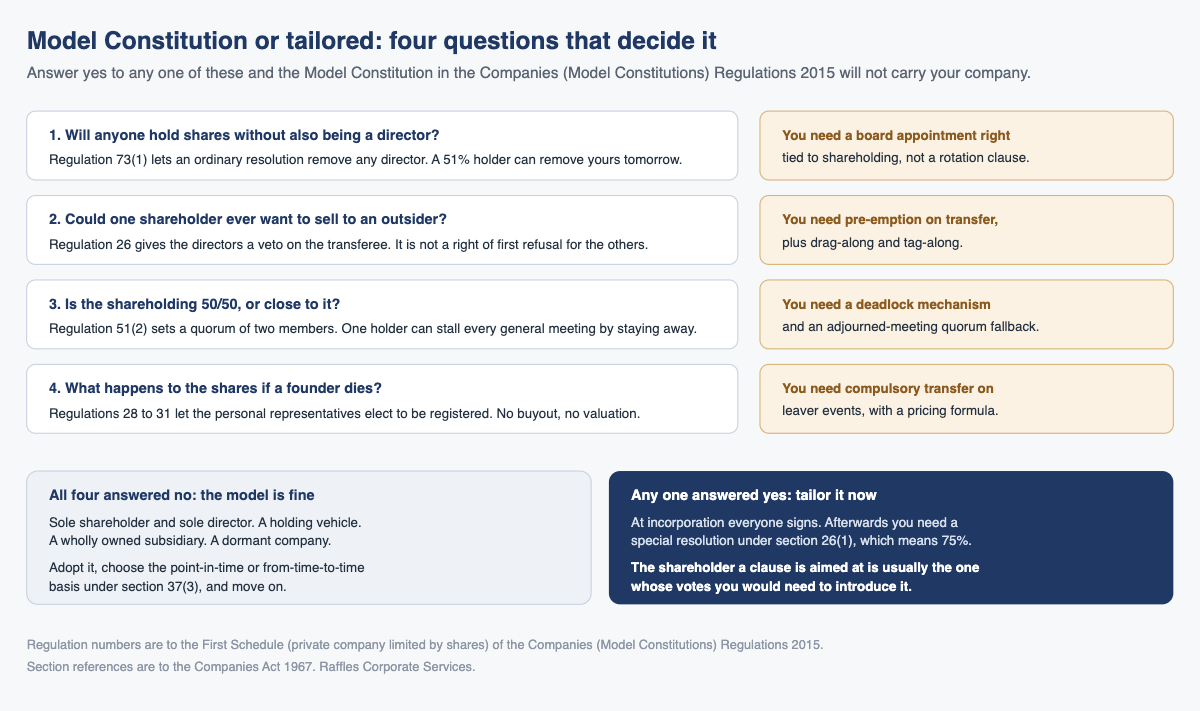
The gaps that matter once there is more than one shareholder
These are not defects. A general-purpose default cannot anticipate a specific bargain. But they are gaps, and they are always the same gaps.
| What the model gives you | What it does not give you |
|---|---|
| Directors may decline to lodge a transfer if they do not approve the transferee (regulation 26) | A right of first refusal for the other shareholders, or any drag-along or tag-along |
| New shares must first be offered pro rata to existing shareholders (regulation 45(1)) | Protection against that pre-emption being switched off by a contrary direction in general meeting |
| Directors may be removed by ordinary resolution (regulation 73(1)) | Any guarantee that a minority shareholder keeps a board seat |
| Personal representatives may elect to be registered on a member’s death (regulations 28 to 31) | Any compulsory transfer, buyout or valuation mechanism on death, bankruptcy or departure |
| A chairman’s casting vote at general meetings (regulation 57) and board meetings (regulation 84(2)) | Any deadlock mechanism that does not simply hand the outcome to whoever holds the chair |
| A general meeting quorum of two members present in person (regulation 51(2)) | Any fallback quorum for the adjourned meeting, or reserved matters requiring minority consent |
Dilution: the pre-emption clause that can be switched off
Regulation 45(1) looks reassuring. All new shares must, before issue, be offered to those entitled to receive notice of general meetings, in proportion to their existing holdings.
Read the first six words. The obligation is subject to any direction to the contrary given by the company in general meeting, and that means an ordinary resolution, which means a simple majority. A shareholder holding 51% can direct that pre-emption does not apply to the next issue, and the board may then allot to whomever it likes. The protection lasts exactly as long as the majority wants it to. A tailored constitution fixes this in one line, by making disapplication require a special resolution or the consent of each affected holder. Our note on the corporate secretarial considerations when admitting new investors covers a properly run issue.
Exit: a veto is not a pre-emption right
Regulation 26 lets the directors decline to lodge a notice of transfer where the shares are not fully paid, where they do not approve of the transferee, or where the company has a lien on the shares. Regulation 27 allows lodgement to be suspended for up to 30 days in total in any year.
That is a blocking power, and it says nothing about who gets to buy. If the board approves the buyer, the remaining shareholders have no right to match the offer. If the board blocks the buyer, the departing shareholder is stuck with shares nobody will take, and nothing entitles them to be bought out. Neither party has what they thought they had.
There is also no drag-along, so a 75% holder who has negotiated a sale of the whole company cannot compel the last 25% to sell, and no tag-along, so a minority cannot insist on being included when the majority sells. Both are one paragraph each in a tailored constitution. Our guide to specific performance of a shareholders’ agreement shows what enforcement looks like when the bargain lives outside the constitution.
Death: your co-founder’s estate becomes your shareholder
Regulations 28 to 31 deal with transmission. Where a sole holder dies, the company may recognise only the legal personal representatives, who may elect to be registered as the holder or nominate a transferee.
What is absent is the part that matters: no obligation on the estate to sell, no obligation on anyone to buy, and no formula for what the shares are worth. Under regulation 31 the personal representative is entitled to the same dividends and rights, including voting rights, that the deceased would have had. So the surviving founder’s new business partner is a grieving spouse with no interest in the business and a blocking stake. Life cover and a cross-option agreement solve this cheaply. Nothing in the model does.
Deadlock: the chair decides, until nobody attends
The model handles ties by giving the chairman a second or casting vote, both in general meetings (regulation 57) and at board meetings (regulation 84(2)). In a 50/50 company that is not a deadlock mechanism. It is a rule that whoever controls the chair wins every disputed vote, which makes the chairmanship itself the thing being fought over.
And it can be neutralised. Regulation 51(2) requires two members present in person for a quorum, and regulation 52(b) adjourns an inquorate meeting to the same day the following week. There is no provision that the adjourned meeting proceeds with whoever turns up. A 50% shareholder who simply stays away can therefore prevent any general meeting resolution from being passed, indefinitely. At board level, regulation 87(2) confines a sub-quorate board to increasing its numbers or summoning a general meeting. The company still functions, technically. It just cannot decide anything. Our note on directors’ meeting disputes and when the courts will intervene covers what happens next.
What goes wrong: the cost of fixing it afterwards
Here is the uncomfortable arithmetic. At incorporation, a tailored constitution costs a drafting fee and an hour of everybody’s attention. Every subscriber signs it, so unanimity is free.
Afterwards, section 26(1) requires a special resolution to alter the constitution, which under section 184 means three quarters of the members voting. Think about who you are usually trying to bind. If you want pre-emption on transfer because you are worried about a 30% shareholder selling to a competitor, you need that shareholder not to hold enough to block you. If you want an entrenching provision under section 26A so the clause cannot be stripped out later, you need every member to agree. And if the change affects rights already attached to a class of shares, section 74 requires that class’s consent on top.
In practice the amendment you most need is the one the other shareholder has the most reason to refuse.
When it cannot be agreed, the remaining routes are expensive and slow. Section 216 of the Companies Act 1967 gives a member a personal remedy where the company’s affairs are conducted, or directors’ powers exercised, oppressively or in disregard of members’ interests. Under the Insolvency, Restructuring and Dissolution Act 2018, section 125(1)(i) lets the Court wind a company up where it is just and equitable. These are real remedies. They are also litigation, to obtain an outcome that a paragraph in the constitution would have delivered on day one.
A shareholders’ agreement is often the right complement, and sometimes the right first move, because it can be confidential and amended without a special resolution or a filing. But it binds only the people who sign it. A new shareholder is not caught unless they sign a deed of adherence, whereas the constitution binds every member automatically under section 39(1). Most well-run companies use both, and our comparison of a shareholders’ agreement versus a company constitution sets out what belongs where.
Frequently asked questions
What is the Model Constitution for a Singapore company?
It is a constitution prescribed by the Minister under section 36(1) of the Companies Act 1967 and set out in the Companies (Model Constitutions) Regulations 2015. The First Schedule covers private companies limited by shares, the Second Schedule companies limited by guarantee. A company can adopt it in whole or in part at incorporation, at no cost.
Is the Model Constitution good enough for my company?
It is fine for a sole shareholder who is also the sole director, for a dormant or special purpose vehicle, and for a wholly owned subsidiary. It is not enough once shareholders and directors are different people, or the shareholding is 50/50, because it contains no pre-emption on transfer, no drag-along or tag-along, no leaver provisions and no deadlock mechanism.
What is the difference between adopting the model at a point in time and from time to time?
Section 37(3) offers both. Adopting it as in force at the time of adoption freezes the version current on your incorporation date, so any later change needs your own special resolution. Adopting it as in force from time to time means future amendments to the prescribed model apply to your company automatically, without a members’ resolution.
Can I change from the Model Constitution to a tailored one later?
Yes, by special resolution under section 26(1), needing three quarters of the members voting, then lodgement with the Registrar within 14 days. The difficulty is political rather than procedural: the shareholder a new clause is designed to restrain is usually the one whose votes you need.
Does the Model Constitution stop a majority shareholder diluting me?
Only until they decide otherwise. Regulation 45(1) requires new shares to be offered to existing shareholders in proportion to their holdings, but it is expressly subject to any contrary direction given by the company in general meeting, which is an ordinary resolution. A holder of more than half the votes can disapply the right and allot elsewhere.
Doing this once, at the point where it is cheap
Nobody regrets a tailored constitution. Plenty of people regret the model, and they regret it at the worst possible moment: when a co-founder wants out, when a founder dies, or when two equal shareholders stop speaking.
Raffles Corporate Services drafts constitutions around the bargain the shareholders have actually struck, says plainly when the Model Constitution is the right answer, and handles the resolutions and filings when a company needs to move from one to the other. If your company adopted the model at incorporation and has since taken on a second shareholder, that is worth half an hour now rather than a dispute later.
See also part one, what a company constitution actually does, our guides to drafting and amending a Singapore constitution and altering one under the Companies Act, and the companion piece on deciding share capital and share types.
You can reach us through Raffles Corporate Services, or read more on Singapore corporate secretarial practice at Singapore Secretary Services.
— The Editorial Team, Raffles Corporate Services