
A Singapore limited liability partnership does not hold an annual general meeting, does not file an annual return, and does not lay financial statements before its members. What it files, once a year, is a declaration by one of its managers stating whether the LLP can pay its debts as they fall due.
That filing carries more personal exposure than most partners realise. The manager who signs it can be prosecuted for signing without reasonable grounds, and is separately made answerable for the LLP’s compliance with other sections of the Limited Liability Partnerships Act 2005. An LLP is lighter than a company in filing volume and heavier in personal responsibility.
Day one: the register that must exist immediately
Unless exempt, your LLP must set up a Register of Registrable Controllers on the same day registration is approved. Registrable controllers are the individuals or entities with significant ownership or control, commonly called beneficial owners. Three parts, on different clocks:
- Keep a physical or electronic RORC at your registered office or your corporate service provider’s office.
- Update it within seven days of a change, counting from when the controller confirms their details.
- File the change with the Central RORC within two business days of updating your own register.
LLPs registered from 16 June 2025 file their RORC information at the point of registration, and you must notify every controller at least once a year to confirm their details.
Nothing reminds you to do any of this, which is why it is the obligation most new LLPs get wrong. Our guide to the Register of Registrable Controllers covers who counts as a controller, and our Corporate Service Providers Act 2024 compliance FAQ explains what a provider takes on when it holds it.
The annual declaration of solvency or insolvency
Under section 30 of the Limited Liability Partnerships Act 2005, one of the LLP’s managers lodges a declaration stating that, in that manager’s opinion, the LLP either appears at that date to be able to pay its debts as they become due in the normal course of business, or does not.
That is a solvency opinion, not an accounting return. No financial statements are attached, no auditor signs it, and there is no XBRL.
The deadlines
| Filing | Deadline |
|---|---|
| First declaration, new LLP | Not later than 15 months after registration |
| Every declaration after that | Once in every calendar year, at intervals of not more than 15 months |
| Filing window | Opens three months before the deadline |
| Extension | The Registrar may grant one. ACRA’s standard extension is 60 days |
| Fee | $30 |
The ongoing rule has two limbs and you must satisfy both: once in every calendar year and not more than 15 months apart. An LLP that files in November one year and January the year after has met the 15-month limb but missed a calendar year.
What it costs to get wrong
Late filing exposes the LLP to late lodgement penalties of up to $600, and failure to lodge in time is an offence under section 30(5) carrying a fine not exceeding $5,000.
The provisions after that are worth reading twice:
- A manager who declares the LLP solvent without having reasonable grounds commits an offence. For an individual, the maximum is a fine of $5,000, imprisonment for up to 12 months, or both.
- Anyone who gives a manager materially false or misleading information, knowing or having reason to know it is false, faces a fine of up to $10,000, imprisonment for up to two years, or both.
- Where there is intent to defraud creditors, the ceiling rises to $15,000, three years, or both.
The partner who hands the signing manager a rosy summary is exposed too.
The manager: who they must be and what they carry
Section 29 requires every LLP to have at least one manager who is a natural person, has attained 18 years of age and is otherwise of full legal capacity, and is ordinarily resident in Singapore. A company cannot be a manager. Fail to have a qualifying manager and both the LLP and every partner commit an offence, with a fine not exceeding $5,000 and a further $200 for each day it continues after conviction.
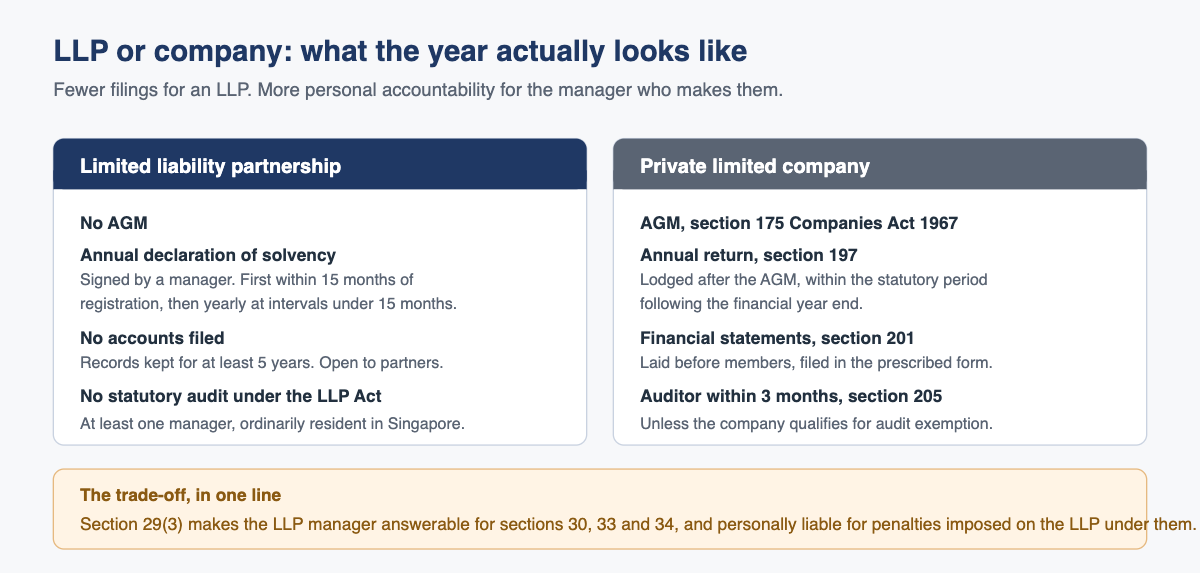
Then comes the clause partners overlook. Section 29(3) makes the manager answerable for everything the LLP must do under sections 30, 33 and 34: the annual declaration, the publication of the LLP’s name and limited liability status, and the registration of changes in particulars. It also makes the manager personally liable for all penalties imposed on the LLP for contravening those sections, unless the manager satisfies the court that they should not be. That is a real difference from a company, where filing penalties attach to the company and its officers in the ordinary way.
An undischarged bankrupt cannot act as a manager at all without the approval of the court or the Official Assignee. Doing so is an offence under section 58 carrying a fine of up to $10,000, imprisonment of up to two years, or both.
Accounts: no filing, but real record-keeping duties
An LLP does not file accounts with ACRA. It is still required to keep them.
Section 31 requires every LLP to keep accounting and other records that sufficiently explain its transactions and financial position, and that enable profit and loss accounts and balance sheets to be prepared giving a true and fair view of its affairs. Those records must be kept for at least five years from the end of the financial year in which the transactions were completed, must be open at all times to inspection by the partners, and must be produced if the Registrar requires it in writing. Contravention is an offence for the LLP and every partner, with a fine not exceeding $10,000, imprisonment for up to two years, or both, for an individual.
Fewer filings is not fewer records. If you cannot produce records explaining your transactions, the exposure is criminal rather than administrative, and it runs to every partner. It is also the precondition for the annual declaration: a manager cannot form a reasonable opinion on solvency out of thin air.
What must be notified, and in how many days
Section 34 sets a uniform 14-day window. Within 14 days the LLP must lodge the particulars of a newly appointed partner or manager, a statement that one has ceased to hold that position, any change in their lodged particulars other than residential address, and any other change in the LLP’s registered particulars. In practice that means the registered office address, the business activity, and every appointment, cessation and change of particulars. Where an appointment or withdrawal is filed, the other position holders must endorse it online within 14 days or it must be filed again.
One point worth knowing: a person who has ceased to be a partner or manager may lodge the cessation themselves if they have reasonable cause to believe the LLP will not, which matters when a partner leaves badly.
Three standing duties that quietly bite
A registered office. Section 32 requires one in Singapore, to which all communications and notices may be addressed and where documents may be served by hand or registered post. A change of address takes effect only on lodgement, not on the day you move.
The limited liability statement. Section 33 requires the LLP’s invoices and official correspondence to bear its name and registration number and a statement that it is registered with limited liability. Contravention carries a fine not exceeding $1,000, plus a further $200 for every day it continues after conviction. A converted LLP must also display a conversion statement naming the former entity and the conversion date, for 12 months beginning 14 days after registration. This is the cheapest item on the list and the most frequently missed, because invoice templates get built once and never revisited.
Two partners. Section 28 requires at least two. You may carry on with fewer for up to two years. Beyond that, a person who was a partner when an obligation was incurred, and who knew the LLP had been short for more than two years, becomes personally liable, jointly and severally with the LLP for it, despite the limited liability section 12 otherwise gives partners. Our overview of the limited liability partnership in Singapore covers how the shield works.
How this differs from a company
| Limited liability partnership | Private limited company | |
|---|---|---|
| Annual meeting | None | AGM under section 175, Companies Act 1967, subject to exemptions |
| Annual filing | Declaration of solvency or insolvency, section 30 LLPA 2005 | Annual return under section 197 |
| Financial statements | Not filed. Records kept under section 31 | Laid before members under section 201, and filed |
| Audit | Not required by the LLP Act | Auditor within three months of incorporation, section 205, unless exempt |
| Who runs it | One manager or more, ordinarily resident, answerable under section 29(3) | Directors, at least one ordinarily resident |
| Minimum participants | Two partners, two-year tolerance | One shareholder, one director |
| Controllers register | RORC required | RORC required |
If you are weighing the two, start with choosing a business structure in Singapore, and the Companies Act 1967 deep-dive FAQ for what the company column involves.
What goes wrong
The manager signs the solvency declaration without looking at anything. It takes two minutes in Bizfile and feels administrative. It is an opinion the Act attaches criminal consequences to, and the defence is the records kept under section 31.
The LLP files eleven months late and nobody connects it to the manager. Late lodgement penalties attach to the LLP, but section 29(3) makes the manager personally liable for them unless a court is persuaded otherwise.
The firm runs on one partner for three years. The second partner left, nobody filed the cessation, and the limited liability protection quietly stopped applying to new obligations.
Frequently asked questions
When must a new Singapore LLP file its first annual declaration?
Not later than 15 months after registration. After that, it must be lodged once in every calendar year and at intervals of not more than 15 months from the previous one. You can begin filing three months before the deadline, and the fee is $30.
Does an LLP have to file financial statements with ACRA?
No. An LLP does not file accounts and is not required by the LLP Act to be audited. It must still keep accounting and other records sufficient to explain its transactions and financial position and to allow true and fair accounts to be prepared, and must keep them for at least five years.
What happens if an LLP drops to one partner?
Nothing immediately. The Act allows an LLP to carry on with fewer than two partners for up to two years. Beyond that, a partner who knew the position and was a partner when an obligation was incurred becomes personally liable for it, jointly and severally with the LLP, despite the usual limited liability protection.
Is the LLP manager personally liable for late filing penalties?
Yes, in the cases the Act names. Section 29(3) makes the manager answerable for the annual declaration, the publication of name and limited liability, and the registration of changes in particulars, and personally liable for penalties imposed on the LLP under those sections unless the court is satisfied otherwise.
Keeping an LLP quietly compliant
An LLP is a forgiving structure, right up to the point where the manager who carries the statutory duties has not been given the records to do the job properly.
Raffles Corporate Services maintains LLP registers, tracks the 15-month declaration cycle, files changes inside the 14 days, and makes sure the manager signing the declaration has something defensible in front of them. If your last declaration was more than a year ago, or you are not sure the RORC was set up, that is worth a conversation this week.
You can reach us through Raffles Corporate Services, or read more on Singapore corporate secretarial practice at Singapore Secretary Services.
— The Editorial Team, Raffles Corporate Services