

Buy the counterparty’s ACRA business profile, read four things in it (status, officers, shareholders, charges), then check the people behind it against the public watchlists and the bankruptcy register. That is thirty minutes of work and it is the cheapest risk control you own.
Raffles Corporate Services works with a panel of experienced Singapore law firms who offer cost-effective and efficient legal service and advice. This article is general information only and is not legal advice.
Most bad trade debts in Singapore are not sophisticated frauds. They are ordinary companies that were already in trouble when they placed the order, run by people who had been in trouble before, trading through an entity that was registered a few months earlier. Every one of those facts sits in a public record that anyone can buy.
The point of this walkthrough is not to make you paranoid about new customers. It is to make the check routine enough that you actually do it, and to tell you honestly where the register stops being useful.
Start with the free search, then buy the profile
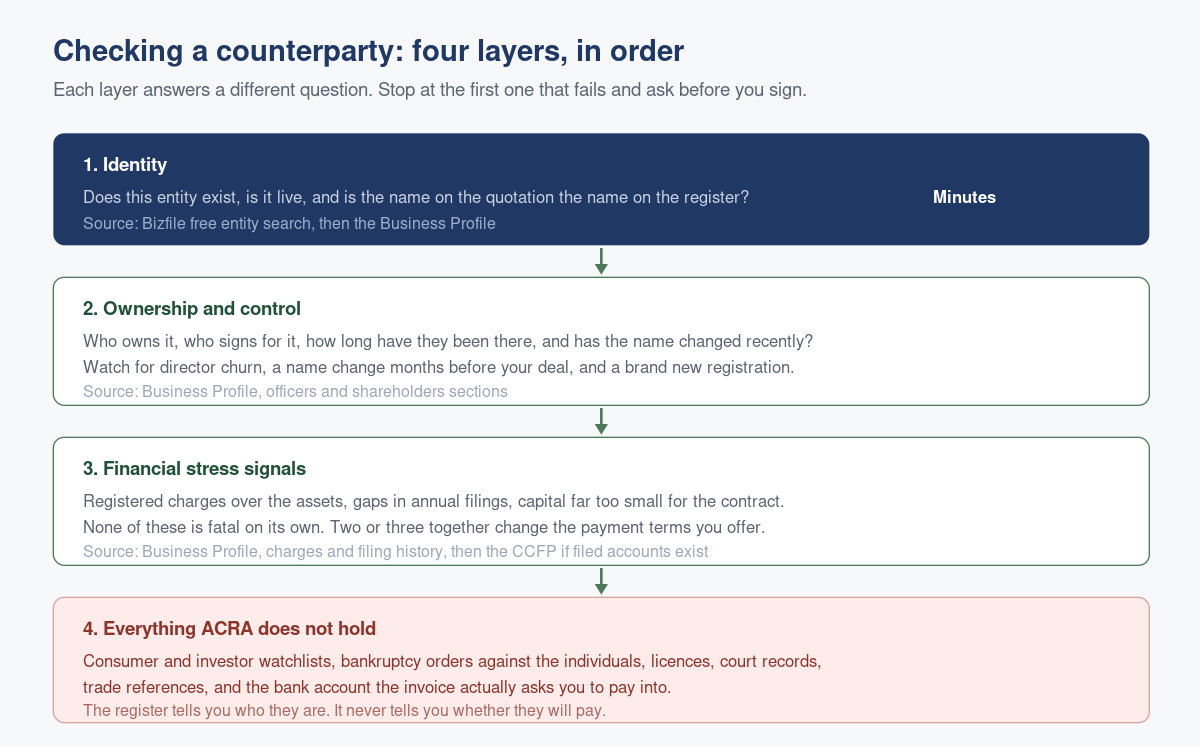
Bizfile lets anyone search the register by entity name or UEN without paying and without logging in. That free search is enough to confirm the entity exists, that the name on the quotation matches the name on the register, and what its current status is. If the status is anything other than live, stop there and ask.
Everything past that point is a paid information product. For counterparty checks the workhorse is the business profile, which pulls together the entity’s identity, its registered office, its officers, its shareholders and its registered charges into one document. Prices sit on ACRA’s own buying business information pages and change from time to time, so check there rather than trusting a figure you read in an article.
Two practical points before you buy. First, make sure you are searching the UEN, not the trading name, because a trading name tells you very little and several unrelated entities can operate under similar-sounding names. Second, a business profile is a snapshot of what has been lodged, not of what is true. Those are different things, and the gap between them is where most of the useful signal lives.
What to read in the profile, and in what order
| What you are looking at | The question it answers | What a bad answer looks like |
|---|---|---|
| Entity status and type | Is this thing alive, and is it a company or a sole proprietorship? | Struck off, in liquidation, cancelled, or a sole proprietorship where you assumed limited company |
| Registration date | How long has it traded? | Registered weeks before it approached you for credit |
| Former names | Has it rebranded recently? | A name change shortly before the deal, or two in three years |
| Registered office address | Where does formal service go? | An address you cannot connect to the business at all |
| Principal activities | Does the declared business match the deal? | A construction supplier whose declared activity is investment holding |
| Officers and appointment dates | Who signs, and how long have they been there? | Wholesale director turnover, or one director appointed last month |
| Shareholders | Who actually owns it? | A single overseas holder you cannot identify, or a nominee arrangement |
| Paid-up capital | What stands behind the contract? | Capital of a few dollars against a six-figure order |
| Charges | Has a lender taken security over the assets? | A live charge over all assets, with you as an unsecured trade creditor |
Read them in that order. Each one is quick, and the early ones are the ones that kill deals outright.
The red flags, and what they actually mean
A recent change of name
Companies change names for perfectly good reasons: a rebrand, a group reorganisation, a founder leaving. The profile shows former names, so you will see it.
What makes a name change interesting is timing. A name changed shortly before a company starts soliciting credit is worth a direct question, because the most common reason to shed a name is to shed what people find when they search it. Ask what the previous name was trading as, then search that name in the news and in the consumer alert lists.
Director churn
Look at appointment dates rather than the number of directors. A company where three directors resigned in the last eighteen months and the current board was appointed recently is telling you something, even if you cannot yet tell what. Directors resign when they disagree with what is happening, when they are not being paid, and when they have been advised to.
The opposite pattern matters too. A company with one director who has held the seat since incorporation, at a consistent address, is a materially safer counterparty than the profile alone can prove.
A live registered charge
A charge on the profile means a lender or financier has taken security over the company’s assets, usually a bank facility or receivables financing. That is entirely normal and often a sign of a real trading business.
What matters is your position relative to it. If the company fails, a secured creditor is paid out of the charged assets before unsecured trade creditors see anything. So a live all-assets charge is not a reason to refuse the deal, it is a reason to change the terms: deposit up front, shorter credit period, retention of title on goods, or a personal guarantee. The profile shows you the charge is there. Nobody will tell you how much is drawn under it, so ask.
A very short trading history
A company registered three months ago is not automatically a problem. Everyone starts somewhere and Singapore is designed to make starting easy. What a short history does mean is that the register has nothing to tell you, so your comfort has to come from somewhere else: a deposit, a director’s guarantee, references from the people behind it, or a first order small enough that losing it would not hurt.
Be particularly careful where a new entity appears to be a continuation of an older business under new registration. Ask what happened to the old one, then look it up.
A registered office at a mass address
Thousands of legitimate Singapore companies use their corporate secretary’s address as the registered office, and there is nothing improper about it. It is how the registered office requirement is normally satisfied by small companies that do not want their filings going to a home address. Treat it as neutral.
What it does mean is that the registered office tells you nothing about where the business physically operates. If you are dealing with a supplier who is meant to hold stock, manufacture, or receive returns, you need an operating address and you need it in the contract, because serving a notice on the corporate secretary’s counter will not reach a warehouse that does not exist.
Gaps in the filing record
The Companies Act 1967 requires every company to file an annual return with ACRA each year, and the profile shows the filing history. A company that has not filed for two years is either dormant, disorganised, or in difficulty. All three are relevant to whether you extend credit, and the last two tend to travel together with unpaid invoices. Late filing also attracts late lodgement penalties, so persistent gaps usually mean the company is either not being advised or not listening.
The checks that are not on ACRA at all
ACRA holds the register. It does not hold the reputation. Four external sources close part of the gap, and all of them are free.
The consumer alert list maintained by the Consumers Association of Singapore names businesses that have attracted patterns of complaints. Useful mainly for consumer-facing trades.
The investor alert list published by the Monetary Authority of Singapore names entities that appear to be carrying on regulated financial activity without being regulated to do it. If your counterparty is offering anything that looks like an investment, a return, or a fund, check this list before anything else.
The insolvency and bankruptcy search run by the Ministry of Law lets you check whether a bankruptcy order has been made against an individual. Run it on the directors and the beneficial owners, not just the entity. An undischarged bankrupt who is still visibly running a business is a serious signal, because the Companies Act restricts a bankrupt from acting as a director without leave.
Accreditation and licensing. For consumer-facing trades, CaseTrust accreditation indicates the business has submitted to a set of practice standards. For regulated activity, the relevant regulator’s public register is the only check that matters. Neither is a guarantee, but the absence of a licence where one is legally required ends the conversation.
Then do the ordinary thing that professionals skip because it feels unsophisticated: search the company name, the former names and the directors’ names in the news and in online reviews. Adverse coverage, a pattern of unpaid subcontractors, or a trail of angry customers will usually surface in ten minutes.
Where ACRA data stops being enough
This is the part ACRA cannot say for you, so we will.
The register does not tell you whether they can pay. Most Singapore private companies are exempt private companies and are not required to lodge financial statements with ACRA, which means for the typical SME there are simply no accounts on file. ACRA’s Corporate Compliance and Financial Profile product is genuinely useful where financial information has been filed, but for a small private supplier it will often be thin. If solvency matters to your deal, ask for management accounts and a bank reference as a condition of credit.
The register is only as current as the last filing. Changes must be lodged with ACRA, but a company that has stopped filing has effectively stopped updating its public record. A director who resigned and was never filed still appears. A share transfer agreed but not lodged does not.
The register says nothing about litigation, arbitration or enforcement. Court records are searched separately. So are winding-up applications until they reach the point of a filing.
And the register cannot verify the person in front of you. It tells you that a company exists and who its officers are. It does not tell you that the person emailing you the invoice is one of them, or that the bank account on that invoice belongs to the company. Invoice redirection fraud works precisely because the victim verified the company and not the payment instruction. Confirm any change of bank details by telephone on a number you already held, never on a number contained in the email asking for the change.
What goes wrong in practice
The usual failure is not skipping the check. It is doing the check once, at onboarding, and never again.
A customer you cleared two years ago may since have changed hands, changed directors, granted a charge over everything it owns, and stopped filing. None of that generates a notification to you. If that customer now carries your largest receivable, the check you did in 2024 is not protecting you.
The fix is unglamorous. Set a rule: any counterparty above a credit threshold you choose gets a fresh profile pulled annually and before any material increase in exposure. It costs a modest amount per entity and it is the only way the file stays honest.
The second failure is treating a clean profile as clearance. A profile with no red flags means the register holds nothing alarming. It does not mean the counterparty is good for the money. Credit terms, deposits, guarantees and retention of title do work that no amount of searching can do.
Frequently asked questions
Can I check a Singapore company for free?
Partly. A free Bizfile search confirms the entity exists and shows its current status and UEN. Details of officers, shareholders, charges and filing history come in the business profile, which is a paid product. The external checks, including the regulator watchlists and the bankruptcy search, are free.
What is the single most useful document to buy?
The business profile. It consolidates status, registration date, former names, registered office, principal activities, officers, shareholders and registered charges into one file. For most supplier and customer checks it answers everything the register can answer, and it is the document your lawyer will ask for if things go wrong.
Is a registered office at a corporate secretary’s address a warning sign?
No. It is standard practice for small Singapore companies and carries no negative meaning on its own. It simply means the registered office is not an operating address, so if you need to deliver goods, inspect premises or serve notice on a real place of business, get an operating address written into the contract.
How do I check the directors personally, not just the company?
Take the names and identification details from the business profile, then run the Ministry of Law insolvency search for bankruptcy orders, check the relevant regulator’s register if the activity is licensed, and search the names in news sources. Directors of failed companies frequently reappear at the head of new ones.
How often should I repeat the check?
Annually for any counterparty carrying meaningful credit, and again before you materially increase exposure, extend payment terms, or enter a long-term supply commitment. Ownership, directors and security over assets can all change without anyone telling you.
Does a registered charge mean the company is in trouble?
No. A charge usually means a bank or financier has lent against the assets, which is what healthy trading companies do. It matters because it ranks that lender ahead of you if the company fails, so treat it as a reason to tighten payment terms rather than a reason to walk away.
Making this someone’s job
Due diligence fails because it belongs to nobody. Sales wants the order, finance wants the check, and the check quietly becomes a formality somebody performs after the goods have already shipped.
Raffles Corporate Services pulls and reads ACRA records for clients every week, both on their own entities and on the counterparties they are about to commit to. We know what a profile looks like when a company is about to stop paying, because we have read a great many of them. If you want a second pair of eyes on a supplier, a customer or a proposed joint venture partner before you sign, that is a short engagement and a cheap one.
While you are here, our guide to what Bizfile actually is explains the platform itself, nominee shareholder arrangements covers what the shareholder list may be hiding, and the Corporate Service Providers Act 2024 compliance FAQ explains the duties your own service provider owes on the same subject. For the reverse exercise, showing your own company well to a lender, see preparing your company for financing.
— The Editorial Team, Raffles Corporate Services
Need help with corporate secretarial or compliance matters?
If you would like help with your company's corporate secretarial, governance or compliance requirements, email [email protected] or WhatsApp +65 8501 7133.
Our team can assist with corporate secretarial, accounting and tax matters. Where legal advice is needed, advisers from our associated law firms can assist.