

Your ACRA obligations depend entirely on what you registered. A private limited company files an annual return and holds an AGM. An LLP files an annual declaration. A sole proprietorship renews its registration and keeps its Medisave current. Nothing else in the list applies to you.
Raffles Corporate Services works with a panel of experienced Singapore law firms who offer cost-effective and efficient legal service and advice. This article is general information only and is not legal advice.
That sounds obvious, and it is the single most common source of compliance failure we see. Directors read a checklist written for a listed company and panic. Sole proprietors read a checklist written for a company and assume they have nothing to do. Both are wrong in expensive ways.
What follows is the map: which obligations attach to which entity type, when they fall due, and what ACRA charges when you are late. Every figure below is ACRA’s published figure.
Which entity type are you, and what does that mean?
ACRA regulates seven profiles, and the obligations diverge sharply between them.
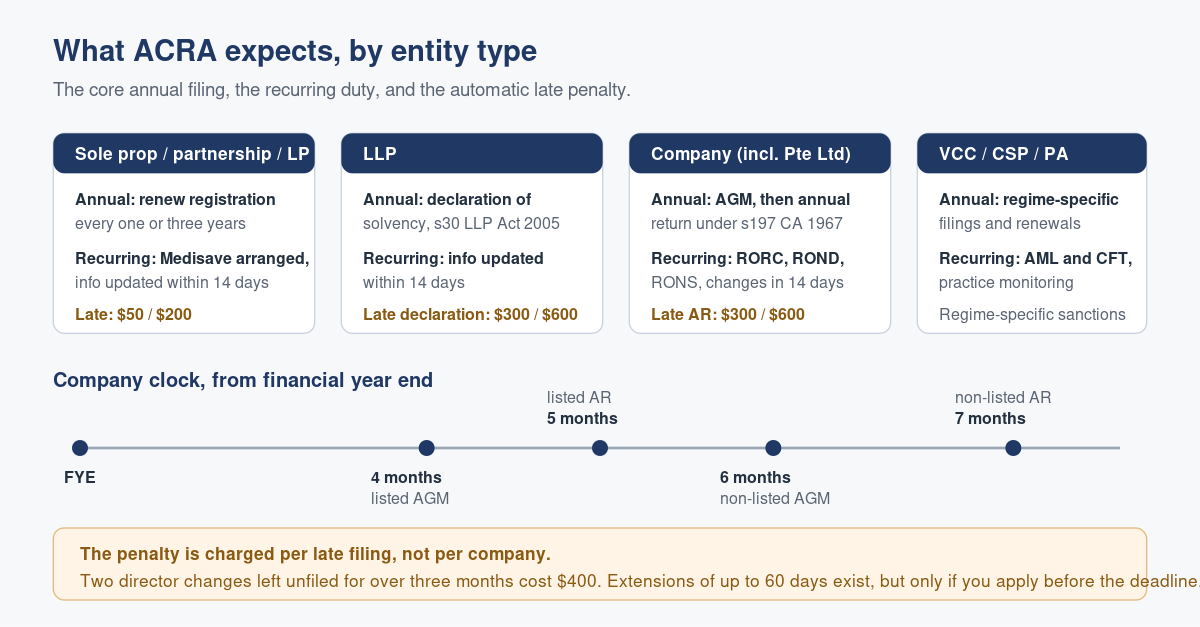
| Entity or profile | The core annual obligation | The other recurring obligation |
|---|---|---|
| Sole proprietorship or partnership | Renew the business registration every one or three years | Keep CPF Medisave contributions arranged; update business information within 14 days |
| Limited partnership (LP) | Renew the registration | Update information within 14 days |
| Limited liability partnership (LLP) | File an annual declaration of solvency or insolvency | Update information within 14 days |
| Company (including Pte Ltd) | Hold an AGM (unless exempt or dispensed with) and file an annual return | Maintain the RORC, ROND and RONS; update information within 14 days |
| Variable capital company (VCC) | Annual filings for the umbrella and its sub-funds | Fund structure and operational reporting |
| Corporate service provider (CSP) | Registration and ongoing fitness obligations | AML and CFT controls, client due diligence, client list upkeep |
| Public accountant or accounting entity | Registration renewal and practice monitoring | AML and CFT reviews, code of conduct compliance |
If you are a foreign company branch, you sit in the company column but with a different filing set, built around section 373 of the Companies Act 1967 rather than the local annual return.
Companies: the deadlines that actually bite
Two deadlines matter more than everything else combined, and they are separate deadlines even though they feel like one event.
The AGM deadline
A listed company must hold its AGM within four months after its financial year end. A non-listed company has six months.
A private company can skip the AGM in two situations. First, if it sends its financial statements to all members within five months after the financial year end. Second, if it is dormant, not listed and not a subsidiary of a listed company, and has total assets of $500,000 or less. Separately, all members can pass a resolution to dispense with AGMs altogether and handle the business in writing.
Skipping the AGM does not mean skipping the declaration. When you file the annual return you must still state what happened: AGM held, exempt, or dispensed with.
The annual return deadline
The annual return is filed under section 197 of the Companies Act 1967, and the window depends on company type.
| Company type | Annual return deadline |
|---|---|
| Listed | Within five months after FYE |
| Listed, with share capital and an overseas branch register | Within six months after FYE |
| Non-listed | Within seven months after FYE |
| Non-listed, with share capital and an overseas branch register | Within eight months after FYE |
Two points that catch people. A dormant company still files. A company granted a tax waiver by IRAS still files. The annual return is a register-accuracy obligation, not a tax obligation, and being inactive does not switch it off.
If you need more time, an extension of time of up to 60 days is available for both the AGM and the annual return. The annual return extension application costs $200 each time, so it is cheaper than the penalty but not free.
What it costs when you are late
ACRA’s penalty structure is deliberately simple, and it is charged automatically when you file.
| Filing | Late by up to three months | Late by more than three months |
|---|---|---|
| Company annual return | $300 | $600 |
| Company, any other filing (registered office, officer changes) | $50 | $200 |
| LLP annual declaration | $300 | $600 |
| LLP, any other filing | $50 | $200 |
The critical word in the second row is per filing. ACRA’s own worked example makes the point: a company that let one director resignation and one director appointment drift past three months paid $400, being $200 for each of the two changes. A company that quietly accumulates six unfiled changes is looking at a four-figure bill for paperwork that would have cost nothing to file on time.
Beyond the automatic penalties, there is a second tier. ACRA may offer a composition sum instead of prosecuting, and its published example of a company roughly one month late on both its AGM and its annual return shows a composition of at least $500 for each breach. If composition is not accepted, or the lateness is repeated, ACRA may prosecute in court, where a conviction can carry a fine of up to $10,000 per charge plus a default penalty. Directors can be disqualified and debarred.
And then there is the quiet one. Under section 344(1) of the Companies Act 1967, ACRA can strike a company off its own register where there is reasonable cause to believe the company is not carrying on business. Several consecutive years of unfiled annual returns is the classic trigger. You get 30 days from the striking off notice to object.
The obligations nobody puts in the calendar
Annual filings get diarised. These do not, and they are where most penalties are actually incurred.
- Changes to entity information, within 14 days. Registered office address under section 143(1) of the Companies Act 1967, officer appointments and cessations under section 173A(1)(b). Fourteen days, from the date of the change, not the date somebody remembered.
- Registrable controllers. The RORC and the central register must be maintained and kept current. This sits outside the annual cycle entirely.
- Nominee directors and nominee shareholders. The ROND and RONS carry their own maintenance and filing duties. If you use nominee arrangements, read our note on nominee shareholder arrangements and beneficial ownership disclosure before you assume the annual return covers you.
- New charges, within 30 days of creation. Miss it and you are not just facing a penalty, you are facing a priority problem.
- Errors in filed financial statements, within 30 days of the date of revision. A Notice of Error filed late attracts a late lodgement penalty of its own.
- Medisave, for the self-employed. If your annual net trade income exceeds $6,000 you must have arranged your Medisave contributions with the CPF Board, in full or by instalments. Outstanding Medisave can get your business registration cancelled early, and will block your renewal.
What goes wrong in practice
Three failure patterns account for most of the penalties we clean up.
The company that thinks dormant means exempt. It is not carrying on business, it has no revenue, the bank account is idle, and nobody files anything for three years. The annual return obligation never paused. By the time the owner notices, there are three $600 penalties, a possible composition sum, and sometimes a striking off notice already gazetted. Restoring the position after that is a court exercise, not a filing exercise, as our note on restoring statutory registers and records after a company reinstatement explains.
The 14-day trap after a transaction. A share transfer completes, a director steps down, the office moves, and everyone involved assumes the corporate secretary was copied in. Nobody tells them. The clock runs anyway. This is the cheapest compliance problem in Singapore to prevent and one of the most common.
The financial year end that was changed for tax reasons. Change the FYE and you move the AGM deadline and the annual return deadline with it. You also cannot change the FYE once the filing deadline has passed. If you are considering it, read our note on changing your financial year end and the basis period consequences first.
If you want the underlying statutory framework rather than the deadline list, our Companies Act 1967 deep-dive FAQ is the place to start, and ACRA publishes its own late lodgement penalty tables and compliance requirements index.
Frequently asked questions
Does a dormant Singapore company still have to file an annual return?
Yes. Every company listed as live on ACRA’s register files an annual return each year, including dormant and inactive companies, and including companies IRAS has granted a tax waiver. The late penalty is $300 if you are up to three months late and $600 beyond that.
What is the penalty for filing a director change late?
For companies, $50 if you file within three months of the due date and $200 if you are later than that. The penalty applies to each late transaction separately, so two unfiled director changes more than three months old cost $400, not $200.
Do I have to hold an AGM if I am the only shareholder and director?
Not necessarily. A private company is exempt if it sends its financial statements to all members within five months after the financial year end, and members can also pass a resolution to dispense with AGMs entirely. You must still declare which route you took when filing the annual return.
Can I get an extension if I am going to miss the annual return deadline?
Yes. ACRA grants extensions of up to 60 days for both the AGM and the annual return, but you must apply before the deadline passes. The annual return extension application costs $200. Applying is cheaper than a $600 late penalty plus a possible composition sum.
What does an LLP have to file if it has not traded?
An annual declaration, stating whether the LLP was able to pay its debts in the normal course of business. It is due within 15 months of registration and then at intervals of no more than 15 months, under section 30 of the Limited Liability Partnerships Act 2005. Late declarations cost $300 or $600.
Can ACRA strike off my company without me applying?
Yes. Under section 344(1) of the Companies Act 1967 ACRA can initiate striking off where it has reasonable cause to believe a company is not carrying on business, most often after several years of unfiled annual returns. You have 30 days from the striking off notice to object.
Making the calendar somebody else’s problem
Almost nobody misses an ACRA deadline on purpose. They miss it because the obligation sits with a person who is also running a business, and because the 14-day items do not announce themselves.
That is the work we do. Raffles Corporate Services runs the compliance calendar for several hundred Singapore entities, files changes inside the statutory windows, and tells you before a deadline rather than after it. If you are not sure whether your entity is currently clean on ACRA’s register, that is a short conversation and usually a quick fix.
You can reach us through Raffles Corporate Services, or read more on Singapore corporate secretarial practice at Singapore Secretary Services.
— The Editorial Team, Raffles Corporate Services
Need help with corporate secretarial or compliance matters?
If you would like help with your company's corporate secretarial, governance or compliance requirements, email [email protected] or WhatsApp +65 8501 7133.
Our team can assist with corporate secretarial, accounting and tax matters. Where legal advice is needed, advisers from our associated law firms can assist.