

Singapore’s mandatory sustainability reporting regime is climate-first and phased. Listed companies begin with financial year 2025. Large non-listed companies follow from financial year 2030. ACRA administers it, and it sits inside your existing annual reporting cycle rather than beside it.
Raffles Corporate Services works with a panel of experienced Singapore law firms who offer cost-effective and efficient legal service and advice. This article is general information only and is not legal advice.
That last point is the one most boards miss. Sustainability reporting is not a separate publishing exercise with its own calendar. It attaches to the same financial year, the same set of accounts and the same annual report that your directors already sign. If your year end moves, it moves. If your accounts are late, it is late.
This article is the orientation piece: what the regime is for, which body decides which part of it, and where it lands in the twelve months you already manage. The detail of who is caught and by when is covered in part one of our requirements guide, and the substance of what actually has to be disclosed is covered in part two.
What the regime actually is
A sustainability report, in the regulatory sense being built here, is not a brochure. It is a set of disclosures about climate-related risks and opportunities, prepared to a defined standard, published with the annual report, and eventually subject to external assurance in the same way accounts are subject to audit.
Three design choices shape everything else.
It is climate-first. The regime does not begin by asking for the full breadth of environmental, social and governance reporting. It begins with climate, and greenhouse gas emissions in particular. Other topics may follow; climate is what is being mandated now.
It is built on international standards, not a home-grown template. The disclosure requirements are based on the standards issued by the International Sustainability Standards Board, adopted into a Singapore standard rather than reinvented. The practical benefit is that a Singapore report is legible to a foreign lender, a foreign parent and a foreign acquirer without translation.
It is phased, deliberately and slowly. Listed companies go first from FY2025. Large non-listed companies are not required until FY2030. Assurance arrives later still: external limited assurance on Scope 1 and Scope 2 greenhouse gas emissions applies from FY2029 for listed companies and from FY2032 for large non-listed companies.
Read those dates as a preparation runway rather than a reprieve. Emissions data for a reporting year has to be captured during that year. You cannot reconstruct a utilities and fuel history in the month after year end, which is precisely what companies attempt on their first cycle.
Who governs which part
Sustainability reporting in Singapore is not one regulator’s project. Four different bodies own different pieces of it, and knowing which one owns your problem saves a great deal of time.
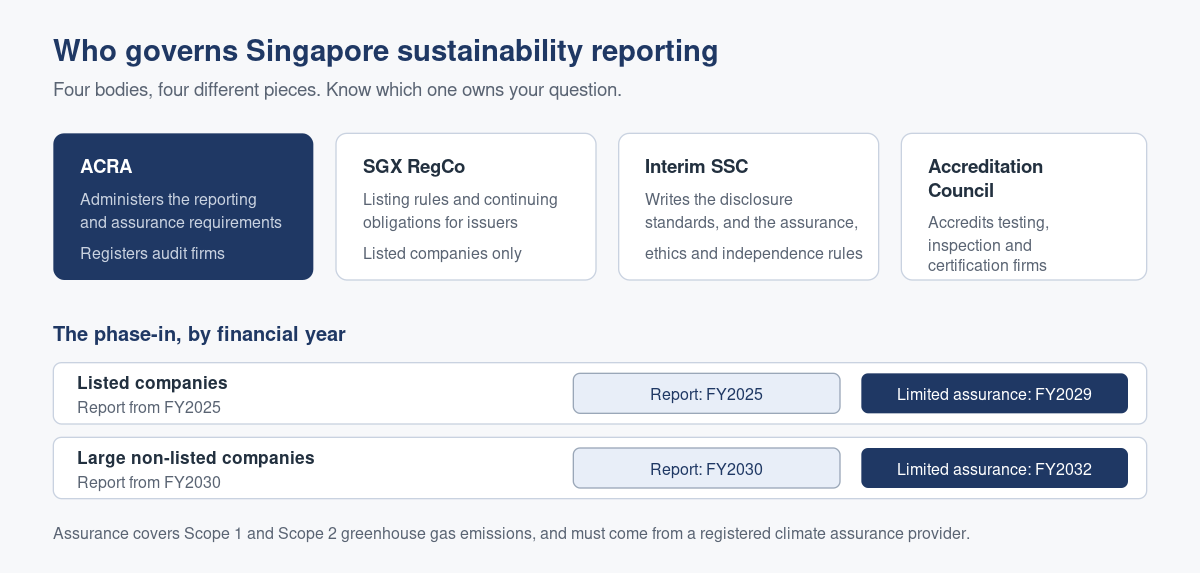
| Body | What it decides | What that means for you |
|---|---|---|
| ACRA | Administers the reporting and assurance requirements, registers audit firms, and sits at the centre of the regime | Your obligation, and the consequences of missing it, run through ACRA |
| SGX RegCo | Listing rules and continuing obligations for listed issuers | If you are listed, your reporting duty has a listing-rules layer on top of the statutory one |
| Interim Sustainability Standards Committee | Develops the sustainability disclosure standards, and the assurance, ethics and independence standards for assurance providers | The content of your disclosures and the rules your assurance provider works to |
| Singapore Accreditation Council | Accredits testing, inspection and certification firms | Determines part of the pool of firms that can give you assurance |
The Interim SSC was appointed by ACRA specifically to build the standards ahead of the requirements taking effect. Its co-chairpersons and members are drawn from industry, the profession, the assurance sector and the public service rather than from a single regulator, which is why the standards it produces tend to arrive through public consultation rather than by announcement. We covered one of those consultations in our note on ACRA’s draft sustainability disclosure standards.
Who can give you assurance
When assurance becomes mandatory, you cannot simply ask your auditor to sign an extra page. The provider must be a registered climate assurance provider, drawn from either audit firms registered with ACRA or testing, inspection and certification firms accredited by the Singapore Accreditation Council.
That is a deliberately mixed pool. Emissions assurance is part accounting discipline and part engineering measurement, and the regime recognises that the two skill sets do not always sit in the same firm.
Where it sits in your annual reporting cycle
Here is the sequence, in order, for a company caught by the requirements. Nothing in it is new except steps four and eight.
- Financial year ends. The reporting period for the sustainability disclosures is the same financial year as the accounts, not a calendar year of your choosing.
- The books are closed and the financial statements are prepared under the applicable accounting standards.
- The directors approve the financial statements and sign the directors’ statement.
- The sustainability disclosures are prepared for the same period and included in the annual report.
- The auditor reports on the financial statements.
- The annual report, containing both the accounts and the sustainability disclosures, goes to members.
- The annual general meeting is held, and the accounts are laid before members within the period the Companies Act 1967 allows.
- Once assurance is mandatory for your class of company, the assurance report on Scope 1 and Scope 2 emissions accompanies the disclosures.
- The annual return is filed with ACRA.
Two consequences follow from that ordering. First, the sustainability work has to be finished before the annual report is printed, which in practice means it has to be finished in parallel with the audit rather than after it. Second, anything that shifts your financial year shifts the sustainability period with it. If you are contemplating that, read our guide to changing your company’s financial year end before you file the change.
What goes wrong in practice
The data does not exist when the deadline arrives. Scope 1 and Scope 2 emissions are calculated from fuel, refrigerant, electricity and other utility consumption. If nobody was collecting meter readings and invoices in a usable form during the year, the first reporting cycle becomes an archaeology project. Companies that start eighteen months early report calmly. Companies that start two months before year end do not.
Nobody owns it. Sustainability reporting falls between the finance function, the operations function and the company secretary. The classic failure is a board that discusses it three times without ever naming an owner, then discovers in month eleven that the discussion was the whole of the work. The corporate secretary is frequently the right coordinating point, and we set out why in our piece on the corporate secretary’s role in sustainability reporting.
The report says more than the company can support. A disclosure regime turns marketing language into a representation. A statement that a group is on a defined emissions trajectory becomes something an assurance provider will look for evidence of, and something a regulator can ask about. The safest first report is a narrow, accurate one.
A private company assumes it is unaffected and is wrong in commercial terms. Even where a private company has no statutory duty, the duty of its listed customers, its lenders and its foreign parent pulls emissions questions down the supply chain. Being asked for Scope 3 data by a customer is not a compliance obligation, but losing the contract for being unable to answer has the same effect on the accounts. Related tax and levy exposure sits separately again, and we cover that in our note on Singapore’s carbon tax and the Carbon Pricing Act.
How this differs from the reporting you already do
Financial reporting has forty years of settled practice behind it. Sustainability reporting does not, and the gap shows up in three places.
The measurement basis is less stable, because emissions factors and methodologies are still being refined. The comparatives problem is harder, because the first year has no prior year to compare against. And the boundary question is genuinely difficult, because the entities you consolidate for accounting purposes are not always the entities whose emissions you control.
None of that is a reason to delay. It is a reason to document your methodology, your boundary and your assumptions on the first pass, so that the second year is a comparison rather than a fresh start. For the wider landscape of Singapore reporting expectations, including the SGX and international standards picture, see our sustainability reporting roadmap overview.
Frequently asked questions
Does my private limited company have to produce a sustainability report?
Only if it falls within the large non-listed company category, and then not until financial year 2030. Smaller private companies have no statutory reporting duty under this regime. Many still face emissions questions commercially, from listed customers, banks and foreign parents who do have a duty.
Who enforces sustainability reporting in Singapore?
ACRA administers the reporting and assurance requirements. Listed issuers also answer to SGX RegCo under the listing rules. The disclosure and assurance standards themselves are developed by the Interim Sustainability Standards Committee, which ACRA appointed for that purpose.
Do I need my sustainability report audited?
Not audited, and not immediately. External limited assurance on Scope 1 and Scope 2 greenhouse gas emissions applies from financial year 2029 for listed companies and from financial year 2032 for large non-listed companies. Limited assurance is a lower level of comfort than a financial statement audit.
Can my existing auditor provide the assurance?
Possibly. The provider must be a registered climate assurance provider, either an audit firm registered with ACRA or a testing, inspection and certification firm accredited by the Singapore Accreditation Council. Your auditor qualifies only if the firm is registered for that purpose.
Does the sustainability report follow my financial year?
Yes. The disclosures cover the same financial year as the accounts and are published with the annual report. If you change your financial year end, the sustainability reporting period changes with it, including the length of any transitional period.
Is this the same thing as carbon tax?
No. Carbon tax is a fiscal charge on emissions from taxable facilities under separate legislation. Sustainability reporting is a disclosure obligation administered by ACRA. A company can be caught by one and not the other, and the emissions figures used are not automatically interchangeable.
Where to start, if you have not
Pick the owner first, then the boundary, then the data. Most of the cost of a first sustainability report is not in the writing. It is in discovering, late, that the underlying consumption data was never captured in a form anyone can rely on.
Raffles Corporate Services works alongside finance teams and boards on the reporting cycle as a whole: the accounts, the directors’ statement, the annual report timetable and the filings that follow. If you are trying to work out whether this regime reaches your company at all, and what you should be capturing now rather than in 2029, that is a short conversation worth having early.
You can also read more on Singapore corporate secretarial practice at Singapore Secretary Services, and the underlying requirements are set out on ACRA’s sustainability reporting pages.
— The Editorial Team, Raffles Corporate Services
Need help with corporate secretarial or compliance matters?
If you would like help with your company's corporate secretarial, governance or compliance requirements, email [email protected] or WhatsApp +65 8501 7133.
Our team can assist with corporate secretarial, accounting and tax matters. Where legal advice is needed, advisers from our associated law firms can assist.