

ACRA handles four categories of complaint: business names, breaches of the statutes it administers, misconduct by public accountants, and breaches by corporate service providers. It does not handle fraud, forged signatures or disputes between directors and shareholders. Those go elsewhere.
Raffles Corporate Services works with a panel of experienced Singapore law firms who offer cost-effective and efficient legal service and advice. This article is general information only and is not legal advice.
That boundary is the single most useful thing to understand before you write anything. A complaint sent to the wrong regulator is not merely slow. It burns weeks you may not have, and in a dispute where someone is moving shares or draining a bank account, weeks matter.
So here is the map: what ACRA is, what it is for, which complaints it will take, and where everything else actually belongs.
What ACRA is, and why that determines the scope
ACRA is a registry and a regulator of the statutes that create and govern business entities. It maintains the public record of who exists, who runs them and who owns them, and it enforces the filing and conduct duties written into the legislation it administers: the Companies Act 1967, the Business Names Registration Act 2014, the Limited Liability Partnerships Act 2005, the Limited Partnerships Act 2008, the Corporate Service Providers Act 2024 and the Accountants Act 2004.
It is not a police force, a court, or a commercial arbitrator. It has no jurisdiction to decide who is telling the truth about an oral shareholders’ agreement, and it has no power to order anyone to pay anyone else money.
Once you see the scope that way, the exclusions stop looking arbitrary. ACRA takes complaints about compliance with the statutes it administers. Everything else, however serious, belongs to a body with the power to deal with it.
The four categories ACRA takes
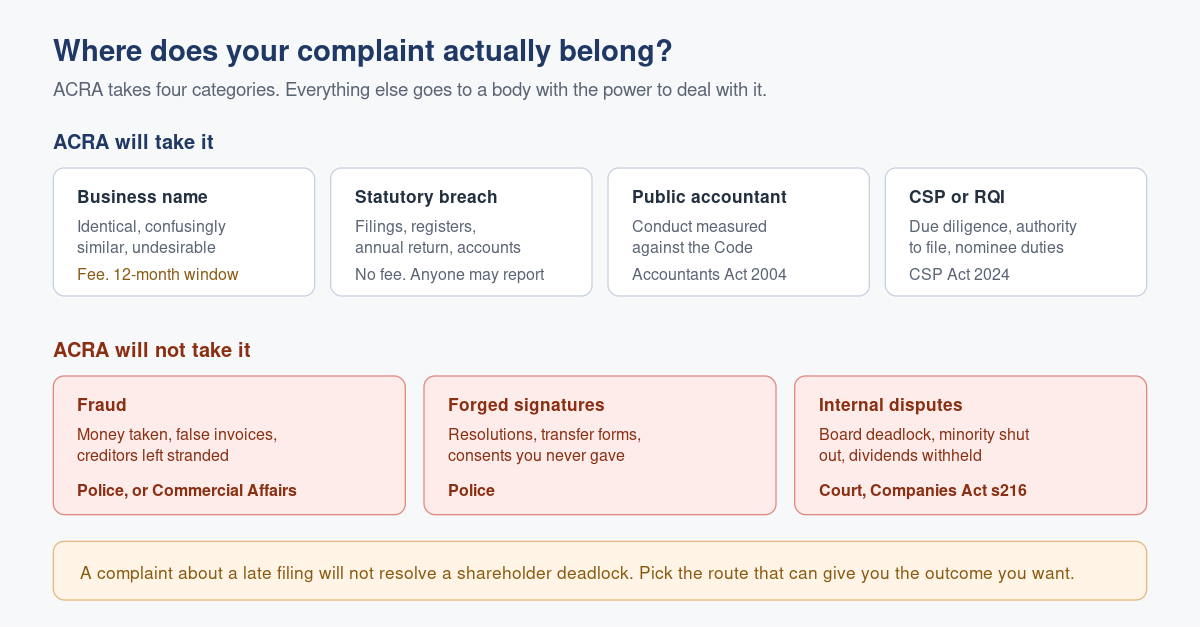
| Complaint type | Typical trigger | Governing legislation | Notes |
|---|---|---|---|
| Business name complaint | A competitor registers a name identical or confusingly close to yours, or a name that is offensive or restricted | Companies Act 1967 section 27, Business Names Registration Act 2014 section 17 | Fee payable. A strict 12-month window applies to the “too similar” ground |
| Statutory breach | An entity fails a filing, disclosure or conduct duty under a statute ACRA administers | Companies Act 1967, Business Names Registration Act 2014, Limited Liability Partnerships Act 2005, Limited Partnerships Act 2008 | Reported through Bizfile. No fee |
| Public accountant or accounting entity | An auditor departs from the Code of Professional Conduct and Ethics | Accountants Act 2004 | Handled through ACRA’s oversight of public accountants |
| Corporate service provider or registered qualified individual | A CSP or RQI breaches its obligations, including customer due diligence duties | Corporate Service Providers Act 2024 | A relatively new regime with real teeth |
Business name complaints
This is a formal request that the Registrar direct another entity to change its name. It is available where the name is identical to an existing one, so similar as to be likely to be mistaken for yours, undesirable, or protected or restricted by legislation.
The “too similar” ground carries a deadline that catches people out constantly: the application must reach the Registrar within 12 months of the other entity’s registration or name change. Miss it and the statutory route closes, whatever the merits. We deal with the mechanics, the evidence and the fee in our separate guide to filing a name complaint against another business.
Statutory breach complaints
This is the broadest category and the least used. It covers the ordinary compliance failures written into the statutes: registers not kept, changes in officers or shareholders not lodged, annual returns not filed, financial statements not laid, the registered office not open as required, a controllers register not maintained.
Anyone may report these. You do not need to be a member, an officer or a creditor, and there is no fee. In practice most reports of this kind come from minority shareholders who cannot get information out of the board, and from counterparties who discover during due diligence that an entity’s public record has been stale for years.
Complaints about public accountants
Public accountants and public accounting entities in Singapore are regulated by ACRA under the Accountants Act 2004 and are bound by a Code of Professional Conduct and Ethics. Where an audit has been conducted in disregard of independence requirements, or where an auditor has behaved in a way the Code does not permit, that is a complaint ACRA will consider.
Note the boundary carefully. Disagreeing with an audit opinion is not misconduct. Nor is an auditor’s refusal to accept your explanation of a balance. The complaint has to be about conduct measured against the Code, not about an outcome you dislike.
Complaints about corporate service providers
The Corporate Service Providers Act 2024 brought CSPs and their registered qualified individuals into a licensing and conduct regime of their own. Complaints here typically concern anti-money-laundering failures, nominee director arrangements handled improperly, filings made without proper authority, or a provider that has effectively abandoned a client’s compliance.
The obligations on this side are heavier than most clients realise, and they are worth understanding before you complain, because knowing which duty was breached makes the complaint far more effective. Our Corporate Service Providers Act 2024 compliance FAQ sets them out.
What ACRA will not touch, and where it goes instead
Three categories are expressly outside ACRA’s complaints channel, and if you send them there they may be forwarded on rather than acted upon.
Fraud. Misappropriation of company money, false invoicing, phoenix trading designed to leave creditors stranded. This is a police matter. Serious or complex commercial fraud is the domain of the Commercial Affairs Department.
Forged signatures. A resolution you did not sign, a share transfer form with your name on it, a consent to act as director you never gave. Forgery is a criminal offence, and the fact that the forged document was then lodged with ACRA does not convert it into a filing problem. Report it to the police. Separately, ACRA has tightened the declaration requirements around directorship consents, which we cover in our note on the amended Form 45 and money-laundering disqualification.
Internal disputes between directors, shareholders or other officers. Deadlocked boards, a majority shareholder shutting a minority out of information, dividends withheld, a director excluded from management. None of this is a registry matter. The remedy is section 216 of the Companies Act 1967, the oppression provision, which lets a member apply to the Court where the company’s affairs are being conducted oppressively or in disregard of members’ interests. That is a legal proceeding, not a complaint form.
The temptation, in a dispute, is to lodge an ACRA complaint because it is free and fast and feels like doing something. It is worth resisting. A complaint about a stale filing will not resolve a shareholder deadlock, and having tried it does not strengthen your position later.
What goes wrong in practice
Complaining about the wrong thing, correctly. A minority shareholder locked out of the accounts reports the company for a late annual return. ACRA may well act on the late return. The shareholder still has no accounts. The complaint was valid and entirely beside the point.
Missing the 12-month name window while gathering perfect evidence. The strict deadline on the “too similar” ground does not pause while you assemble your file. Companies spend eight months collecting misdirected invoices and then discover they have four weeks left.
Treating a complaint as a substitute for a cease and desist. Where the real grievance is brand confusion rather than registry error, the stronger routes are usually a passing off action or a trade mark injunction. Our note on passing off and protecting your business name explains what those get you that a name complaint does not.
Expecting to be told everything. A complainant is not a party to an enforcement action. You may be asked for information and told the outcome in general terms. You will not receive a file.
Not checking your own record first. It is uncomfortably common for a company to report a counterparty and discover, when the matter is looked at, that its own registers and filings are behind. Before you complain, pull your own record. Our guide to what Bizfile is and what you can do in it covers how, and the Companies Act 1967 deep-dive FAQ covers the duties you are checking against.
Frequently asked questions
Can I complain to ACRA anonymously?
You can report a suspected statutory breach without being a member or officer of the entity concerned. Providing contact details is usually better, because ACRA may need to ask you for the documents that make the complaint actionable. A name complaint is different: it is a formal application and must come from an identified applicant.
Does it cost anything to complain to ACRA?
Reporting a suspected statutory breach does not carry a fee. A name complaint does, because it is an application for the Registrar to direct another entity to change its name rather than a report. The current fee is published on ACRA’s name complaint page.
My co-director is refusing to sign anything and the company is paralysed. Will ACRA help?
No. Deadlock between directors is an internal dispute and outside ACRA’s complaints scope. The route is the Court, most commonly under section 216 of the Companies Act 1967, or whatever dispute mechanism your constitution or shareholders’ agreement provides.
Someone lodged a filing for my company without my authority. Is that an ACRA complaint?
It may be two things at once. If a signature or consent was forged, that is a criminal matter for the police. If the filing was made by a corporate service provider without proper authority, that is also potentially a breach of the Corporate Service Providers Act 2024 and within ACRA’s scope.
How long does ACRA take to deal with a complaint?
There is no fixed period, and the honest answer is that it depends on the category. A straightforward filing breach can move quickly. A contested name complaint, where both sides make submissions and evidence has to be weighed, takes considerably longer.
Can I complain about my auditor’s opinion?
Not as such. ACRA regulates public accountants against a Code of Professional Conduct and Ethics, so a complaint has to identify conduct that departs from the Code. Disagreement with a judgment properly made, or with a qualification you did not want, is not misconduct.
Getting the routing right the first time
Most complaints that fail do not fail on the merits. They fail because they were addressed to a body without the power to give the complainant what they actually wanted.
Raffles Corporate Services spends a good deal of its time on exactly this triage: working out whether a client’s problem is a registry matter, a professional conduct matter, a criminal matter or a shareholder dispute, and then making sure the right route is taken inside whatever deadline applies. If you are staring at a situation and are not sure which it is, ask before you file.
You can also read more on Singapore corporate secretarial practice at Singapore Secretary Services, and the scope of ACRA’s complaints channel is set out on ACRA’s complaints and appeals pages.
— The Editorial Team, Raffles Corporate Services
Need help with corporate secretarial or compliance matters?
If you would like help with your company's corporate secretarial, governance or compliance requirements, email [email protected] or WhatsApp +65 8501 7133.
Our team can assist with corporate secretarial, accounting and tax matters. Where legal advice is needed, advisers from our associated law firms can assist.