

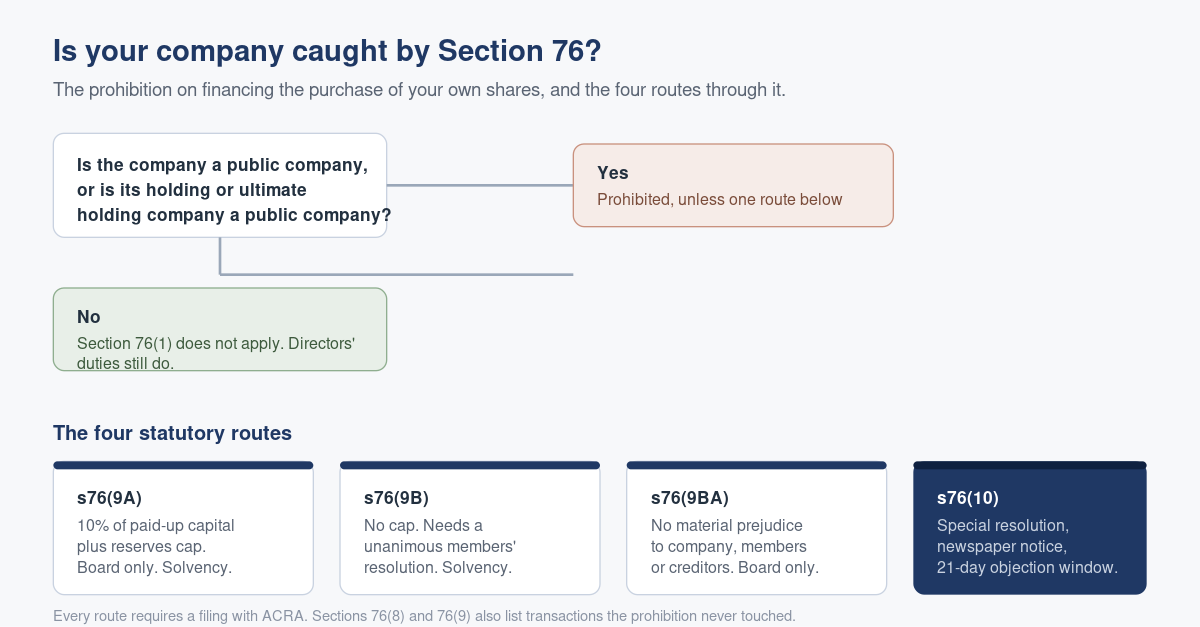
A Singapore private company with no holding company, or whose holding company is also private, is not caught by the Section 76 prohibition on financial assistance at all. Public companies, and companies whose holding or ultimate holding company is public, are prohibited unless they use one of four statutory routes.
Raffles Corporate Services works with a panel of experienced Singapore law firms who offer cost-effective and efficient legal service and advice. This article is general information only and is not legal advice.
That first sentence saves a lot of people a lot of money. The financial assistance rule carries a fearsome reputation from older company law and from other jurisdictions, and it is routinely applied to Singapore private companies that were never within its scope. Before you spend on a whitewash procedure, establish whether you need one.
If you are within scope, the rest of this guide is what matters: what counts as assistance, which route fits, what has to be filed, and what happens to the directors personally if the transaction proceeds without one.
What the prohibition actually says
Section 76(1) of the Companies Act 1967 prohibits a public company, or a company whose holding company or ultimate holding company is a public company, from giving any financial assistance, directly or indirectly, for the purpose of or in connection with the acquisition or proposed acquisition of shares or units of shares in the company or in its holding or ultimate holding company. A parallel prohibition in Section 76(1A) stops a company acquiring its own shares, purporting to acquire shares in its holding company, or lending money on the security of such shares.
Two definitional points do most of the work in practice.
The definition of assistance is deliberately broad. Section 76(2) says financial assistance includes making a loan, giving a guarantee, providing security, releasing an obligation, releasing a debt “or otherwise”. That last word is not decorative. A guarantee your company gives to the buyer’s bank is assistance. Security granted over your company’s property for the buyer’s acquisition debt is assistance. Waiving a debt the buyer owed you is assistance.
Purpose is tested substantively. Under Section 76(3), the company is taken to have given assistance for the purpose of an acquisition if that purpose was among the company’s purposes and was a substantial one. Under Section 76(4), assistance is given in connection with an acquisition if, when it was given, the company was aware it would financially assist the acquisition. You cannot dress the transaction as something else and rely on the label.
Whether a holding company relationship exists is itself a live question in group structures. The statutory tests turn on control of the board or of voting power rather than on percentage ownership alone, and our note on what counts as a related corporation sets out how they run.
The transactions the prohibition never touched
Before reaching for a whitewash, check Sections 76(8) and 76(9). They list transactions the prohibition does not bite on at all. Among them:
- dividends lawfully made, and distributions in a winding up;
- a payment made pursuant to a reduction of capital under the Act;
- the discharge of a liability incurred in good faith on ordinary commercial terms;
- a guarantee or security given in good faith and in the ordinary course of commercial dealing by a subsidiary in relation to repayment of moneys by a borrowing corporation;
- an allotment of bonus shares;
- a redemption of redeemable shares in accordance with the company’s constitution;
- financial assistance for shares to be held by or for the benefit of employees of the company or of a related corporation, including a salaried director;
- a purchase by a company of its own shares under the share buy-back provisions;
- lending, guarantees or security given in the ordinary course of business, on ordinary commercial terms, by a company regulated under banking, finance company or insurance legislation or supervised by the Monetary Authority of Singapore.
The redemption exemption is the one most often relevant to private groups: if the transaction is genuinely a redemption of redeemable preference shares in accordance with the constitution, Section 76 is not your problem. Employee share plans come next, and the plan’s drafting determines whether the exemption is available, so check rather than assume. Our guide on admitting new investors covers the surrounding paperwork.
The four routes through, compared
If the company is in scope and no exemption applies, the Act offers four gateways. They differ in what they cap, who has to approve, and how much process they carry.
| Route | Amount cap | Solvency statement by all directors? | Members’ approval | Notable extra steps |
|---|---|---|---|---|
| Section 76(9A) | 10% of paid-up capital plus reserves per the latest compliant financial statements, counting outstanding 76(9A) assistance | Yes | Not required | Fair value to the company; notice to every member within 10 business days of providing the assistance; notice and solvency statement lodged the next business day |
| Section 76(9B) | None | Yes | Yes, unanimous among members entitled to vote | Notice to members the next business day after the board resolution; resolution and solvency statement lodged the next business day after the members’ resolution; assistance given within 12 months |
| Section 76(9BA) | None | No | Not required | No material prejudice to the company, its shareholders or its ability to pay creditors; board resolution lodged with ACRA |
| Section 76(10) | None | No | Yes, by special resolution, plus one from a listed or Singapore-incorporated ultimate holding company where applicable | Explanatory notice and directors’ statement to members and debenture holders, lodged the day after despatch; newspaper notice within 21 days; 21-day window for objectors to apply to court |
A few practical observations on choosing between them.
Section 76(9A) is the light-touch route, and its cap is the constraint. The 10% test is cumulative: earlier 76(9A) assistance still outstanding counts against the limit. The fair value requirement is easy to state and harder to evidence, so document the valuation.
Section 76(9B) trades unanimity for headroom. No cap, but the members’ resolution must be passed by all members present and voting, or if by written means, by all the members. One dissenting or simply uncontactable minority shareholder closes this route.
Section 76(9BA) is the lightest on paper and the heaviest on judgement. No solvency statement and no members’ resolution, just a board resolution setting out in full the grounds for the directors’ conclusions, plus a filing. The no-material-prejudice condition is a substantive test the directors must defend afterwards.
Section 76(10) is the full public procedure, slow by design: notice, statement, special resolution, newspaper publication and a statutory objection period during which a member, debenture holder, trustee for debenture holders, creditor or the Registrar may apply to court to oppose the assistance.
One clarification, because it is commonly misread: the special resolution under Section 76(10) is a resolution of the members, not of the board.
The directors’ resolutions in the 76(9A), 76(9B) and 76(9BA) routes must each set out in full the grounds for the directors’ conclusions. Reciting the statutory wording and stopping there does not comply. See our guide on board resolutions in Singapore for the drafting standard, and our Section 76 whitewash deep dive for the statutory analysis.
The stop-the-transaction provisions nobody reads
Approval is not permission to proceed regardless of what happens next.
Section 76(9C) provides that a company must not give financial assistance under Section 76(9A) or 76(9B) if, before the assistance is actually given, any director who voted in favour ceases to be satisfied that it is in the best interests of the company or that the terms are fair and reasonable, or if any director no longer has reasonable grounds for an opinion expressed in the solvency statement. Section 76(9CA) does the same for the 76(9BA) route.
So where money moves weeks or months after the resolution, somebody has to re-ask the question immediately before drawdown. Bake it into the completion checklist.
Section 76(9D) then removes the comfort blanket. Passing the resolutions does not relieve a director of any duty owed to the company under Section 157 or otherwise, whether fiduciary or not.
What it costs to get this wrong
Under Section 76(5), if a company contravenes Section 76(1) or 76(1A), the company is not guilty of an offence. Every officer in default is, and is liable on conviction to a fine not exceeding $20,000 or imprisonment for up to three years, or both. That allocation is deliberate: the exposure lands on individuals, not on the balance sheet.
Section 76(6) goes further. Where an officer is convicted and the court is satisfied that the company or another person suffered loss or damage as a result of the contravention, the court may order the convicted person to pay compensation, enforceable as a judgment.
Separately, any director who makes a solvency statement without reasonable grounds for the opinions in it commits an offence under Section 7A(6), punishable by a fine not exceeding $100,000 or imprisonment for up to three years, or both. That is a second, independent exposure.
What goes wrong in practice
Assuming a whitewash is needed when it is not. A private company with no holding company, or with a private holding company, sits outside Section 76(1).
Assuming a whitewash is not needed because the group “feels” private. The mirror-image error. A private Singapore subsidiary is caught if its parent is a public company within the meaning of the Act, and the chain runs to the ultimate holding company, not just the immediate one.
Treating the assistance as a one-off event when it is a facility. Under the 76(9A) route the 10% cap is measured against assistance whose repayment remains outstanding. A revolving arrangement can drift over the limit without any single drawdown looking unusual.
Missing the filing deadlines, which run in business days. The 76(9A) and 76(9B) routes require lodgement not later than the business day next following the relevant trigger. That is not a 14-day window: the paperwork must be ready before the trigger event.
Filing under the wrong subsection. Each route has its own notice type and attachments in Bizfile. Our companion guide on filing the Section 76 notice to members walks through which to select. An error that a notice of error cannot fix may require an order of court, which is a disproportionate outcome for a dropdown selected in haste.
Nobody re-checks before drawdown. See Sections 76(9C) and 76(9CA) above.
Frequently asked questions
Does Section 76 apply to my Singapore private limited company?
Only if it is a public company, or if its holding or ultimate holding company is a public company. A private company with no holding company, or whose holding company is also private, is outside the Section 76(1) prohibition. Directors’ general duties to the company still apply regardless.
Is a guarantee financial assistance, or does it have to be cash?
A guarantee is financial assistance. Section 76(2) expressly includes making a loan, giving a guarantee, providing security, releasing an obligation and releasing a debt. Providing security over company assets for a buyer’s acquisition loan is squarely within the definition even though no company money moves.
What is the 10% limit under Section 76(9A) measured against?
The aggregate of the company’s total paid-up capital and its reserves, as disclosed in the most recent financial statements complying with Section 201. The test is cumulative: it counts the proposed assistance together with any other Section 76(9A) assistance still outstanding.
Can the board pass the special resolution under Section 76(10)?
No. A special resolution is a members’ resolution. Under Section 76(10) the company by special resolution resolves to give the assistance, and where the company is a subsidiary of a listed corporation or of a Singapore-incorporated ultimate holding company, that corporation must approve by special resolution too. The directors’ role is the accompanying statement.
What happens if we give the assistance without following any route?
Every officer in default is liable on conviction to a fine not exceeding $20,000 or imprisonment for up to three years, or both. The court may additionally order a convicted officer to compensate the company or another person for resulting loss. The company itself is not guilty of the offence.
Scope first, then process
The single most valuable thing a company can do here is settle the scope question in writing at the start: is this company, on the day of the transaction, caught by Section 76(1)? Everything downstream follows from the answer, and answering it late is how transactions slip.
Raffles Corporate Services advises Singapore companies on share transactions, including scoping the financial assistance question across group structures, running the appropriate route, drafting the resolutions and member notices to the standard the Act requires, and filing inside the business-day deadlines.
You can reach us through Raffles Corporate Services, or read more on Singapore corporate secretarial practice at Singapore Secretary Services. The full text of Section 76 is on Singapore Statutes Online, and ACRA’s filing portal is Bizfile.
— The Editorial Team, Raffles Corporate Services
Need help with corporate secretarial or compliance matters?
If you would like help with your company's corporate secretarial, governance or compliance requirements, email [email protected] or WhatsApp +65 8501 7133.
Our team can assist with corporate secretarial, accounting and tax matters. Where legal advice is needed, advisers from our associated law firms can assist.