

An XBRL exemption is permission to file financial statements that fail one of ACRA’s BizFinx validation rules. It is free, it is decided by email, and it usually takes three to seven working days. It does not exempt you from filing financial statements at all.
Raffles Corporate Services works with a panel of experienced Singapore law firms who offer cost-effective and efficient legal service and advice. This article is general information only and is not legal advice.
That last sentence is the one that saves people a wasted week. Two completely different things share the word “exemption” in ACRA’s vocabulary. One is the relief that lets a dormant relevant company or a solvent exempt private company skip filing financial statements altogether. The other, the one this article is about, is a narrow technical waiver of a single validation rule inside the BizFinx preparation tool.
If you are here because BizFinx has flagged an error and refuses to let you proceed, read on. If you are here because you think your company should not be filing financial statements in the first place, you want who must file XBRL financial statements and who does not, or the broader overview in our guide to XBRL filing with ACRA, instead.
What an XBRL exemption actually is
ACRA layers business rules on top of the taxonomy. The taxonomy tells you what an element means. The business rules test whether the numbers you have tagged hang together: that a total equals the sum of its parts, that a comparative period is present, that a text block contains a complete set of financial statements, that a date is in the expected format.
Most of the time a rule fires because something in your file is genuinely wrong. Fix the file and the error disappears.
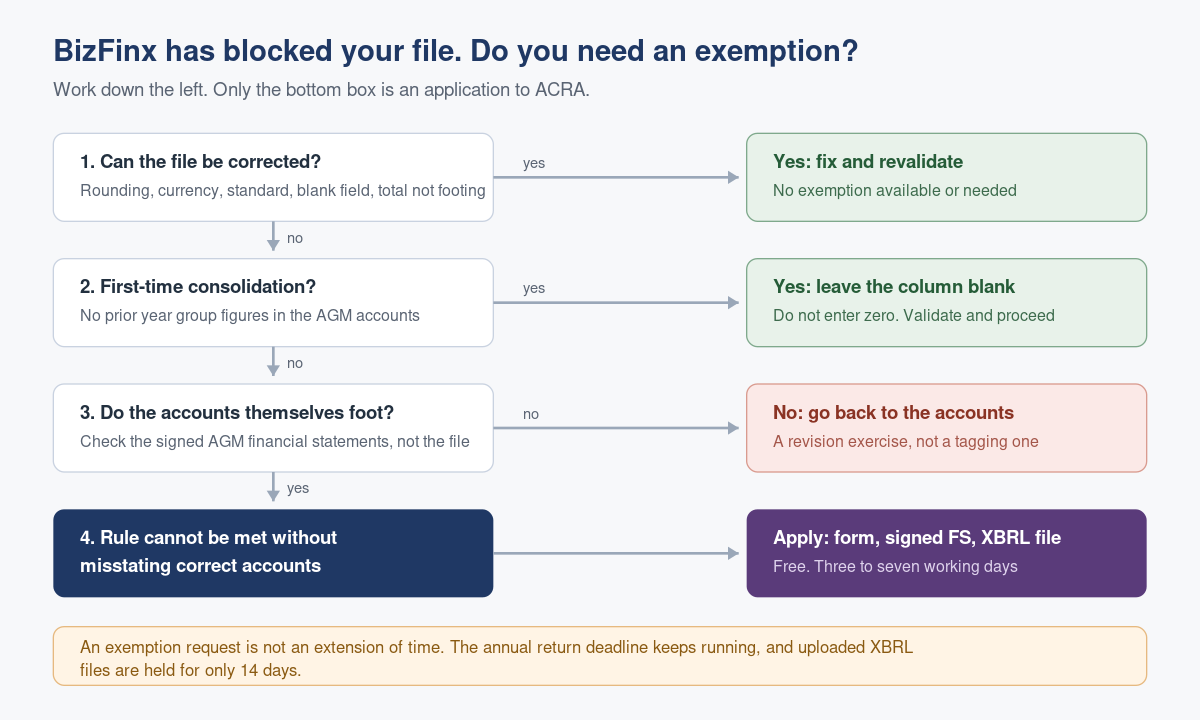
Occasionally a rule fires on a file that is correct. Your accounts legitimately do not contain what the rule expects, and no correction will satisfy it without misstating them. That is what ACRA calls a genuine error, and it is the situation an exemption is designed for.
The test is not “this is annoying”. It is “the rule cannot be satisfied without making my financial statements wrong”.
Two kinds of exemption, and the one you probably mean
| What people call it | What it really is | Where it comes from |
|---|---|---|
| Exemption from preparing financial statements | Relief for a dormant relevant company meeting the statutory conditions | Section 201A of the Companies Act 1967 |
| Exemption from filing financial statements | Relief for a solvent exempt private company, declared when you file the annual return | Companies Act 1967 and ACRA’s filing requirements |
| Exemption from XBRL filing requirements | Waiver of a specific BizFinx business rule so a correct file can be uploaded | ACRA administrative process, by application |
Only the third one is an email to ACRA. The first two are conditions you either meet or do not, tested every financial year, with nothing to apply for.
When an exemption is the right answer
A few situations come up repeatedly.
Your text block is complete but the rule says it is not. The “disclosure of complete set of financial statements” text block is tested for length and for certain keywords. A short set of accounts for a small company can be complete and still fall below what the rule expects. If you have genuinely pasted in the statement by directors, the auditor’s report, all four primary statements and the notes, and the rule still complains, that is an exemption candidate.
A required disclosure does not exist in your accounts. Some rules assume a disclosure the accounting standards did not require you to make. You cannot invent the figure, and you should not enter a zero that implies a fact.
A structural feature of the accounts defeats the rule. Restatements, unusual period lengths, a change of presentation currency or an unusual group structure can all produce a result that no correct tagging will clear.
When it is not the right answer
First-time consolidation. If you are preparing consolidated financial statements for the first time and your AGM accounts carry no prior year group figures, leave the prior year group column blank. Do not enter zero. You do not need an exemption for this. Validate online and proceed.
An error you can fix. Rounding level, currency indicator, a wrong accounting standard, a missing cash flow field, a parent total that does not equal the sum of its children, a cover page date in the wrong format. All fixable, and an exemption request will come back telling you to fix them. Our companion piece on the XBRL errors that actually stall a filing works through each one.
A file you have not validated properly. Validate online, read the whole result, and deal with everything you can before you write to ACRA. A request against a file with five open errors invites a slow, unhelpful reply.
How to apply, in order
- Validate online and record the exact error code. Not a description. The code, for example Misc_041. ACRA works from the code.
- Satisfy yourself the error is genuine. Go back to the AGM financial statements and confirm that the file is right and the rule is the problem, not the other way round.
- Complete ACRA’s exemption request form. It is published at go.gov.sg/xbrl-exemption-request-form. Say which rule, which company, which financial year, and why the rule cannot be met without misstating the accounts.
- Gather the two attachments. The signed AGM financial statements, and the XBRL file itself.
- Email the form and attachments to ACRA’s XBRL application address, [email protected].
- Wait three to seven working days, longer if the case is complicated.
- Validate the file online again once ACRA has processed the request, and read the new result.
You can upload the file to BizFinx when the validation result for the offending rule shows either “Possible” or “Granted exemption / not applicable”. Those two outcomes are the green light. Anything else means the block is still in place.
Cost and timing at a glance
| Item | Detail |
|---|---|
| Fee | None. ACRA does not charge for an XBRL exemption request |
| Channel | Email, with the completed form and attachments |
| Attachments required | Signed AGM financial statements, and the XBRL file |
| Processing time | Three to seven working days, depending on complexity |
| Outcome you are looking for | Validation result showing “Possible” or “Granted exemption / not applicable” |
What goes wrong in practice
The annual return deadline does not stop while you wait. This is the expensive one. An exemption request is not an extension of time. The annual return obligation under section 197 of the Companies Act 1967 runs on its own clock, and ACRA’s late lodgement penalties apply whether or not you were waiting on an email. A company that discovers a blocking validation error ten days before its annual return is due has already left it too late. Our note on annual return filing under section 197 sets out how the deadline is counted.
The XBRL file sits on the server and quietly expires. Uploaded XBRL files are held for 14 days from the date of upload. If the annual return is not filed inside that window, the file drops off and has to be uploaded again. That trips companies who upload early, chase an exemption, and come back three weeks later expecting to find their work waiting.
The request goes in without the accounts attached. ACRA cannot assess whether an error is genuine without seeing the financial statements the file is supposed to represent. A request with no attachments is a request that will be answered with a question.
Somebody applies for the wrong exemption entirely. A director hears “we can get an exemption” and understands it as relief from filing accounts. The company then does not file, and the position quietly becomes a compliance breach rather than a technical delay.
The underlying problem was a data problem. If a total does not foot because the accounts themselves do not foot, no exemption will help. The honest answer is to go back to the accounts, and if that means revising financial statements already laid before members, that is a separate and more serious exercise.
Where the exemption sits in your year-end sequence
Think of the year-end run as four gates. Prepare the accounts. Tag them into XBRL. Validate. File the annual return. The exemption process sits between gates three and four, and it is the only one that depends on somebody else’s inbox.
That is the argument for validating early. You can tag and validate a draft file long before the accounts are signed, purely to find out which rules will fire. Any exemption you need can then be sought while the audit is still running. Companies that treat validation as the final step, rather than a rehearsal to be run twice, are the ones that end up paying penalties.
If your financial year end is itself under review, note that moving it changes every downstream date, and the rules on that are set out in our guide to changing your company’s financial year end.
One group of filers can skip all of this. A registered foreign company does not prepare XBRL at all, so no BizFinx rule can ever block it and no exemption is available or needed. If that is you, go straight to filing financial statements for a foreign company.
Frequently asked questions
Does an XBRL exemption cost anything?
No. ACRA does not charge a fee for processing an XBRL exemption request. The cost is time: three to seven working days, and longer where the case is complex. Since there is no fee, there is also no expedited option, which is why the request should go in well before your annual return deadline.
Can I file my annual return while the exemption request is pending?
Not if the validation error is blocking the upload of your XBRL financial statements, because the annual return cannot be completed without them. The annual return deadline continues to run regardless. That is the whole reason for validating early rather than treating it as a final step.
What is a “genuine error”?
A validation rule that fires on a file that correctly represents the signed financial statements, and that cannot be satisfied without misstating those accounts. A rule that fires because a figure was tagged wrongly, a rounding level was mismatched or a field was left blank is not a genuine error. It is an error.
Do I need an exemption for a first-time consolidation with no prior year group figures?
No. Leave the prior year group column blank rather than entering zero, and validate online. ACRA treats the resulting messages as ones you can proceed past. Entering zero is worse than leaving the column empty, because zero asserts a fact about the prior year that is not true.
How long will ACRA keep my uploaded XBRL file?
Fourteen days from the date of upload. If the annual return has not been filed inside that window, upload the file again. Nothing is lost permanently, but the re-upload is easy to forget when a filing has been sitting in limbo waiting for a reply.
Who should send the request?
Whoever prepared the file and can answer questions about the accounts, usually the accountant or the corporate secretary handling the annual return. There is no requirement that a director sends it, but the person sending it should have the signed financial statements to hand.
Getting the file through the first time
Most XBRL exemptions are sought in a panic. They do not need to be. The errors that genuinely require a waiver are a small and fairly predictable set, and they can be identified weeks in advance by validating a draft file the moment the accounts are close to final.
Raffles Corporate Services prepares and files XBRL financial statements for Singapore companies across the full range of templates, runs validation early enough for an exemption to be sought without drama, and files the annual return inside the statutory window. If a validation error is currently sitting between you and a filing deadline, that is a short conversation.
You can reach us through Raffles Corporate Services, or read more on Singapore corporate secretarial practice at Singapore Secretary Services.
— The Editorial Team, Raffles Corporate Services
Need help with accounting or bookkeeping?
If you would like accounting, bookkeeping or financial reporting support for your business, email [email protected] or WhatsApp +65 8501 7133.
Our accounting and tax advisers can assist. Where legal advice is needed, advisers from our associated law firms can also assist.