
Mapping means matching each line item in your AGM financial statements to a concept in ACRA’s taxonomy so the figures can be filed in XBRL. The taxonomy is closed: you cannot invent a concept to fit your accounts, so you fit your accounts to the concepts that exist.
Raffles Corporate Services works with a panel of experienced Singapore law firms who offer cost-effective and efficient legal service and advice. This article is general information only and is not legal advice.
That single fact explains almost every difficulty people have with XBRL filing. Your chart of accounts was built for your business. The taxonomy was built so that every Singapore company’s filed data can be compared. Where the two do not line up, judgement is required, and the judgement is yours to make and yours to defend.
Here is how the taxonomy works, the four ways a line item can be mapped, when a footnote is compulsory, and what a bad mapping actually costs you.
What the ACRA taxonomy is
Think of it as a dictionary for the XBRL language. Every concept in it, “Revenue”, “Property, plant and equipment”, “Trade and other receivables”, has a defined meaning drawn from the disclosure requirements in Singapore’s accounting standards and in the Companies Act 1967. When you tag a number with a concept, you are asserting that the number means what the taxonomy says that concept means.
Two design features matter in daily use.
It is closed. You cannot add company-specific concepts and you cannot invent relationships between concepts. There is no extension mechanism. This is deliberate: it is what makes the filed data comparable across the whole register, and it is why the tagging burden falls on you rather than on ACRA.
It allows presentation flexibility. You can customise labels to match your own terminology and you can reorder concepts so the filed statement reads the way your accounts read. What you cannot change is the underlying concept a number is attached to. Renaming a label does not change what you have asserted.
If XBRL filing itself is new to you, start with our XBRL Filing with ACRA guide, which covers who must file in full XBRL, who files a simplified set, and the filing timeline. This article assumes you already know you have to file and are now staring at the template.
Which taxonomy version do I use?
Use the current ACRA taxonomy. Both the taxonomy and the BizFinx preparation tool are updated from time to time, and a template built on a superseded version can be rejected at validation.
The practical habit is simple: download a fresh copy of the preparation tool template at the start of each filing cycle rather than reusing last year’s file. Carrying forward a prior-year template saves an hour and occasionally costs a day. Subscribing to ACRA’s news updates is the low-effort way to hear about a change before it bites.
The four ways to map a line item
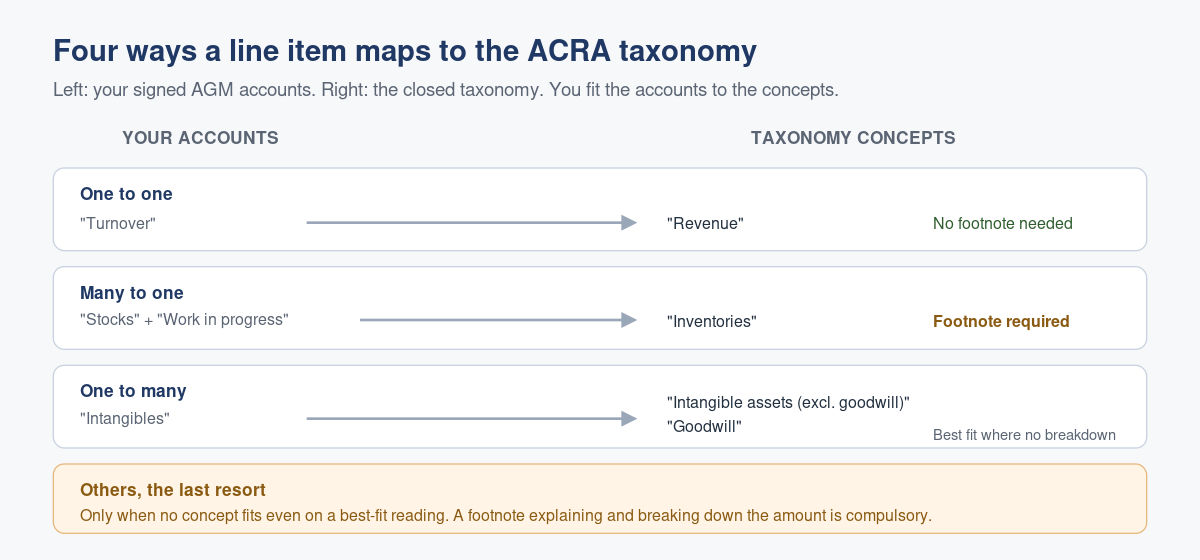
Every line in your accounts falls into one of four patterns. Getting the pattern right is most of the work.
| Mapping type | What it means | Worked example | Footnote required? |
|---|---|---|---|
| One-to-one | A single line item corresponds to exactly one taxonomy concept | “Turnover” in your accounts maps to “Revenue” in the taxonomy | No |
| Many-to-one | Two or more line items are combined and filed against a single concept | “Stocks” and “Inventories and work in progress” are added together and mapped to “Inventories” | Yes, to explain the aggregation |
| One-to-many | A single line item is split and filed against separate concepts | “Intangibles” is broken into “Intangible assets (excluding goodwill)” and “Goodwill” | Not automatically, but document the split |
| Others | The item has no relation to any concept, even on a best-fit reading | A genuinely unusual item with no equivalent in the taxonomy | Yes, always, with a breakdown |
The best-fit principle, and where judgement enters
One-to-many mapping is where accounting knowledge actually earns its keep. If you have a line called “Equipment”, the taxonomy may offer several plausible homes, for example “Machinery and other equipment” or “Communications and network equipment”. Where the accounts contain no breakdown and there is no exact equivalent, you map the full amount to the closest matching concept.
“Closest matching” is a judgement, not a lookup. Two competent preparers can land differently, and both can be defensible. What is not defensible is picking whichever concept appears first in the dropdown. Write down why you chose what you chose, because in two years nobody will remember, including you.
When a footnote is not optional
Two situations require a footnote using the footnote mechanism in the XBRL format.
Aggregation. If you have combined several line items into one taxonomy concept, the footnote explains what went into it. Without it, a reader sees a single inventories figure and has no way to know it was assembled from two disclosed lines.
Anything classified under “Others”. The footnote must both explain the item and break it down. “Others” with no footnote is the single most common validation and review complaint, and it is entirely self-inflicted.
Treat “Others” as a last resort, not a convenience. If you find yourself pushing a material amount there, the likelier explanation is that you have not found the right concept yet.
What you map from, and what you must complete
You map from the AGM financial statements: the set the directors signed and the members received. Not the management accounts, not the trial balance, not a working file that was 95 per cent of the way there when someone started tagging.
Two rules govern the template itself:
- All tabs in the BizFinx preparation tool template must be completed. You do not get to skip a tab because it looks irrelevant.
- Leave a field blank if the information it asks for is not disclosed in the AGM financial statements. Blank means “not disclosed”. Do not fill a gap with a plausible figure from your ledger. The filed data has to reflect what was actually presented to members.
Those two rules pull in opposite directions the first time you read them, and that is the point. Complete every tab, and within each tab, say nothing that the signed accounts did not say.
Who in the company should do the mapping?
The person most familiar with the financial statements. That is the intent, and it is the right one.
In practice this is the finance manager or the accountant who prepared the accounts, not an administrator working from a PDF. The taxonomy asks questions that only someone who knows the accounts can answer: what exactly sits inside that other receivables line, whether an amount is current or non-current, whether an item was disclosed or merely calculated.
Whoever does the tagging, the company should review the mapping before it is submitted. The directors are responsible for what is filed. A review by a second pair of eyes takes twenty minutes and catches the obvious category errors, which are the ones that cause trouble.
What goes wrong, and what it costs
Mapping from the wrong version of the accounts. Someone starts tagging a near-final draft, the auditors then move a number, and nobody re-tags. The filed XBRL and the filed PDF accounts disagree. That inconsistency is visible on the public record and is exactly what financial reporting surveillance is designed to notice.
Overusing “Others”. A large unexplained “Others” balance with no footnote makes the filing look evasive even when it is merely lazy, and it strips the filing of the comparability that is the whole point of the exercise.
Silent aggregation. Combining line items without the required footnote. The figure may be perfectly correct, but the reader cannot reconstruct it, and the omission is a defect in the filing rather than a matter of taste.
Reusing last year’s template without checking the version. The taxonomy and the preparation tool change. Rework under deadline pressure is the usual outcome, and it tends to land in the last week before the annual return is due. The section 197 annual return timetable is unforgiving of that.
Treating classification as clerical. Mapping is an accounting exercise. Where an amount could sit in more than one place, the choice engages measurement and disclosure judgement of the sort that appears throughout the standards. Our note on FRS 113 fair value measurement is a useful illustration of how much definitional work sits underneath a single balance sheet caption.
Forgetting that a financial year end change alters the comparatives. If the period covered by the accounts is not twelve months, the mapping and the period tags have to reflect that. See Changing Your Singapore Company’s Financial Year End.
Frequently asked questions
Can I create my own concept if nothing in the taxonomy fits?
No. The ACRA taxonomy is closed, so there is no extension mechanism. Where nothing fits even on a best-fit reading, you classify the item under “Others” and add a footnote that explains it and breaks it down. Creating custom concepts is not an option.
Do I have to use ACRA’s wording for every line?
No. You can customise labels so the filed statement uses your own terminology, and you can reorder concepts for presentation. What you cannot change is the underlying concept each figure is tagged to. A renamed label does not alter the meaning you have asserted.
What do I do when two line items need to be combined?
Add them together, map the total to the single taxonomy concept that covers them, and create a footnote explaining the aggregation using the footnote mechanism in the XBRL format. The footnote is required, not optional, because otherwise the reader cannot see how the figure was built.
Should I fill in a field if the figure exists in my ledger but not in the signed accounts?
No. Leave it blank. Fields are completed from the AGM financial statements, and a blank field correctly signals that the information was not disclosed. Filling it from the ledger makes the filed data inconsistent with the accounts the members received.
Who should do the mapping inside the company?
The officer most familiar with the financial statements, usually the person who prepared them. The mapping requires knowledge of what sits inside each line. The company should then review the mapping before submission, since the directors remain responsible for the filed data.
What is the best-fit principle?
Where a line item has no exact taxonomy equivalent and no breakdown is available, you map the full amount to the closest matching concept rather than defaulting to “Others”. Choosing the closest match requires accounting judgement, so record the reasoning for the following year’s file.
Making this a twenty-minute job instead of a two-day one
Companies that find XBRL painful are usually doing the mapping from scratch every year. Companies that find it routine did the thinking once, wrote down which line goes to which concept and why, and now only revisit the entries that changed.
Raffles Corporate Services prepares and files XBRL financial statements for Singapore companies and keeps a documented mapping for each client, so the second year costs a fraction of the first. If your last filing involved a scramble, or a large unexplained “Others” balance, that is worth a look before the next annual return falls due.
You can reach us through Raffles Corporate Services. ACRA’s own XBRL filing pages set out the current requirements and exemptions, the Accounting Standards Committee site holds the standards the taxonomy is built on, and there is more on Singapore corporate secretarial practice at Singapore Secretary Services.
— The Editorial Team, Raffles Corporate Services
Need help with accounting or bookkeeping?
If you would like accounting, bookkeeping or financial reporting support for your business, email [email protected] or WhatsApp +65 8501 7133.
Our accounting and tax advisers can assist. Where legal advice is needed, advisers from our associated law firms can also assist.