

If a lender holds a charge over your limited liability partnership’s assets and the LLP defaults, that lender can appoint a receiver to enforce the charge. The receiver can sell the charged assets or run the business for long enough to recover what is owed. The partners are not removed, but in practical terms they stop controlling the assets that matter.
Raffles Corporate Services works with a panel of experienced Singapore law firms who offer cost-effective and efficient legal service and advice. This article is general information only and is not legal advice.
Receivership is not winding up. The LLP continues to exist, it remains on ACRA’s register, and its statutory obligations continue to run. What changes is that a person appointed by one secured creditor now stands between the partners and the property.
The framework sits in the Fourth Schedule to the Limited Liability Partnerships Act 2005, which the Act applies through its receivership and schedule-amendment provisions. It is short, it is specific, and most of it consists of deadlines that carry criminal fines. Here is what it actually requires.
Who can be appointed, and who cannot
The Fourth Schedule disqualifies a list of people from acting as receiver of an LLP’s property, and the list is worth reading before anyone signs an appointment, because an appointment made in favour of a disqualified person is not a small problem.
The following cannot be appointed and must not act:
- A corporation, unless a written law authorises that corporation to act as receiver.
- An undischarged bankrupt.
- A chargee or other security holder of any property of the LLP.
- An auditor of the LLP.
- A partner, manager or employee of the LLP.
- A director, secretary or employee of any corporation that is a chargee or other security holder of the LLP’s property.
- Anyone who is neither a licensed insolvency practitioner nor the Official Receiver.
The last item is the one that governs in practice. A receiver over an LLP must be a licensed insolvency practitioner or the Official Receiver. A lender cannot appoint its own relationship manager, its solicitor’s junior partner or a friendly accountant, and nor can the LLP’s own auditor step across.
The filings, and the clock on each
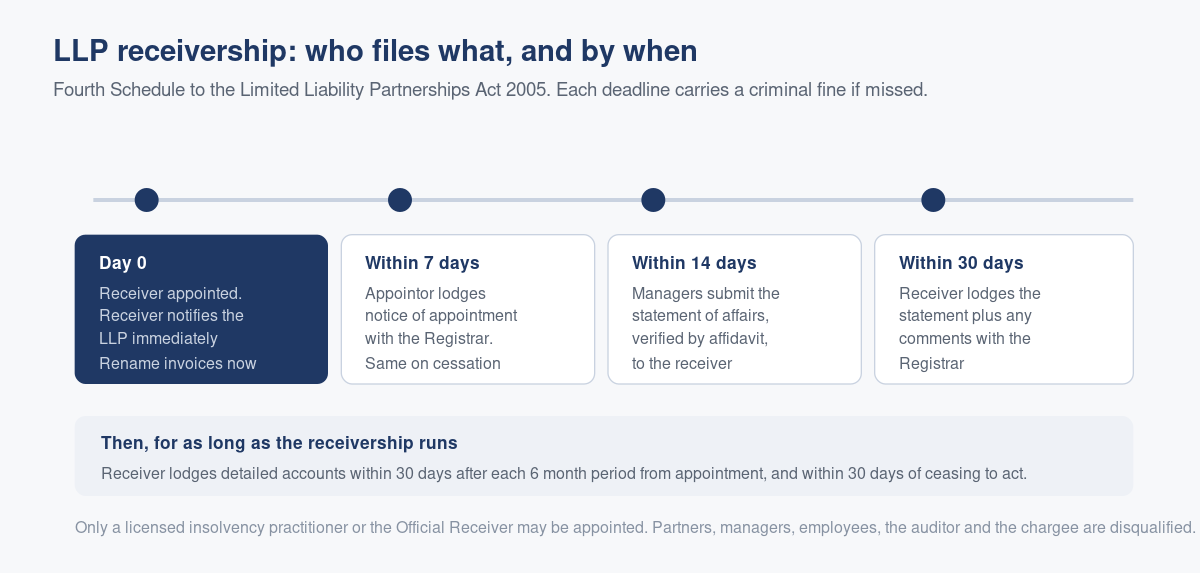
This is the section ACRA’s own page does not reach, and it is the section that generates the offences.
| Event | Who must act | Deadline |
|---|---|---|
| Appointment of receiver or manager, whether by court order or under an instrument | The person who obtained the order or made the appointment | Lodge notice with the Registrar within 7 days |
| Receiver appointed | The receiver | Send notice of the appointment to the LLP immediately |
| Statement of affairs | The LLP’s managers, or others the receiver requires | Submit to the receiver within 14 days of receiving the receiver’s notice, or such longer period as the receiver or the court allows |
| Statement of affairs plus the receiver’s comments | The receiver | Lodge with the Registrar within 30 days of receiving the statement |
| Receiver’s accounts | The receiver | Lodge within 30 days after each 6 month period from appointment, and within 30 days of ceasing to act |
| Receiver or manager ceases to act | The receiver or manager | Lodge notice with the Registrar within 7 days of ceasing |
Non-compliance is an offence in each case. The Fourth Schedule sets maximum fines of $1,000 for most of these failures and $2,000 for failures relating to the information provisions, with a further fine of up to $200 for every day the offence continues after conviction.
What the statement of affairs has to contain
The statement must be verified by affidavit, and it must show, as at the date of the receiver’s appointment, the LLP’s assets, its debts and liabilities, the names and addresses of its creditors, the securities those creditors hold, and the dates those securities were given.
It is ordinarily made by one or more of the people who were managers of the LLP at the date of appointment. The receiver can also require it from current or former officers, from anyone involved in the formation of the LLP within the preceding year, and from current or recent employees who the receiver thinks can supply the information.
A receiver who enters into possession of LLP assets to enforce a charge is personally liable, despite any agreement to the contrary, for debts incurred in the course of the receivership for services rendered, goods purchased and property hired, leased, used or occupied. The company equivalent of that exposure is covered in our note on a receiver’s liability for company contracts.
The people who make the statement and affidavit are entitled to have their reasonable costs of preparing it paid by the receiver out of receipts, with an appeal to the court if the receiver’s view of “reasonable” is not shared.
The obligation nobody remembers: naming the receivership
Once a receiver or manager has been appointed, every invoice, order for goods and business letter issued by or on behalf of the LLP, the receiver, the manager or the liquidator, on which the LLP’s name appears, must carry a statement immediately after the name that a receiver or manager has been appointed.
This is a live trap. The LLP keeps trading, the accounts team keeps sending the same invoice template, and a requirement that exists to warn counterparties quietly goes unmet for months. The offence catches the LLP, every officer, every liquidator and every receiver or manager who knowingly and wilfully authorises or permits the breach, with a fine of up to $1,000.
If your LLP goes into receivership, changing the invoice and letterhead templates is a same-day task, not a month-end task.
Who gets paid, and in what order
Where a receiver is appointed on behalf of debenture holders secured by a floating charge, and the LLP is not at that point being wound up, certain preferential debts must be paid out of the assets reaching the receiver’s hands ahead of any claim for principal or interest under the debentures.
Those preferential debts are the ones that would be preferential in a winding up and are due by way of wages, salary, retrenchment benefit or ex gratia payment, vacation leave, and superannuation or provident fund payments, together with amounts payable under the corresponding winding up provisions in the Fifth Schedule. They are paid in the same order of priority that applies in a winding up.
For this purpose a floating charge means a charge which, as created, was a floating charge. The crystallisation of the charge on default does not defeat the employees’ priority, which is the whole point of that definition.
Such payments are to be recouped, so far as possible, out of the assets available for general creditors. A floating charge holder over an LLP with a payroll should assume it is funding the employee claims first. The company position is covered in our guide to priority disputes between a receiver and preferential creditors.
The gap that catches counterparties: there is no LLP charge register
Here is something worth knowing before you extend credit to an LLP.
The Companies Act 1967 requires companies to register charges with ACRA, and that register is searchable. The Limited Liability Partnerships Act 2005 contains no equivalent registration regime. Its Part on receivership and winding up deals with receivers, managers and liquidators, but there is no LLP counterpart to the company charge register.
The practical consequence is that you cannot do for an LLP what you routinely do for a company: pull the register and see who holds security over its assets. Charges over specific asset classes may be discoverable through other registers, land being the obvious example, but there is no single ACRA search that shows an LLP’s secured borrowing.
What is filed is the receivership itself. The notice of appointment lodged within 7 days, and the accounts lodged periodically, mean that by the time a receivership is visible on the Registrar’s records, the security has already been enforced. That is a late warning. If you are assessing an LLP counterparty, ask for the security position directly and put the answer in writing. Our note on using Bizfile’s search functions before you sign anything covers what you can and cannot establish from the public record.
What goes wrong in practice
The managers treat the receivership as the end of their duties. It is not. The LLP still has to file its annual declaration, keep its accounts and maintain its register of registrable controllers. Receivership suspends control over charged assets; it does not suspend the LLP Act.
The 14 day statement of affairs slips. Managers who are already demoralised put it off, and the receiver’s own 30 day clock cannot start until they deliver. Both sets of offences accrue daily.
The wrong person is appointed. A lender in a hurry appoints someone who is not a licensed insolvency practitioner, or appoints an individual who is an employee of the chargee. Both are expressly disqualified, and the fix is not retrospective.
Nobody applies to court for directions. The Fourth Schedule expressly allows a receiver or manager to apply to court for directions on any matter arising in the performance of their functions, and allows debenture holders to do the same where the appointment was made for their benefit. Where the receiver and the partners are deadlocked over an asset, that application is usually cheaper than the argument.
The receivership drifts into a winding up nobody planned. If the LLP cannot trade out, the next step is the closing process. ACRA’s overview of closing an LLP sets out the strike off and winding up routes, and the choice between them is not always obvious.
Frequently asked questions
Does receivership mean our LLP is being wound up?
No. Receivership is enforcement of security by a chargee, not a collective insolvency process. The LLP stays on the register and its filing obligations continue. Winding up is a separate procedure under the Fifth Schedule to the LLP Act 2005, and a receivership may or may not lead to one.
Who can act as receiver of an LLP’s property?
Only a licensed insolvency practitioner or the Official Receiver, and only if none of the other disqualifications apply. Corporations, undischarged bankrupts, the LLP’s auditor, its partners, managers and employees, chargees, and officers or employees of a corporate chargee are all disqualified.
How quickly must the appointment be filed with ACRA?
Within 7 days. The obligation falls on the person who obtained the court order or made the appointment under the instrument, not on the LLP. The same 7 day period applies when a receiver or manager appointed under an instrument ceases to act.
Do employees get paid ahead of the lender?
Where the receiver is appointed on behalf of holders of debentures secured by a floating charge and the LLP is not in winding up, debts for wages, salary, retrenchment benefit, ex gratia payments, vacation leave and provident fund contributions that would be preferential in a winding up rank ahead of claims under the debentures.
Can we search ACRA to see whether an LLP has granted charges?
No. The LLP Act 2005 has no charge registration regime equivalent to the Companies Act provisions for companies, so there is no public ACRA register of LLP charges to search. Ask the LLP directly and get the position confirmed in writing.
If a receiver is on the horizon
Most LLPs that end up in receivership saw it coming for at least a quarter. The window in which options still exist closes well before the appointment is made, and it closes quietly.
Raffles Corporate Services supports LLPs and their managers through the statutory side of a receivership: the notices, the statement of affairs, the continuing annual declarations and the register obligations that do not pause because a receiver has arrived. If your LLP is under pressure from a secured lender, the useful conversation is the one that happens before the demand letter, not after it.
You can reach us through Raffles Corporate Services, or read more on Singapore corporate secretarial practice at Singapore Secretary Services. For the company equivalent of this process, see our comparison of receivership and judicial management.
— The Editorial Team, Raffles Corporate Services
Need help with corporate secretarial or compliance matters?
If you would like help with your company's corporate secretarial, governance or compliance requirements, email [email protected] or WhatsApp +65 8501 7133.
Our team can assist with corporate secretarial, accounting and tax matters. Where legal advice is needed, advisers from our associated law firms can assist.