

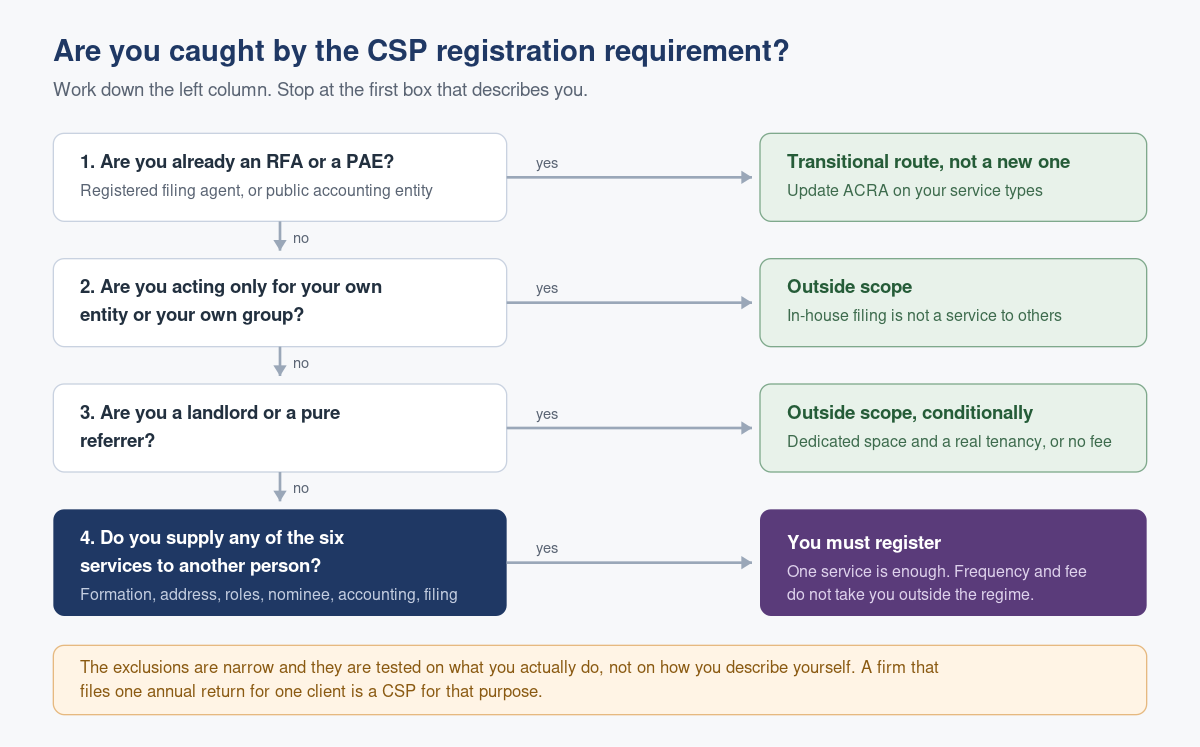
If you provide any one of six corporate services to another person in Singapore, you must be registered as a corporate service provider with ACRA. Not three of them, not as your main business, not for a fee. One service, once, to someone other than your own entity.
Raffles Corporate Services works with a panel of experienced Singapore law firms who offer cost-effective and efficient legal service and advice. This article is general information only and is not legal advice.
That is the part most firms get wrong. The Corporate Service Providers Act 2024 does not ask what you call yourself. It asks what you do. An accounting practice that files an annual return for a client is inside the regime. A serviced office operator that lets clients use its address as a registered office is inside the regime. A consultant who introduces a director and invoices for it is inside the regime.
Getting this wrong is not a paperwork problem. Providing corporate services without registration is an offence, and ACRA has said the exposure runs to a fine of up to $50,000 on conviction. Worse in practice: your filings stop working, because the Bizfile profile you need in order to act for a client does not exist.
Here is how to work out, properly, whether you are caught.
What the CSP Act actually regulates
The Corporate Service Providers Act 2024 is anti money laundering legislation dressed as a licensing regime. That framing matters, because it explains why the scope is drawn so widely.
Singapore’s exposure through corporate service providers is well documented: shell companies formed at speed, nominee directors with no real involvement, registered addresses that are nothing more than a mail slot. The Act’s answer is to put a regulated, accountable intermediary between the public register and anyone who wants to use it on someone else’s behalf. If you are that intermediary, you register, you do customer due diligence, and you carry the consequences when you do not.
So the question is never “am I a corporate secretarial firm”. It is “do I stand between a client and the register, in any of the six ways the Act describes”.
The six services that trigger registration
Any single one of these, provided to another person, brings you into the regime.
| Service | What it looks like in practice | Commonly missed by |
|---|---|---|
| Business registration | Incorporating companies, LLPs or other entities for clients | Law firms, business consultants |
| Address services | Registered office, business address, correspondence address, virtual office | Serviced office and coworking operators |
| Role services | Acting as, or arranging for others to act as, director, secretary or partner | Recruiters, introducers, family offices |
| Nominee shareholder services | Acting as, or arranging, a nominee shareholder | Trust and holding structures |
| Designated accounting services | Accounting, audit, management accounting or tax work carried out alongside a designated activity for the client | Accounting practices with client money handling |
| Filing services | Lodging ACRA transactions for others, including for companies where you are the secretary | Anyone who files an annual return for a client |
Two of these catch people by surprise
Role services do not require you to hold the role yourself. If you hand a client a shortlist of three prospective directors and let them choose, you have arranged for another to act as a director. If you introduce someone to act as a director and invoice for the introduction, same result. The service is the arranging, not the sitting.
Address services extend well beyond registered offices. A business address with no fixed physical space, a correspondence address where the client is never actually present, a virtual office package: all of these are address services. This is the single biggest source of accidental non registration among operators who think of themselves as landlords or office providers.
Designated accounting services need both halves
The accounting limb is narrower than it first reads. It is not every bookkeeping engagement. It is accounting, internal audit, management accounting or tax services carried out while you also carry out a transaction for the client in a designated activity: buying or selling real estate, managing client money, securities or assets, managing bank or securities accounts, organising contributions to form or run a corporation, creating or running legal persons or arrangements, or buying and selling business entities.
Preparing a client’s management accounts is not, by itself, a designated accounting service. Preparing them while operating the client’s bank account is a different matter entirely.
Who is genuinely outside the regime
The exclusions exist, and they are real, but they are narrower than the optimistic reading.
You file only for your own entity. A director, secretary, partner, sole proprietor or other authorised representative filing for their own business is not providing a service to another person. This is the everyday exclusion and it covers most companies.
You file for your own group. A group secretary or an authorised employee filing for the holding company or related corporations is within the same exclusion. The relationship has to be genuine corporate relatedness, not a commercial arrangement dressed up as one.
You are a landlord with a real tenancy. If you lease a dedicated physical unit or space to a business under a proper tenancy agreement, and that business uses the address as its registered office, you are a landlord rather than an address service provider. The words doing the work are dedicated, physical and proper tenancy agreement. Hot desks and mail handling do not qualify.
You only refer. An intermediary who refers customers to registered CSPs and does nothing else is outside. The moment you start arranging rather than referring, the exclusion evaporates.
You are already an RFA. Existing registered filing agents were carried across into the CSP regime automatically rather than made to register afresh, but they were required to tell ACRA which corporate services they actually provide. That is an update obligation, not a nothing obligation.
You are a registered public accounting entity. PAEs sit outside CSP registration, with one exception that swallows a good deal of the rule: if you file transactions on behalf of others, you need the registration.
The transition has already closed
The CSP Act commenced on 9 June 2025, with a six month runway. Firms already providing corporate services were required to register by 9 December 2025. That date has passed.
If you are reading this in 2026 and you have worked out that you are caught, you are not in a transition. You are in breach, and you should treat the registration as urgent rather than as a project for next quarter. Our note on the common mistakes and rejection reasons in CSP applications is worth reading before you file, because a rejected application costs you the fee and the time.
What goes wrong in practice
The “we only do a little bit of it” assumption. There is no de minimis threshold in the Act. A firm that files two annual returns a year for two old clients is providing filing services. We have seen practices conclude they were outside the regime on volume grounds. Volume is not a criterion.
The serviced office blind spot. Operators selling virtual office packages with a registered office address have, in several cases we are aware of, simply not connected their product to the CSP regime at all. They think of themselves as property, not corporate services. ACRA does not.
Treating the RFA carry over as a free pass. Being deemed registered is not the same as being compliant. The service type update, the registered qualified individual requirements and the ongoing AML obligations all still apply, and an RFA that never updated its service types has an incomplete record sitting in ACRA’s system.
Group relatedness that is not. A shared director is not a group relationship. If two companies have common ownership but neither is the other’s holding company or related corporation, filing for one from the other is filing for a third party.
The cost of getting it wrong. Beyond the statutory exposure, the practical damage is that you cannot lawfully bill for work you have already done, and your clients’ filings sit in limbo. If your client relationships depend on you being able to act, unregistered status is an existential problem rather than a compliance ding. The wider consequences for clients are set out in our piece on what the CSP Act means for the companies being served.
If you are caught, what happens next
Working out that you are inside the regime is step one of three. Step two is clearing the eligibility bar, which involves a registered qualified individual, the fit and proper test, and mandatory AML training. Step three is the Bizfile application itself.
We have written both up separately: CSP registration requirements covers what you have to be able to demonstrate, and using Bizfile to register as a CSP covers the form. The overview sits at registering as a corporate service provider.
Frequently asked questions
I am a coworking operator. Do I really need to register as a CSP?
If your clients use your address as their registered office, business address or correspondence address without a dedicated physical unit under a proper tenancy agreement, yes. Virtual office and mail forwarding products are address services under the CSP Act. A genuine lease of a dedicated space is different.
I file annual returns for two clients as a favour. Am I caught?
Yes. Filing ACRA transactions on behalf of others is one of the six regulated services, and there is no minimum volume or fee below which the Act stops applying. Doing it unpaid does not help you either.
Our accounting firm does bookkeeping only. Is that a designated accounting service?
Not by itself. The accounting limb requires that you carry out a transaction for the customer in a designated activity, such as managing their money or accounts, or forming and running entities, alongside the accounting work. Pure bookkeeping with no such transaction sits outside.
We were a registered filing agent. Do we need to reapply?
No. Existing RFAs were treated as registered CSPs when the Act commenced, so there is no fresh application. You do have to tell ACRA which of the six corporate services you provide, and the ongoing obligations of a registered CSP apply to you in full.
What is the penalty for providing corporate services without registering?
ACRA has stated that an unregistered provider may face a fine of up to $50,000 on conviction. The practical consequence arrives sooner: you cannot lawfully provide corporate services in Singapore or overseas, so client filings and billing stall immediately.
Can I check whether a firm is a registered CSP?
Yes. Bizfile’s entity search will tell you whether an entity holds CSP status. Our guide to Bizfile’s search functions explains how to use it properly before you appoint anyone.
Getting the scope question right the first time
The honest reading of the CSP Act is that it was drafted to catch people, not to let them out. If you find yourself constructing an argument for why your particular arrangement falls outside the six services, that argument is probably wrong, and it is certainly not one you want to be running for the first time in front of a regulator.
Raffles Corporate Services is itself a registered corporate service provider, so we have been through the scope analysis, the registration and the ongoing AML obligations from the inside. If you are not certain which side of the line your firm sits on, that is a short conversation and it is far cheaper than the alternative. You can also read more on Singapore corporate secretarial practice at Singapore Secretary Services, and the fit and proper criteria themselves are published in the subsidiary legislation on Singapore Statutes Online.
The Editorial Team, Raffles Corporate Services
Need help with corporate secretarial or compliance matters?
If you would like help with your company's corporate secretarial, governance or compliance requirements, email [email protected] or WhatsApp +65 8501 7133.
Our team can assist with corporate secretarial, accounting and tax matters. Where legal advice is needed, advisers from our associated law firms can assist.