
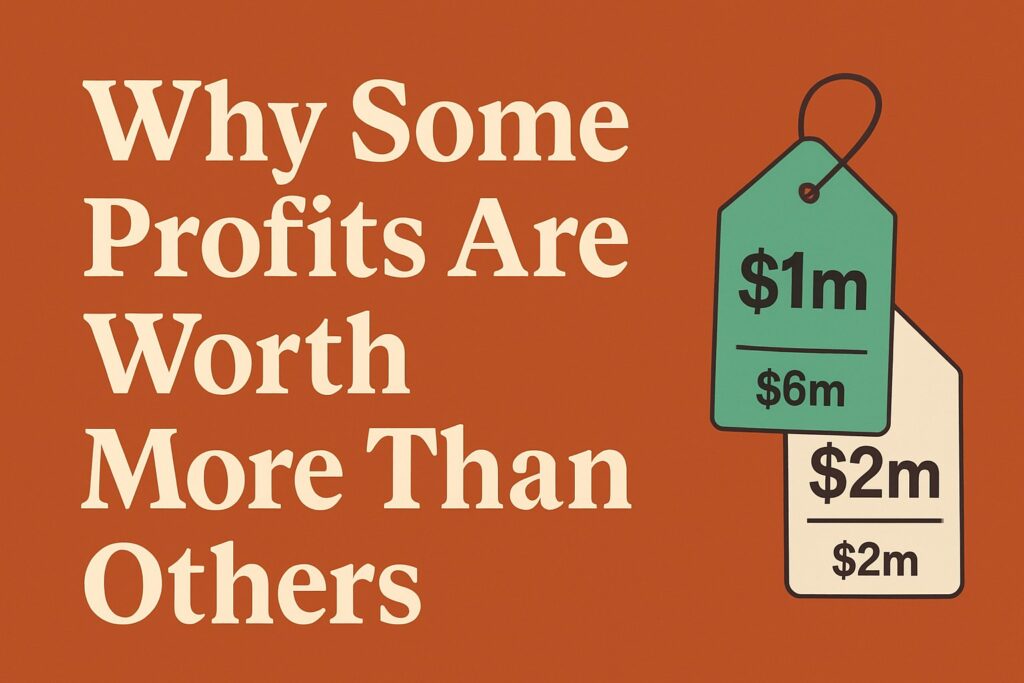
Two companies each show $1 million in profit on their books. One built that profit steadily through dozens of repeat customers. The other struck gold with a single big contract that won’t repeat.
Raffles Corporate Services works with a panel of experienced Singapore law firms who offer cost-effective and efficient legal service and advice. This article is general information only and is not legal advice.
On paper they look the same — but one is far more valuable.
Why? Because some profits are worth a lot more than others.
What “Quality of Profit” Really Means
Profit isn’t just about how much. It’s also about how reliable, repeatable, and sustainable those profits are.
Think of it like personal income:
-
A stable monthly paycheck is high quality – boring, but predictable.
-
Winning the lottery is low quality — exciting, but unpredictable.
Your business works the same way.
Three Dimensions of Profit Quality
Think of these as three simple tests you can apply to your own business. Each one gives you a clearer view of how strong — or fragile — your profits really are.
1. Recurring vs One-off
-
Tuition centre: Students pay term fees → recurring, predictable profit.
-
Freelance trainer: Relies on ad-hoc workshops → one-off profit.
-
Both add to profit, but the tuition centre’s model builds reliability.
👉 Ask yourself: How much of your profit is repeatable versus one-time windfalls?
2. Diversified vs Concentrated
-
Bakery: 200 walk-in customers daily → no single point of failure.
-
Supplier: 70% of revenue from one supermarket chain → risky dependence.
-
Concentration creates fragility. Diversification builds resilience.
👉 Ask yourself: If you lost your biggest customer tomorrow, how much of your profit would disappear?
3. Cash-backed vs Paper-only
-
Retail shop: Collects cash daily → profit shows up in the bank fast.
-
Contractor: Books $200,000 profit, but waits 120 days to get paid.
-
On paper it looks good; in practice it strains cash flow.
👉 Ask yourself: Is my profit consistently turning into cash, or is it stuck in unpaid invoices?
Why It Matters
Profit quality isn’t just a technical idea — it has an emotional weight too. Low-quality profit creates constant stress: sleepless nights, cash flow worries, and the fear of losing a key customer. High-quality profit, on the other hand, gives confidence. It lets owners plan ahead, invest boldly, and run the business with peace of mind.
High-quality profit is more valuable than high-quantity profit — not just in theory, but in very practical ways:
-
Investors and buyers pay more. When due diligence teams review a business, they don’t just look at the size of profit. They discount one-off gains and reward companies with recurring, predictable earnings. A business with $500k of steady, subscription-like profit may be valued higher than another with $1m of lumpy, project-based profit.
-
Banks lend more easily. Lenders worry about repayment risk. Consistent cash flow reassures them that your business can service debt reliably. A clean pattern of receivables turning into cash on time gives you access to bigger facilities at better terms.
-
Owners sleep better. Beyond external stakeholders, high-quality profit gives peace of mind. If you know a base level of revenue and margin will come in month after month, you can plan investments, hire confidently, and weather downturns. Low-quality profit, by contrast, keeps you guessing — and often forces reactive, short-term decisions.
In short: quality doesn’t just make your business look better on paper. It directly impacts valuation, financing options, and your ability to run the company with confidence.
A Mini Case Study
Consider two SMEs, each reporting $1 million profit last year:
-
Company A: $1m profit, 70% from long-term service contracts, spread across 50 clients. Cash is collected within 30 days. With recurring, diversified, and cash-backed earnings, it could be valued at 6x profit — or $6m.
-
Company B: $1m profit, largely from two big one-off projects. Payment terms stretch to 120 days, and cash collection is patchy. With fragile and uncertain earnings, it might fetch only 2x profit — or $2m.
On paper, the bottom line is the same. But in valuation, Company A commands a far higher multiple because its profit is steady and dependable. Company B’s profit, though equal in size, is far less valuable.
This is why quality often outweighs sheer quantity when it comes to profit.
What About Cyclical Businesses?
Take construction as an example. Big building projects come in waves, but a firm can balance them with ongoing maintenance contracts or service agreements. That blend cushions the cycles and gives steadier cash flow.
Not every business can or should look like a SaaS company. Cyclical industries — such as construction, events, or commodities — will always have ups and downs.
The point of the quality test isn’t to turn you into a subscription model. It’s to help you spot where your profits are fragile and where you can build more durability.
Ways to do this include:
-
Securing multi-year or framework contracts instead of one-off jobs.
-
Adding maintenance or service lines alongside big projects.
-
Diversifying clients (government, private, overseas) to spread risk.
-
Building cash reserves in boom years to prepare for lean ones.
👉 The goal isn’t to eliminate cyclicality, but to manage it and make your profits as dependable as your industry allows.
The Takeaway
This week, take one small step: review your top five customers and ask yourself how each contributes to the quality of your profit.
When you review your financials, don’t just ask:
“How much profit did I make?”
Ask instead:
“How much of this profit will I reliably make again next year?”
✅ What % of my profit is recurring?
✅ How dependent am I on my biggest customer?
✅ Is my profit turning into cash quickly?
That’s the real quality test — and it tells you far more about your business than the bottom line alone.
Need help with this?
Raffles Corporate Services can handle the ACRA filings, compliance documentation and records for you, and where court proceedings or legal advice are needed, we work with a panel of experienced Singapore law firms who offer cost-effective and efficient legal service and advice.
Email: [email protected]
Call, SMS or WhatsApp: +65 8501 7133