
Starting a Company
Company Secretary in Singapore (2026): Appointment, Duties & Section 171 Requirements
Every company incorporated in Singapore must have a company secretary. It is not an optional back-office role or a title you hand out for convenience. The company secretary is a statutory officer under the Companies Act 1967, and the law is specific about who can hold...
Private Trust Company (PTC) setup — Eligibility and requirements checklist
Private Trust Company (PTC) setup — Eligibility and requirements checklist. For HNW individuals planning trusts and succession in Singapore. Practical 2…
Resident Director Requirement in Singapore (2026): Section 145 & Your Options
One of the first surprises for a foreign entrepreneur setting up a Singapore company is this: you cannot run the company entirely from overseas on paper. The Companies Act 1967 requires every locally incorporated company to have at least one director who is ordinarily...
Startup SG Founder Grant (2026): Funding, Mentorship & Eligibility
For first-time founders in Singapore, the hardest capital to raise is the very first tranche — the money that turns an idea into a registered company with a working prototype. Startup SG Founder is the government scheme built precisely for that moment. It pairs...
Global Investor Programme Singapore 2026: Requirements, Application Process and Common Mistakes
Singapore's Global Investor Programme (GIP) is the country's premier permanent residence pathway for genuinely wealthy business owners and investors. Unlike the Employment Pass route (which requires you to hold a job in Singapore) or the standard PR route (which...
Complete Guide to Setting Up a Family Office in Singapore 2026: Section 13O vs 13U, MAS Requirements and Costs
Singapore has cemented its position as Asia's leading wealth management hub, with the number of single family offices growing from around 400 in 2020 to more than 2,000 by 2025. If you are a high net worth family considering Singapore as the base for your wealth...
Re-domiciliation of foreign companies into Singapore — Timeline and processing benchmarks
Re-domiciliation of foreign companies into Singapore — Timeline and processing benchmarks. For foreign parent companies entering Singapore. Practical 20…
Singapore representative office — 3-year sunset — Timeline and processing benchmarks
Singapore representative office — 3-year sunset — Timeline and processing benchmarks. For foreign parent companies entering Singapore. Practical 2026 wa…
Singapore branch office of foreign parent — Timeline and processing benchmarks
Singapore branch office of foreign parent — Timeline and processing benchmarks. For foreign parent companies entering Singapore. Practical 2026 walkthro…
Convertible Notes and SAFE Agreements for Singapore Startups (2026): Structures, Companies Act Rules and Tax Treatment
Complete 2026 guide to convertible notes and SAFEs in Singapore — how each works, key Companies Act rules, IRAS tax treatment and common founder pitfalls.
Running a Company

Reconciling Bank Accounts Properly: Why It Matters and How Often to Do It
Learn why reconciling bank accounts matters for Singapore companies, how often to reconcile, step-by-step guidance and practical examples for compliance and control.

Setting Up Bank Feeds and Automation in Your Accounting System Safely
Learn how to set up bank feeds and automation in your accounting system in Singapore securely, while meeting GST, CPF and ACRA compliance requirements.

Cloud Accounting Software for Singapore SMEs: Features to Look For and Pitfalls
Discover how Singapore SMEs can choose cloud accounting software: key features, GST, CPF, ACRA filings, integration and common pitfalls to avoid for compliance.

Accounting for Startups: Burn Rate, Runway and Investor‑Friendly Reporting
Learn how Singapore startups calculate burn rate and runway, prepare investor‑friendly reports, and meet ACRA, IRAS and MOM compliance with practical steps and examples.
MAS AML / CFT for licensed entities — Documents required and templates
MAS AML / CFT for licensed entities — Documents required and templates. For wealth managers and fintechs navigating MAS regulation. Practical 2026 walkt…
MAS technology risk management (TRM) and outsourcing — Documents required and templates
MAS technology risk management (TRM) and outsourcing — Documents required and templates. For wealth managers and fintechs navigating MAS regulation. Pra…

Negative Pledge Clauses in Singapore (2026): Meaning, Breach and How the Courts Enforce Them
Almost every loan agreement and debenture contains a negative pledge, yet it is one of the least understood clauses in commercial lending. A borrower promises not to grant security over its assets to anyone else; a lender relies on that promise to protect its...

Singapore Court Applications to Enforce Security Over Company Assets (2026): A Secured Creditor’s Guide
A lender who takes security over a company’s assets does so for one moment: the moment the company defaults. When that day comes, the question is how to turn the paper security into actual recovery. Sometimes the debenture allows the creditor to act privately; often,...

Enterprise Financing Scheme (EFS) in Singapore 2026: The Loan Facilities, Risk-Share and How SMEs Qualify
When a Singapore SME needs financing, whether to fund day-to-day cash flow, buy equipment, finance a shipment or acquire another company, the Enterprise Financing Scheme (EFS) is usually the first place to look. It is the government’s umbrella loan programme, and its...

Letter of Consent (LOC) in Singapore 2026: How Employers Hire Dependant’s Pass and LTVP Holders
Employers often assume that a spouse or child already living in Singapore on a family pass can simply start work. The rules changed in 2021, and getting this wrong exposes a company to illegal-employment penalties. The Letter of Consent (LOC) is the mechanism that...
Growing a Company
Free Trade Zone (FTZ) usage and customs — Eligibility and requirements checklist
Free Trade Zone (FTZ) usage and customs — Eligibility and requirements checklist. For trading companies setting up Singapore operations. Practical 2026…
Enterprise Sustainability Programme (ESP) Singapore (2026): Grants & Green Capability Support
Sustainability has moved from a nice-to-have to a business requirement for Singapore companies. Large customers, banks and overseas buyers increasingly ask suppliers about their carbon footprint, energy use and sustainability practices. To help smaller firms respond,...
IP Development Incentive (IDI) in Singapore (2026): Concessionary Tax on IP Income
Singapore wants companies not just to own intellectual property, but to develop it here. The Intellectual Property Development Incentive (IDI) is the tax scheme built for that purpose. It gives an approved company a concessionary corporate tax rate of 5% or 10% on...
The M&A Scheme in Singapore (2026): M&A Allowance and Stamp Duty Relief
Growing by acquisition is expensive, and the Singapore tax system offers a targeted incentive to soften the cost: the Mergers and Acquisitions (M&A) Scheme. It gives a qualifying acquiring company an allowance on the value of shares it buys, a double deduction on...
Startup SG Tech (2026): POC & POV Grants for Deep-Tech Startups
For a start-up building genuinely new technology, the hardest money to raise is the earliest money — the funding needed to prove that an idea works before there is a product to sell or a customer to point to. Startup SG Tech is Enterprise Singapore's answer to...
SMEs Go Digital (2026): Grants, Pre-Approved Solutions & How to Apply
Digitalisation is no longer a "nice to have" for Singapore SMEs - it is the difference between winning and losing customers, controlling costs, and keeping up with larger competitors. The problem for most small businesses is not motivation; it is knowing where to...
MAS Licensed Fund Management Company (LFMC) — Eligibility and requirements checklist
MAS Licensed Fund Management Company (LFMC): eligibility, S$250k base capital, A/I vs Retail LFMC, requirements, costs and MAS timeline explained.
MAS Capital Markets Services (CMS) licence — Eligibility and requirements checklist
MAS Capital Markets Services (CMS) licence: eligibility, base capital, SFA 2001 s82 requirement, costs, timeline and the application process explained.

How to Appeal an Employment Pass Rejection in Singapore (2026)
Rejected Employment Pass? Learn how to appeal to MOM in 2026: the 3-month deadline, new evidence, COMPASS fixes, and when it is smarter to reapply.
EDG vs PSG vs MRA 2026: Which Singapore Government Grant Is Right for Your Business?
Singapore SMEs have their pick of government grants. The three most heavily used are the Enterprise Development Grant (EDG) from Enterprise Singapore, the Productivity Solutions Grant (PSG) from Enterprise Singapore, and the Market Readiness Assistance (MRA) grant...
Taxes and GST
GST Transfer of a Going Concern (TOGC) in Singapore (2026): When a Business Sale Escapes GST
When one company buys another company's business — the trade, the equipment, the stock, the customer contracts — the natural assumption is that GST applies to the sale, just as it would on any other supply of goods. For a GST-registered seller, that would mean...
Multi-jurisdiction family office structures — Documents required and templates
Multi-jurisdiction family office structures — Documents required and templates. For HNW families establishing a Singapore family office. Practical 2026…
Family office MAS approval, annual review and audit — Documents required and templates
Family office MAS approval, annual review and audit — Documents required and templates. For HNW families establishing a Singapore family office. Practic…
13O → 13U transition mechanics — Documents required and templates
13O → 13U transition mechanics — Documents required and templates. For HNW families establishing a Singapore family office. Practical 2026 walkthrough c…
Section 13D offshore fund scheme — Documents required and templates
Section 13D offshore fund scheme — Documents required and templates. For HNW families establishing a Singapore family office. Practical 2026 walkthrough…
Section 10L Foreign-Sourced Disposal Gains in Singapore (2026): The Economic Substance Test
For decades, one of Singapore's most attractive features was simple: it did not tax capital gains. A company could sell a foreign asset at a profit, bring the money home, and pay no Singapore tax on the gain. Since 1 January 2024, that is no longer universally true....
Section 13U enhanced-tier fund scheme — Documents required and templates
Section 13U enhanced-tier fund scheme — Documents required and templates. For HNW families establishing a Singapore family office. Practical 2026 walkth…
Section 13O tax incentive scheme — full lifecycle — Documents required and templates
Section 13O tax incentive scheme — full lifecycle — Documents required and templates. For HNW families establishing a Singapore family office. Practical…
Single Family Office (SFO) Singapore setup — Documents required and templates
Single Family Office (SFO) Singapore setup — Documents required and templates. For HNW families establishing a Singapore family office. Practical 2026 w…
Approved Third Party Logistics (3PL) Company Scheme Singapore (2026): GST Suspension for Logistics Hubs
Singapore markets itself as a logistics hub, and a great deal of the cargo that flows through the country never actually belongs to the local company handling it. Third-party logistics operators store, pick, pack, and re-export goods owned by overseas clients. Under...
Bookkeeping

When Should Shipping Costs Be Separated from the Related Product Sale?
In the world of small and medium enterprises (SMEs), efficient book-keeping and accurate accounting are crucial to maintaining financial health and making informed business decisions. One area that often causes confusion is the treatment of shipping costs in relation...

How Should Incentive Payments Be Accounted For?
Incentive payments play a crucial role in motivating employees, driving performance, and achieving business goals. For small business owners in Singapore, understanding how to properly account for these payments is essential to ensure compliance with local regulations...

Can non-refundable upfront fees be recognised in revenue when received?
Under Singapore Financial Reporting Standards (SFRS), specifically SFRS 15 "Revenue from Contracts with Customers," non-refundable upfront fees are generally not recognised as revenue when received. Instead, these fees are considered part of the total transaction...

Under what conditions can customisation or installation services be considered separately from the related product sale?
Under Singapore Financial Reporting Standards (SFRS), specifically SFRS 15 "Revenue from Contracts with Customers," customisation or installation services can be considered separately from the related product sale under the following conditions: Distinct in the...

Can contract acquisition costs be capitalised, or must they be expensed?
Under the Financial Reporting Standards (FRS), particularly FRS 15/ASC 606, contract acquisition costs can be capitalised, rather than expensed immediately, if conditions are met. Capitalisation of Contract Acquisition Costs 1. Incremental Costs of Obtaining a...

All about XBRL Filing in Singapore
Mastering the intricacies of financial reporting, particularly eXtensible Business Reporting Language (XBRL) filing in Singapore, presents a formidable challenge. This blog aims to demystify XBRL filing, offering a comprehensive overview encompassing its significance,...
News
Singapore Budget 2026 Corporate Income Tax Rebate: What Every Business Owner Needs to Know
Singapore’s Budget 2026, delivered in February, introduced a suite of tax measures aimed at supporting businesses in a period of global economic uncertainty. Among the most relevant for company owners is the Corporate Income Tax (CIT) Rebate for the Year of Assessment...
How the April 2026 ACRA Amendments Affect Singapore Directors: New Penalties, Duties, and Compliance Steps
If you are a director of a Singapore company, April 2026 marks a watershed moment. The Corporate and Accounting Laws (Amendment) Act 2025, passed by Parliament on 5 November 2025, introduces some of the most significant changes to Singapore’s corporate governance...
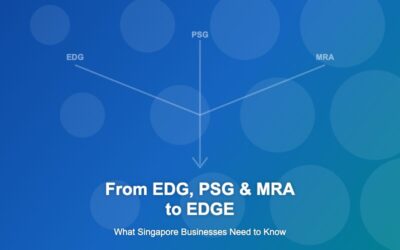
Singapore’s New EDGE Grant Programme: What the Merger of EDG, PSG, and MRA Means for Your Business
Introduction Singapore Budget 2026, delivered in February 2026, introduced one of the most significant restructurings of the Government's enterprise support landscape in years: the consolidation of three flagship grant schemes — the Enterprise Development Grant (EDG),...

Understanding the COMPASS Framework: A Guide to Singapore’s Employment Pass Criteria in 2026
Singapore's Employment Pass (EP) remains the primary work visa for foreign professionals seeking to work in the city-state. However, since the introduction of the Complementarity Assessment (COMPASS) framework in September 2023, employers and EP applicants have had to...
The Corporate and Accounting Laws (Amendment) Act 2025: What Singapore Directors Must Know About the April 2026 Changes
Singapore's corporate regulatory landscape is undergoing one of its most significant overhauls in recent years. On 5 November 2025, Parliament passed the Corporate and Accounting Laws (Amendment) Bill, introducing wide-ranging reforms that reshape how companies...

Singapore’s Corporate Governance Overhaul: Stacked Penalties, Personal Accountability, and What It Means for Companies
A New Era of Accountability in Singapore’s Corporate Landscape Singapore has long prided itself on being one of the world’s most trusted business jurisdictions. On 5 November 2025, Parliament passed major amendments to the Companies Act. This signals a bold shift in...

The $170 Billion Green and Digital Corridor Between China and Singapore: A New Chapter in Sustainable Trade
A Visit Focused on Action, Not Ceremony Chinese Premier Li Qiang’s visit to Singapore, the first in seven years, was rich in symbolism. Yet the meeting’s real purpose lay in execution, not ceremony. Following the 2023 upgrade to an “All-around, High-quality,...

BLOOM Unlocked: Singapore’s Leap to AI-Driven, Compliant Cross-Border Payments
Cross-border payments have long been slow and expensive. Many systems still rely on outdated technology, creating friction for businesses worldwide. On 16 October 2025, the Monetary Authority of Singapore (MAS) announced BLOOM — short for Borderless, Liquid, Open,...

Singapore’s New Banking Lockdown: Navigating the Mandatory 24-Hour Cool-Off Period
The digital speed that makes Singapore's financial sector world-class is getting a mandatory speed bump. Starting October 15, 2025, major retail banks in Singapore, including DBS, OCBC, UOB, and others, will introduce a new, stringent anti-scam safeguard: the...

Understanding Singapore’s Central Registers of Nominee Directors and Nominee Shareholders
For companies operating in Singapore, understanding and complying with the regulations surrounding the Central Registers of Nominee Directors and Nominee Shareholders is crucial. These registers, maintained by the Accounting and Corporate Regulatory Authority (ACRA),...