
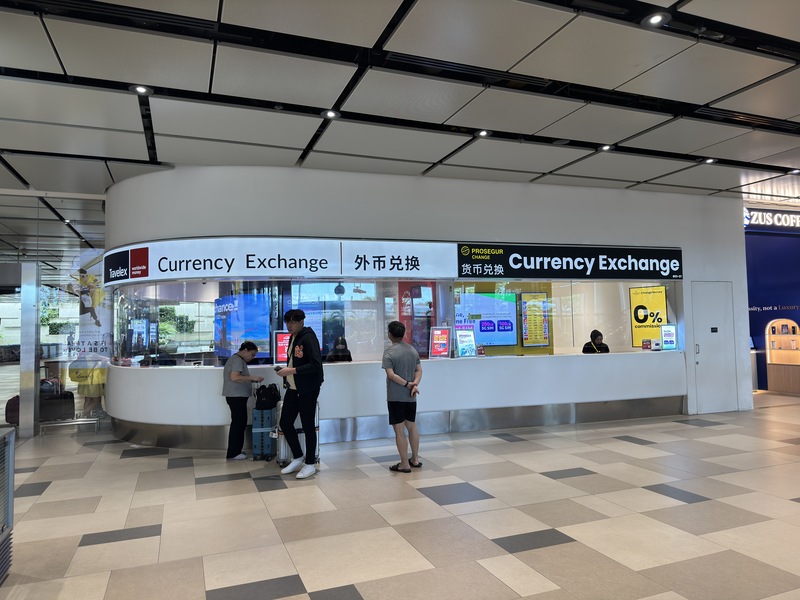
A Singapore trading company that invoices customers in US dollars, pays a supplier in Shenzhen in RMB, and settles a logistics partner in Rotterdam in euros is, in effect, running three currency positions at once through a single SGD current account. Every time money lands or leaves, the bank converts it, and that conversion carries a spread the business absorbs whether it notices or not. Over a year of regular trade, that spread is not a rounding error; it is a real cost sitting quietly on top of the invoice price.
Raffles Corporate Services works with a panel of experienced Singapore law firms who offer cost-effective and efficient legal service and advice. This article is general information only and is not legal advice.
A multi-currency business account lets a company hold and settle balances in the currencies it actually trades in, rather than forcing every receipt and payment through Singapore dollars. For an SME with real overseas exposure, USD/EUR/RMB/GBP receivables and payables, this single change can simplify bookkeeping, reduce avoidable conversion costs, and make foreign exchange (FX) exposure something the finance team manages deliberately rather than something that happens to them at each bank statement.
This guide sets out, for a Singapore Pte Ltd trading overseas in 2026, the practical categories of providers to consider, how account opening and know-your-customer (KYC) checks typically work, how FX gains and losses are treated for accounting and tax purposes, and what to compare across providers before committing.
Why a Multi-Currency Account Benefits an SME Trading Overseas
The core benefit is avoiding forced conversion. Without a multi-currency facility, a USD receipt is converted to SGD on arrival (at whatever spread the bank applies that day), and when the business later needs USD to pay an overseas supplier, it buys USD back, often at a worse rate, incurring the spread twice for what is functionally the same currency need. Holding a USD balance and simply routing incoming USD receivables to outgoing USD payables removes one, and sometimes both, of those conversion events.
The second benefit is matching. A company that has both USD income and USD costs has a natural hedge: it need not convert either leg if the balances broadly offset. This is particularly relevant for import/export traders, regional distributors, and companies in the commodity trading and regional hub space, where a large share of turnover is denominated offshore.
Third, a multi-currency setup simplifies bookkeeping and cash flow visibility. Instead of reconciling a single SGD ledger against multiple conversion entries, the finance team can see each currency’s balance and movements directly, which supports cleaner monthly reporting and better cash flow management across currencies rather than just in aggregate SGD terms.
The Two Broad Categories of Providers in Singapore
A Singapore company generally has two categories to choose from, and increasingly uses a mix of both.
The Three Local Banks
DBS, OCBC and UOB each offer multi-currency or foreign currency (FCY) current accounts to corporate customers, typically covering the major trade currencies (USD, EUR, GBP, AUD, JPY, RMB and others depending on the bank). These accounts sit alongside the company’s SGD operating account, are usually opened as part of a single corporate banking relationship, and integrate with the bank’s trade finance, remittance and cash management services.
MAS-Licensed Non-Bank Payment Institutions
Alongside the banks, Singapore’s Payment Services Act 2019 (PSA) creates a licensing framework for non-bank providers, principally Major Payment Institutions (MPIs) and Standard Payment Institutions (SPIs), authorised by the Monetary Authority of Singapore (MAS) to provide services including account issuance, e-money issuance, and domestic or cross-border money transfers. A number of these licensed institutions offer business customers multi-currency wallets, often with lower transfer fees and faster onboarding than a traditional bank relationship. The regulatory category matters more than any provider’s brand, since it determines how customer funds must be safeguarded (covered below). See our explainer on MAS Payment Services Act licensing for MPIs and SPIs for background on the regime.
Opening an Account as a Singapore Pte Ltd: What the KYC Process Involves
Account opening and KYC for a Singapore private limited company follows a broadly similar pattern whether the provider is a bank or a licensed payment institution, though the depth of checks and documentation can differ.
At a minimum, expect the provider to ask for the company’s ACRA Bizfile business profile extract (confirming incorporation, registered address, directors and shareholders), the company’s register of registrable controllers, which ACRA requires all non-exempt Singapore companies to maintain and lodge, and identification documents for directors, shareholders and any nominee arrangements. Providers will also ask about the purpose of the account, the nature of the business, expected transaction volumes and currencies, and key trading counterparties, since this underpins their anti-money laundering and countering-the-financing-of-terrorism (AML/CFT) risk assessment.
See our notes on corporate secretarial considerations when opening or closing bank accounts and our 2026 guide to opening a Singapore corporate bank account for more on documentation and timelines. New entities and companies with complex ownership chains should expect longer review periods regardless of which category of provider they approach.
Accounting and Tax Treatment of FX Gains and Losses
FRS 21 at a High Level
Under the Singapore Financial Reporting Standard FRS 21 (The Effects of Changes in Foreign Exchange Rates), a company must first determine its functional currency, the currency of the primary economic environment in which it operates, which for most Singapore SMEs is SGD, though a company with predominantly foreign-currency income and costs may have a different functional currency. Foreign currency transactions are initially recorded at the spot rate on the transaction date, and monetary items such as foreign currency bank balances, receivables and payables are retranslated at the closing rate at each reporting date, with the resulting exchange differences generally recognised in profit or loss. Holding balances in a multi-currency account does not remove this retranslation requirement; it simply changes which currencies need tracking.
IRAS Treatment: Realised versus Unrealised
For income tax purposes, IRAS distinguishes between realised and unrealised FX gains or losses. As a general rule, only realised revenue FX differences, where the underlying transaction such as a receipt or payment has actually been completed, are taxable or deductible; unrealised differences from restating an outstanding balance at year end are not, unless the company has made an irrevocable election to be taxed on a “realised and unrealised” basis for all its revenue FX transactions. IRAS also permits a designated foreign currency bank account used mainly for revenue transactions to have its FX differences treated as revenue in nature. Because the correct treatment depends on the facts and any prior elections, businesses should keep a clear tax schedule reconciling FX differences by transaction, and review the position against IRAS’s published e-Tax guide before filing. Our earlier piece on accounting for foreign currency transactions sets out the mechanics in more detail.
Comparing Providers: A Practical Checklist
Headline “no fee” marketing rarely tells the full story. The table below sets out the main variables worth checking before committing to a provider, whether bank or PSA-licensed institution.
| What to check | Why it matters |
|---|---|
| Transaction and monthly account fees | Some providers charge a flat monthly fee per currency wallet; others charge per transaction. Volume and number of currencies used should drive the comparison, not the headline rate alone. |
| FX conversion spread | The spread applied when converting between currencies (or when a payment is received in a currency the company does not hold) is usually the largest hidden cost. Ask for the actual spread over the interbank rate, not just “competitive rates”. |
| Minimum balance or minimum monthly activity | Some accounts require a minimum balance or transaction volume to avoid a fall-below fee; this can matter for a newer SME with irregular flows. |
| Transfer method: SWIFT versus local clearing | A SWIFT transfer typically involves correspondent bank fees and can take one to a few business days; local clearing arrangements (where the provider has a local settlement network in the destination country) can be faster and cheaper for high-frequency payments to the same markets. |
| How funds are protected | Funds held with a bank are covered by Singapore’s Deposit Insurance Scheme up to the prescribed limit per depositor per bank; funds held with a PSA-licensed payment institution are not deposits and are instead protected through safeguarding arrangements (a trust account, bank guarantee, or insurance) required under the Payment Services Act. The practical effect differs, and it is worth understanding which applies before parking significant balances anywhere. |
| Integration and reporting | Whether the account exports clean statements per currency for bookkeeping, and whether it integrates with the company’s accounting software, affects how much manual reconciliation the finance team has to do each month. |
The Deposit Insurance and Policy Owners’ Protection Schemes Act covers Singapore dollar deposits at a full bank up to the prescribed limit per depositor per scheme member; it does not cover money held with an MPI or SPI, which is not a bank deposit. That money is instead safeguarded under the PSA by other prescribed means, such as a trust account, a bank guarantee, or insurance. Both regimes protect customer funds, but differently, so confirm exactly how a non-bank provider safeguards funds before holding meaningful balances with it.
Practical Tips for Choosing
Start from actual currency flows rather than the account with the flashiest app. List the currencies the business genuinely receives and pays in, and roughly what volumes, before comparing fee structures. A company with occasional USD invoices may be better served by its existing bank’s FCY account than by opening a separate wallet purely to chase a marginally better spread.
Treat safeguarding and licensing status as a real due diligence item, not paperwork. Ask a non-bank provider which PSA-permitted safeguarding method it uses, and confirm its licence category and scope on the MAS Financial Institutions Directory, particularly if the business plans to hold larger working balances rather than pass money through quickly.
Finally, keep the accounting and tax angle in view from day one. Decide early whether the company will rely on the default realised-basis tax treatment or elect to include unrealised FX differences, and set up currency-coded ledgers so the FRS 21 retranslation and IRAS reconciliation schedule can be produced without reconstructing a year of transactions after the fact.
Frequently Asked Questions
Can a Singapore Pte Ltd hold multiple foreign currency accounts at once?
Yes. It is common for an actively trading company to hold an SGD operating account plus one or more FCY accounts (for example USD and RMB) at the same bank, and in many cases to also run a separate multi-currency wallet with a PSA-licensed payment institution for specific payment corridors.
Is money in a multi-currency wallet with a fintech as safe as money in a bank?
It is protected differently, not automatically less safely, provided the provider is properly licensed and safeguarding funds as required. Bank deposits benefit from the Deposit Insurance Scheme up to the prescribed limit; PSA-licensed institutions must safeguard customer money through trust arrangements, guarantees or insurance instead. Confirm the provider’s licence and safeguarding method rather than assuming either regime is superior.
Do I need to convert foreign currency income to SGD for tax filing?
Not necessarily as a matter of accounting; the company’s functional currency drives how transactions are recorded under FRS 21. IRAS filings generally need to be presented in Singapore dollars unless the company qualifies to file in a different functional currency under IRAS guidance, so professional advice on the correct approach is worthwhile.
Does holding a multi-currency account remove FX risk entirely?
No. It reduces unnecessary conversion costs and can create a natural hedge when receivables and payables are in the same currency, but any open, unmatched position still moves with the exchange rate. Genuine hedging, using forwards for example, is a separate decision from simply holding a multi-currency account.
What documents should I have ready before applying?
At minimum, the company’s ACRA Bizfile business profile extract, its register of registrable controllers, identification for all directors and shareholders, and a clear description of the business’s purpose for the account, expected currencies and counterparties. Having these ready before the first meeting materially shortens onboarding.
The Editorial Team, Raffles Corporate Services
Need help with this?
Raffles Corporate Services can handle the ACRA filings, compliance documentation and records for you, and where court proceedings or legal advice are needed, we work with a panel of experienced Singapore law firms who offer cost-effective and efficient legal service and advice.
Email: [email protected]
Call, SMS or WhatsApp: +65 8501 7133