
Almost every Singapore trading business that has decided to incorporate should register as a private company limited by shares. If all of its shareholders are individuals and there are twenty or fewer of them, it will also be an exempt private company, which is a status you receive rather than a type you apply for.
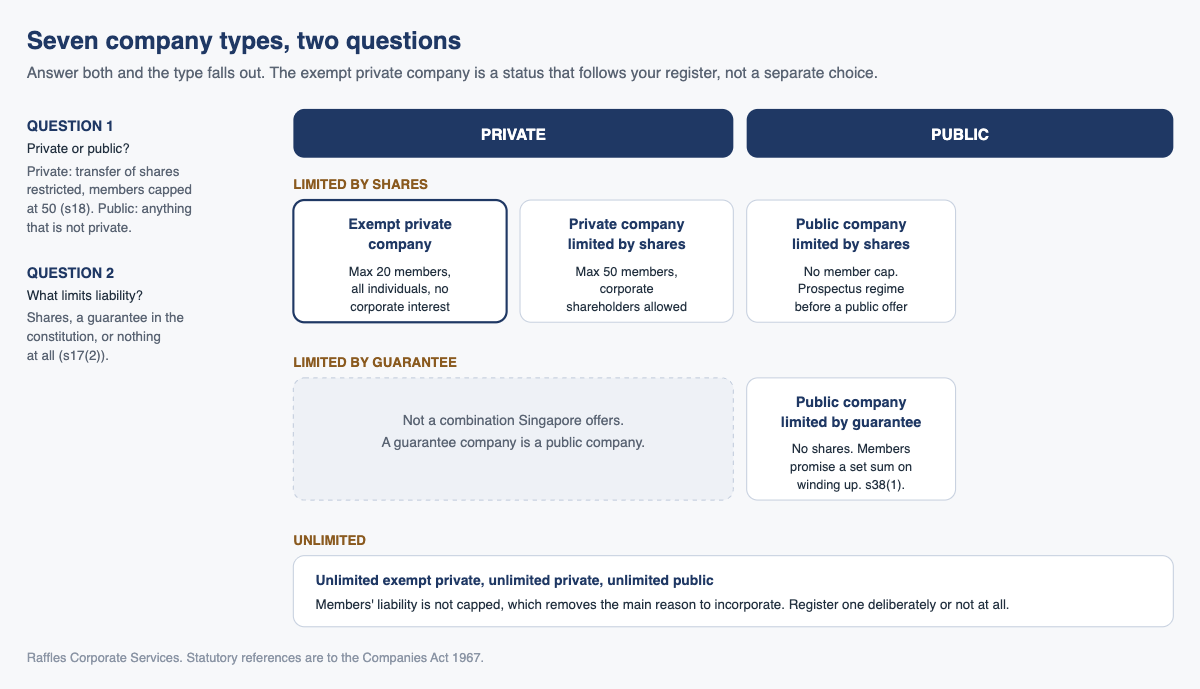
Bizfile offers seven company types at registration, and the list makes the decision look harder than it is. Three are unlimited companies, which almost nobody sensibly chooses. Two are public companies, for businesses that intend to raise money from the public. One is the guarantee company, for organisations not trying to distribute profit at all.
What matters is the two axes the seven types sit on, because the choice determines who can own the business, what you have to publish about it, and how you would ever get investment in.
The two questions underneath all seven
Question one: private or public? A private company, under section 18 of the Companies Act 1967, is one whose constitution restricts the right to transfer its shares and limits its members to not more than fifty. A public company is defined simply as a company that is not a private company. Only a public company can offer shares to the public, which brings in prospectus obligations regulated by the Monetary Authority of Singapore.
Question two: what limits a member’s liability? Section 17(2) gives three answers. A company limited by shares caps each member’s liability at the amount unpaid on their shares. A company limited by guarantee has no shares at all: each member promises, in the constitution, to contribute a set amount if the company is wound up. An unlimited company places no limit on members’ liability, which removes the main reason for incorporating.
Cross the two questions and you get the six main combinations, plus the exempt private company, which is not a separate answer to either but an overlay on the private company limited by shares.
The types, side by side
| Type | Members | Share capital | Who it is actually for |
|---|---|---|---|
| Exempt private company | Up to 20, all individuals, no corporation holding a beneficial interest in its shares | Yes | Owner-managed businesses, founders, family companies |
| Private company limited by shares | Up to 50, individuals or corporations | Yes | Businesses with a corporate shareholder, a holding company, or investors |
| Public company limited by shares | No limit | Yes | Companies raising money from the public, listed or intending to list |
| Public company limited by guarantee | Members, not shareholders | None | Charities, trade associations, professional bodies, non-profits |
| Unlimited private company | Up to 50 | Optional | Rare; specialist structures where unlimited liability is deliberate |
| Unlimited exempt private company | Up to 20 individuals | Optional | Rarer still |
| Unlimited public company | No limit | Optional | Effectively unused by ordinary businesses |
The exempt private company, and why it matters more than it sounds
Section 4(1) defines an exempt private company as a private company in the shares of which no beneficial interest is held directly or indirectly by any corporation, and which has not more than twenty members. Nothing about that requires an application. Register a private company limited by shares with three individual founders and no corporate shareholder, and you are an exempt private company from day one.
Two consequences follow, and both are real money.
A solvent exempt private company does not file its financial statements with ACRA. Every other company type attaches its accounts to the annual return, in XBRL or as a PDF, where they become public. A solvent exempt private company instead declares its solvency and the accounts stay private. For an owner-managed business that does not want its margins visible to competitors, customers and staff, that is the most valuable thing about the status.
Section 162 does not apply to it. Section 162(2) prohibits a company, “other than an exempt private company”, from making a restricted transaction, which includes loans and quasi-loans to its own directors, guarantees given in connection with such loans, and credit transactions for a director’s benefit. In a small company where money sometimes moves between the director and the company before anyone has decided what it is, that exemption removes a category of problem a non-exempt private company has to live with.
You lose the status the moment a corporation acquires a beneficial interest in the shares, or the twenty-first member is entered. Nobody notifies you. You declare the change yourself, in the annual return, in a dropdown.
The private company limited by shares
This is the default for anything with a corporate shareholder: a subsidiary, a joint venture, a company with a holding vehicle above it, or a business that has taken investment from a fund. It carries the same fifty-member cap, the same transfer restriction and the same audit position as the exempt private company, but its accounts are filed publicly with the annual return.
If you are choosing between this and exempt private company status, you are not really choosing at all. The status follows the shareholder register. Bringing in a corporate shareholder is a commercial decision with a filing consequence, not the other way round.
The public company
A public company can have unlimited shareholders and can offer shares to the public, which is the point of it. That comes with a prospectus regime administered by MAS, a heavier governance and disclosure burden, an earlier AGM deadline once listed, and no audit exemption on the small company grounds most private companies rely on.
Very few businesses should register as public from day one. Converting a private company to a public one later is well-trodden. Registering as public before you need to be is a permanent tax on your time.
The company limited by guarantee
A guarantee company has members rather than shareholders and no share capital. Section 38(1) makes void any provision in the constitution, or in any resolution, purporting to give a person a right to participate in the divisible profits of the company otherwise than as a member. That is the structural lock that makes it suitable for charities, industry associations and professional institutes, and unsuitable for anything meant to pay a return to its backers.
It is a public company, so its accounts are public. We cover the setup and governance separately in our guide to the company limited by guarantee in Singapore, and the wider landscape in our note on Singapore charitable structures and donor-advised vehicles.
What the choice actually changes
| What you care about | Exempt private | Private ltd by shares | Public ltd by shares | Limited by guarantee |
|---|---|---|---|---|
| Accounts visible to the public | No, if solvent | Yes | Yes | Yes |
| Corporate shareholders allowed | No | Yes | Yes | Not applicable |
| Member cap | 20 | 50 | None | Set by constitution |
| Can raise money from the public | No | No | Yes, with a prospectus | No |
| Loans to directors under section 162 | Exempt | Restricted | Restricted | Restricted |
| Audit exemption on small company grounds | Usually available | Usually available | No | Usually available |
| Annual return deadline (non-listed) | 7 months after FYE | 7 months after FYE | 7 months after FYE | 7 months after FYE |
Two rows drive the decision for real businesses: whether your accounts are public, and whether a company can hold your shares. Everything else is downstream.
Audit is a separate test, driven by size rather than company type. Most private companies qualify for audit exemption as a small company under section 205C, and that is worth confirming rather than assuming: see our guide to audit exemption for small companies. If you are heading towards a first audit anyway, our note on preparing for a first statutory audit is the practical version.
What goes wrong: drifting out of the type you registered as
Company type is not something you set once and forget. It changes with the register, and the consequences arrive without warning.
Losing exempt private company status quietly. A founder sets up a personal holding company and transfers their shares into it for estate planning. That is a corporation holding a beneficial interest in the shares. The company is no longer an exempt private company, and from that financial year its accounts are filed with the annual return and become public. Nobody connects the two events until the accounts appear on a Business Profile.
Drifting past fifty members. This one is worse. Section 32(2) allows the Registrar, where default has been made in complying with the fifty-member limit that section 18(1)(b) requires in a private company’s constitution, to serve a notice determining that the company ceased to be a private company on a specified date. Section 32(3) then deems the company to be a public company from that date, deems its name to have changed by dropping the word “Private”, and requires it to lodge a statement in lieu of prospectus within fourteen days. Section 32(8) makes the underlying default an offence punishable by a fine not exceeding $5,000 or imprisonment for a term not exceeding 12 months, and section 32(5) prevents a company that became public this way from converting back without the permission of the Court.
That is not theoretical for a company running an employee share scheme or an option pool that has been exercised generously, and a company deemed public also picks up ACRA’s late lodgement penalties on anything it then fails to file on the public company timetable. Count your members, and count the ones who become members if the outstanding options are exercised. Section 18(1)(b) counts joint holders as one person and excludes current and certain former employees, but the exclusions are narrower than most founders assume.
Tidying the register without thinking about status. Nominee arrangements, trust holdings and share transfers all touch the two tests that define exempt private company status. Our note on nominee shareholder arrangements explains why the beneficial owner is the question, not the registered holder.
Each of these is cheap to prevent and expensive to unpick, which is the recurring theme of the Companies Act 1967 deep-dive series.
Frequently asked questions
What is the difference between a Pte Ltd and an exempt private company?
An exempt private company is a private company limited by shares that additionally has twenty or fewer members, all individuals, with no corporation holding a beneficial interest in its shares. Both use “Pte Ltd”. The difference is that a solvent exempt private company does not file its financial statements publicly with its annual return.
Do I apply to become an exempt private company?
No. It is a status that follows from your shareholder register, not an application. You declare it when you file your annual return, and you lose it automatically if a corporation takes an interest in your shares or you exceed twenty members. Nobody tells you when it happens.
Can a company be a shareholder of my Singapore company?
Yes, in a private company limited by shares. But a company holding a beneficial interest in the shares removes exempt private company status, so your accounts become publicly filed. Decide whether that matters before you restructure the holding for other reasons.
Which company type should a charity or non-profit use?
Usually a public company limited by guarantee. It has members rather than shareholders and no share capital, and the Companies Act voids any provision giving a person a right to share in the company’s divisible profits other than as a member. Charity registration with the Commissioner of Charities is a separate step.
How many shareholders can a Singapore private company have?
Not more than fifty, and the constitution must say so. Exceed the cap and the Registrar can determine that the company ceased to be a private company, which makes it public, changes its name, and triggers a statement in lieu of prospectus. Watch unexercised share options as well as issued shares.
Should I register as a public company so I can raise money later?
No. Converting from private to public later is a normal process. Registering as public at the outset means public accounts, no small company audit exemption, and a heavier governance load for years before you need any of it.
Getting the type right, and then keeping it
The type you register is the one that fits your shareholder register on day one. The one that causes problems is the type you drifted into three years later without noticing: an exempt private company that stopped being exempt when a holding company was inserted, or a private company that quietly outgrew fifty members.
Raffles Corporate Services incorporates Singapore companies and maintains the register that determines the status, so a share transfer, a new investor or a holding company restructure is assessed for its filing consequences before it is executed rather than afterwards. If you are not sure what type your company currently is, that is a five-minute check on our side.
You can reach us through Raffles Corporate Services, or read more on Singapore corporate secretarial practice at Singapore Secretary Services.
— The Editorial Team, Raffles Corporate Services