

You declare your financial year end when you register the company, under section 19(1)(b) of the Companies Act 1967, and you can choose any date you like. That one date fixes your annual general meeting deadline, your annual return deadline and the shape of your first tax year, for as long as the company exists.
Raffles Corporate Services works with a panel of experienced Singapore law firms who offer cost-effective and efficient legal service and advice. This article is general information only and is not legal advice.
It is the least discussed field on the incorporation form and one of the most consequential. People pick 31 December because it sounds normal, or leave whatever the form suggested, and discover a year later that their accounts, their audit and their tax return all fall due in the month their business is busiest.
Here is what the date controls, how long your first financial period is allowed to run, and the mistake that quietly costs new companies a year of start-up tax exemption.
What a financial year end actually is
Your financial year end is the last day of your accounting period: the period you report on in your financial statements. Section 4(1) of the Companies Act 1967 defines a company’s financial year as the period in respect of which its financial statements are made up, whether that period is a year or not, and adds that for a company it is also determined in accordance with section 198.
Section 198 does the real work. For a company incorporated on or after 31 August 2018, the first financial year starts on the date of incorporation and ends on the last day of the first financial year as furnished to the Registrar at registration. Every subsequent financial year starts immediately after the previous one ends and runs for 12 months, or such other regular interval as the Registrar may allow.
So the company does not have a financial year until you declare one. You declare it once, in the registration form, and it repeats from then on.
Accounting periods run for 12 months or 52 weeks. The 52-week option produces a year end that moves by a day or two each year and always falls on the same weekday, which suits businesses that report weekly. Everybody else uses 12 months.
How long your first financial period can be
Your first financial period is not automatically 12 months. It runs from the date of incorporation to the year end you declared, which could be four months or seventeen. Section 198(2) sets the hard limit: a company’s first financial year must not be longer than 18 months unless the Registrar, on the company’s application, otherwise approves.
| Incorporated | Declared FYE | First period | Comment |
|---|---|---|---|
| 12 March 2027 | 31 December 2027 | About 9.5 months | Short, clean, one tax year. Common and sensible. |
| 12 March 2027 | 31 March 2028 | About 12.5 months | Over 12 months, so the profit is apportioned across two Years of Assessment. |
| 12 March 2027 | 30 June 2028 | About 15.5 months | Within the 18-month cap, but two Years of Assessment and a long first audit or compilation. |
| 12 March 2027 | 31 December 2028 | About 21.5 months | Over the cap. Needs the Registrar’s approval, and you should expect to be asked why. |
The temptation with a late-in-the-year incorporation is to stretch the first period so that you only prepare one set of accounts. That is a genuine saving on accounting fees. It is also where the tax cost hides.
The start-up exemption trap
IRAS assesses a company on the income of a basis period, and where a company’s first set of accounts covers more than 12 months, the profits are attributed across two Years of Assessment rather than one. See IRAS’s basic guide to corporate income tax for companies.
That matters because start-up tax exemption is available for a qualifying new company’s first three consecutive Years of Assessment. A fifteen-month first period does not give you fifteen months of relief. It uses up two of your three qualifying Years of Assessment on one set of accounts, and if the company was barely trading early on, you have spent a year of exemption on almost nothing. Our overview of tax incentives and exemptions for new startups sets out what it is worth.
For most new companies the better answer is a first period of 12 months or less, even if that means an extra small set of accounts early on.
How the FYE drives your annual deadlines
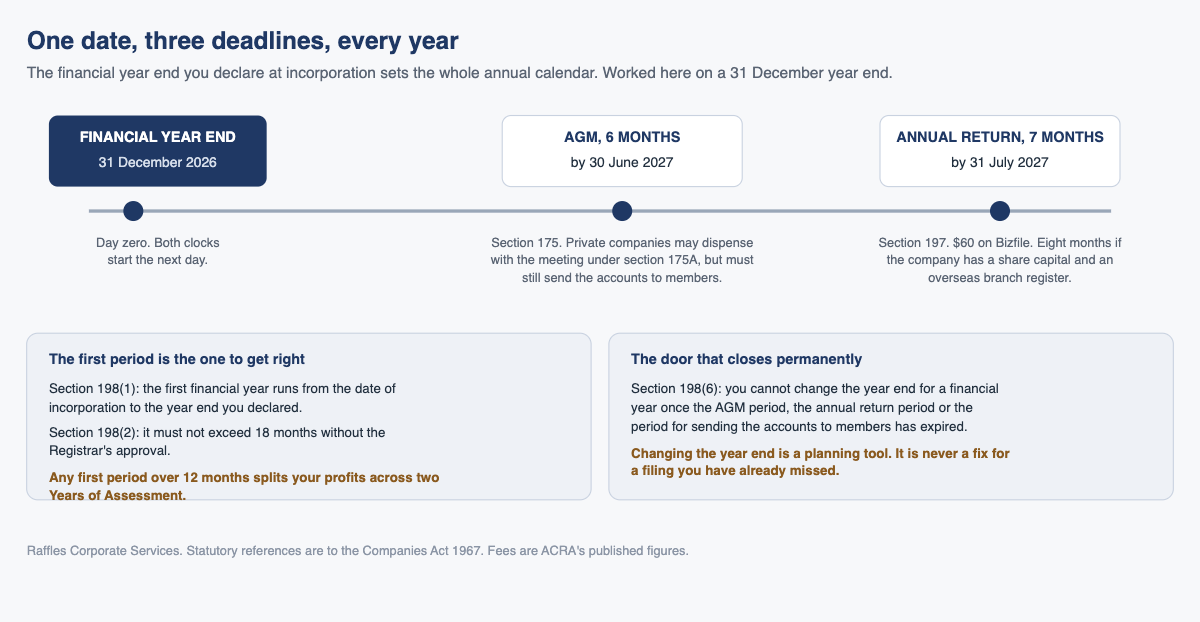
Two statutory clocks run off your financial year end, and both of them start the day after it.
The annual general meeting. Section 175 requires a company to hold an AGM after the end of each financial year, within four months for a listed public company and within six months for any other company. Failure is an offence carrying a fine not exceeding $5,000 and a default penalty, and the Court may order a meeting to be called on a member’s application.
The annual return. Section 197 requires the company to lodge a return with the Registrar after its AGM: within five months of the financial year end for a listed company, and within seven months for any other company. A company with a share capital that keeps a branch register outside Singapore gets an extra month in each case. Failure is an offence carrying a fine not exceeding $10,000 and a default penalty.
The deadlines, worked through
| Financial year end | AGM due (private company) | Annual return due |
|---|---|---|
| 31 December 2026 | 30 June 2027 | 31 July 2027 |
| 31 March 2027 | 30 September 2027 | 31 October 2027 |
| 30 June 2026 | 30 December 2026 | 30 January 2027 |
| 30 September 2026 | 30 March 2027 | 30 April 2027 |
Private companies can often skip the meeting itself. Section 175A allows a private company to dispense with AGMs by a resolution passed by all members voting, and it also removes the AGM requirement for any financial year in which the company has sent the financial statements to everyone entitled to notice of general meetings within the period set out in section 203. That is the route most owner-managed companies take. The annual return still has to be filed, and the form still asks you to declare when the accounts were sent.
The annual return costs $60 on Bizfile. An extension of time is a separate application with its own fee. Late filing attracts ACRA’s late lodgement penalties, which apply per late transaction, so a company that lets two years drift pays twice.
Actually choosing the date
Four considerations, roughly in order of how much they should weigh.
Your own quiet season. The accounts have to be closed, reviewed, possibly audited, laid before members and filed. All of that lands in the six months after your year end. Pick a year end that puts that work into the part of your year when you are least busy, not when you are chasing your biggest quarter.
Your group, if you have one. If your company is a subsidiary, align the year end with the parent. Consolidation across mismatched year ends is expensive, every single year.
Your advisers’ capacity. A very large share of Singapore companies use 31 December, so December year ends compete for the same accountants and auditors in the same months. A 30 June or 30 September year end often gets you better attention and, sometimes, a better fee.
The first period length. As above: keep it to 12 months or less unless you have a positive reason not to.
What should not drive the decision is a vague sense that 31 December is more official. It is not. 31 March, 30 June and 30 September are all common in Singapore.
Changing it later, and why you should not plan to
You can change your financial year end, but section 198 fences it in tightly. A company may by notice lodged with the Registrar specify a new date as the last day of its financial year, but only for its current or previous financial year. The Registrar’s approval is required if the change produces a financial year longer than 18 months, or if the notice is lodged less than five years after the end of an earlier financial year whose end date was itself changed on or after 31 August 2018.
Most importantly, the notice cannot specify a new date once the deadline has passed: not after the section 175 AGM period for that financial year, not after the section 197 annual return period, and not after the section 203 period for sending financial statements to members. You cannot use a year end change to fix a filing you have already missed. That is the most common request we get on this, and the answer is always the same.
The full mechanics, including the interaction with IRAS basis periods, are in our guide to changing your Singapore company’s financial year end.
What goes wrong: the year end nobody chose
The failure mode is not usually a bad choice. It is the absence of a choice.
A director keys a date into the incorporation form without thinking, because the form asks and they want to finish. Eighteen months later the company gets an ACRA reminder about an annual return it did not know was due, because the year end fell in a month nobody associated with anything. The accounts are not ready, the AGM period has run, the annual return period has run, and it is too late to move the year end to something more convenient because section 198(6) has already closed that door.
The consequences stack. Late lodgement penalties apply per late transaction. Persistent default in delivering documents to the Registrar carries consequences for directors personally under section 155. And a company with overdue annual returns on its Business Profile will be asked about it by every bank, landlord and acquirer who looks. Our note on company reinstatement and restoring statutory records covers what happens when this is left long enough to become serious.
The fix is one calendar entry made on the day you incorporate: your year end, plus six months, plus seven months. Three dates, in the diary, before you do anything else with the company.
Frequently asked questions
Can I choose any date as my financial year end?
Yes. ACRA does not restrict the date. Common choices are 31 March, 30 June, 30 September and 31 December, but any date is valid. You declare it when you incorporate, and it then repeats every 12 months unless you formally change it.
How long can my company’s first financial year be?
Up to 18 months, under section 198(2) of the Companies Act 1967, unless the Registrar approves a longer period on application. But any first period longer than 12 months means your profits are split across two Years of Assessment, which consumes two of your three years of start-up tax exemption.
When is my AGM due?
Within six months after the end of the financial year for a private company, and within four months for a listed public company. Many private companies dispense with the AGM entirely by resolution, or by sending the financial statements to members within the statutory period. The annual return is still required either way.
When is my annual return due?
Within seven months after the financial year end for a non-listed company, and within five months for a listed one. A company with a share capital that keeps a branch register outside Singapore has an extra month in each case. The filing fee is $60 and late filing attracts penalties per transaction.
Can I change my financial year end after I have missed a deadline?
No. Section 198(6) prevents a change once the AGM period, the annual return period or the period for sending financial statements to members has expired for that financial year. Changing the year end is a planning tool, not a remedy for a late filing.
Does my financial year end affect my tax filing?
Yes. IRAS assesses your company on the basis period ending in the relevant Year of Assessment, which normally means your accounting period. Changing the year end, or running a long first period, changes which Year of Assessment your profits fall into and can affect the exemptions you qualify for.
Choosing it once, properly
A financial year end is a thirty-second decision with a ten-year consequence. It sets when your accounts are due, when your AGM falls, when your annual return is filed, and how your first tax year is shaped. Getting it wrong is not catastrophic, but correcting it is hemmed in by five-year waiting periods and deadlines that close permanently.
Raffles Corporate Services treats the year end as a deliberate decision at incorporation, weighing the group structure, the first period length and the start-up exemption, then runs the resulting calendar so the AGM, the annual return and the tax filing arrive in an order that makes sense. If your current year end was never really chosen, it is worth a conversation before the next deadline closes the option.
You can reach us through Raffles Corporate Services, or read more on Singapore corporate secretarial practice at Singapore Secretary Services.
— The Editorial Team, Raffles Corporate Services
Need help with corporate secretarial or compliance matters?
If you would like help with your company's corporate secretarial, governance or compliance requirements, email [email protected] or WhatsApp +65 8501 7133.
Our team can assist with corporate secretarial, accounting and tax matters. Where legal advice is needed, advisers from our associated law firms can assist.