
Every Singapore company must appoint at least one company secretary, and the office must not be left vacant for more than six months at any one time. The secretary must be a natural person whose principal or only place of residence is Singapore. If you are the company’s sole director, you cannot do it yourself.
That last sentence is where most one-person companies come unstuck. Founders comfortable being the only director assume the secretary role is a formality they can absorb. Section 171 of the Companies Act 1967 says otherwise, and the bar is absolute rather than a matter of degree.
Here is what the six months really means, who qualifies, what the secretary is for, and what an empty chair costs.
What the six-month rule actually says
The commonly repeated version is that you must appoint a secretary within six months of incorporation. That is a fair working translation, but the statutory rule is broader.
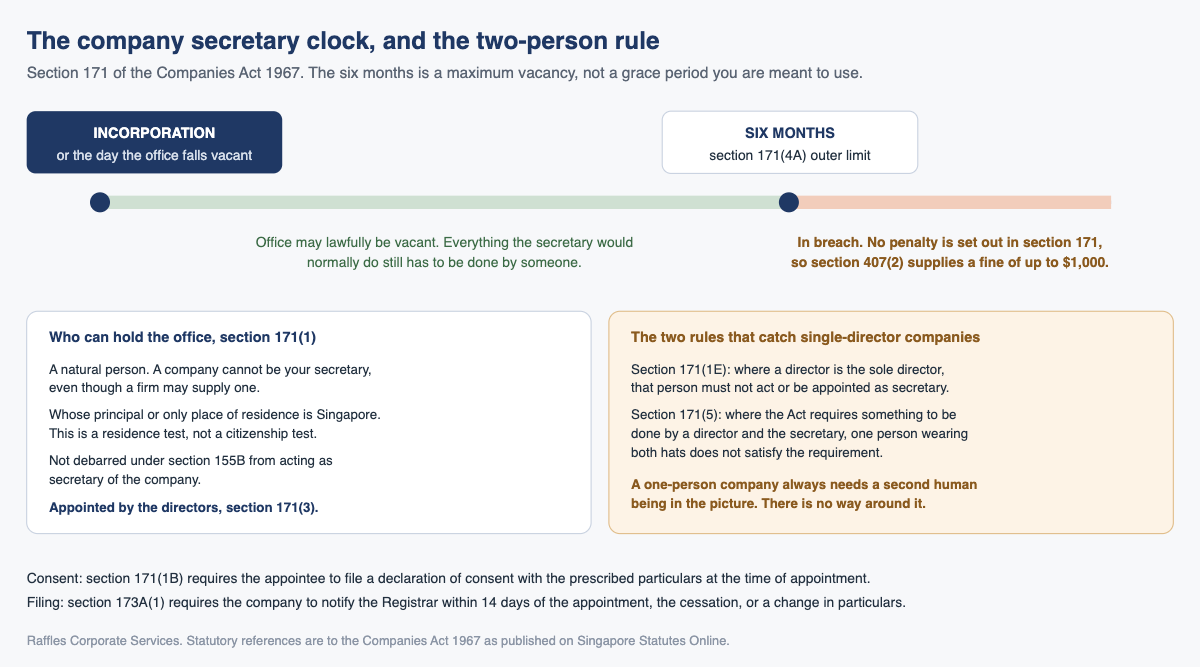
Section 171(4A) provides that the office of secretary must not be left vacant for more than six months at any one time. It applies to every vacancy, not just the first. A company that loses its secretary in year seven is on exactly the same clock as one just registered.
Section 171(4) softens the effect: where the office is vacant, or the secretary is incapable of acting, anything required to be done by or in relation to the secretary may be done by an assistant or deputy secretary, or failing that by any officer the directors authorise. That keeps the machinery working. It does not stop the clock, and it does not cover the things the Act insists a director and the secretary do separately.
Treating six months as a grace period is a mistake anyway. The filings that fall due in a company’s first year do not wait for month seven.
Who is qualified to be a company secretary
Section 171(1) sets three conditions for every company. The secretary must:
- Be a natural person. A corporate services firm cannot itself be your secretary. The firm supplies a named individual, who holds the office and carries the consequences.
- Have his or her principal or only place of residence in Singapore. Note the wording. This is a residence test, not a citizenship or work pass test, and it is drafted differently from the “ordinarily resident” test applied to directors under section 145.
- Not be debarred under section 155B from acting as secretary. Debarment orders are made by the Registrar against officers of companies in unrectified default, and they follow the person to their other appointments.
Beyond that, private companies and public companies are treated very differently.
| Private company | Public company | |
|---|---|---|
| Must be a natural person resident in Singapore | Yes | Yes |
| Formal qualification required by statute | No | Yes, under section 171(1AA) |
| Directors’ duty on competence | Section 171(1A): take all reasonable steps to secure that the secretary appears to have the requisite knowledge and experience | Same duty, plus the prescribed qualification requirement |
| Registrar can force an upgrade | Yes, under section 171(1AB), where the company has failed to keep a register or record properly | Not applicable, the standard already applies |
| Who appoints | The directors, under section 171(3) | The directors, under section 171(3) |
The private company position is widely misread as “anyone will do”. Section 171(1A) places a duty on the directors to take all reasonable steps to secure that each secretary appears to them to have the requisite knowledge and experience to discharge the functions of the office. That is a director-level obligation, and appointing an unqualified friend to fill a box is a breach of it rather than a clever saving.
Section 171(1AB) is the enforcement mechanism. Where the Registrar is satisfied that a private company has failed to comply with the Act in keeping any register or record, the Registrar may require it to appoint a person meeting the public company qualification standard. Appoint someone cheap, let the registers fall apart, and ACRA can compel you to appoint someone properly qualified instead.
The rule that catches single-director companies
Section 171(1E) states it plainly: where a director is the sole director of a company, he or she must not act or be appointed as the secretary of the company.
There is no exemption, no de minimis and no waiver. A single-director company must find a second human being: appoint a second director so that nobody is the sole director, appoint a resident individual as secretary, or engage a corporate services provider who will name one of its people.
Section 171(5) closes the obvious workaround. Where the Act requires a thing to be done by or in relation to a director and the secretary, that is not satisfied by the same person doing it in both capacities. Even in a two-director company, if one of them is also the secretary, that person cannot single-handedly execute a document the Act says needs both roles.
The appointment mechanics
The sequence is short, and each step has a deadline attached.
- The directors appoint. Section 171(3) gives the appointment power to the directors, not the shareholders. It is a board resolution, minuted, not an item for the annual general meeting.
- The appointee files a consent declaration. Section 171(1B) requires the person appointed to file with the Registrar, at the time of appointment, a declaration in the prescribed form that he or she consents to act as secretary, together with the prescribed particulars, either personally or through a registered qualified individual they authorise.
- The company notifies ACRA within 14 days. Section 173A(1) requires notice to the Registrar within 14 days after a person becomes a secretary, and within 14 days of any change in the appointment or in the particulars on the register. Section 173(6) sets out those particulars: full name, residential address, contact address, identification, and the dates of appointment and cessation.
Missing the window attracts ACRA’s late lodgement penalties, charged per transaction rather than per company.
One more piece of housekeeping. Section 171(3) contemplates a secretary being present at the registered office during public access hours, but section 171(3A) relieves a private company of physical presence provided the secretary, or an agent or clerk, is readily contactable by a person at the registered office by telephone or other instantaneous means during those hours.
What the company secretary actually does
The statutory duty list is thinner than the working one. In practice the office is where a Singapore company’s compliance calendar lives, and the work falls into four groups.
The registers. Officers, controllers, members and charges all have to be recorded accurately and kept current. Under section 173 the Registrar keeps the electronic register of directors, chief executive officers, secretaries and auditors, and the company feeds it. The register of registrable controllers, and the nominee director and nominee shareholder registers, sit alongside it with their own obligations. Our note on nominee shareholder arrangements explains why the beneficial owner, not the registered holder, is the question these registers ask.
The annual calendar. Financial year end, accounts sent to members, annual general meeting or the written resolution that replaces it, and the annual return. Each runs off the financial year end, and each has a penalty for being late. Our guide to changing a company’s financial year end sets out how that one date drives everything else.
The paper trail. Board and members’ resolutions, minute books, share certificates, transfers, allotments and the constitution. This looks like administration until a bank, an acquirer or a court asks for it. Our piece on restoring statutory registers and records covers what it costs to rebuild.
Telling the directors what is coming. Deadlines, rule changes, and the consequences of a proposed transaction before it is executed rather than after. In a small company the secretary is usually the only person whose job it is to say “that will trigger a filing”.
Where that remit ends and legal advice begins is its own question: see the CSP and counsel handoff. Corporate services providers also carry their own regulatory obligations now, set out in our Corporate Service Providers Act 2024 compliance FAQ.
What goes wrong: the cost of an empty chair
The direct penalty is small and the indirect cost is not. That asymmetry is exactly why the vacancy persists.
The fine itself. Section 171 attaches no penalty to the six-month rule, so section 407(2) fills the gap: a person guilty of an offence under the Act for which no penalty is expressly mentioned is liable on conviction to a fine not exceeding $1,000. A thousand dollars is not what should worry you.
The cascade is what costs money. With nobody holding the office, the annual return is filed late or not at all and picks up late lodgement penalties per transaction. The registers drift out of step with what the company has actually done, so a share transfer or a director change from eighteen months ago was never lodged. The Registrar notices the pattern. And under section 155B, once a filing default has run three continuous months, the Registrar can make a debarment order against a director or secretary, after 14 days’ notice and an opportunity to show cause. A debarred person cannot take up a new directorship or secretaryship anywhere until the order is lifted.
The forced upgrade. Section 171(1AB) lets the Registrar require a private company that has failed on its registers to appoint a secretary meeting the public company qualification standard. The company that tried to save a few hundred dollars a year ends up with a mandated appointment and a remediation exercise.
Transactions stop. Banks, investors, acquirers and grant bodies all ask for the same three things: a current business profile, clean registers, and the resolutions that support them. A company with no secretary usually cannot produce the third, and reconstructing two years of board minutes under deal pressure is the most expensive way to buy them.
The pattern is familiar from the rest of the Companies Act 1967 deep-dive series: cheap to maintain, expensive to reconstruct. The secretary is one of three appointments to settle at incorporation, alongside appointing company directors and appointing your first auditor.
Frequently asked questions
When must a new Singapore company appoint its company secretary?
The office must not be left vacant for more than six months at any one time, so a new company has up to six months from registration. The rule applies to every later vacancy too. In practice you should appoint at incorporation, because filings fall due well before month six.
Can I be my own company secretary?
Only if you are not the sole director. Section 171(1E) prohibits a sole director from acting or being appointed as the company’s secretary. If you have a co-director, one of you may hold the office, but section 171(5) then prevents that one person from satisfying any requirement that a thing be done by both a director and the secretary.
Does the company secretary have to be a Singapore citizen?
No. The statutory test is that the secretary is a natural person whose principal or only place of residence is Singapore. Citizenship and permanent residence are not required. The test is about where the person actually lives, and it is drafted differently from the ordinarily resident test applied to the resident director.
What happens if we leave the secretary’s position empty?
Beyond a fine of up to $1,000 under the Act’s general penalty provision, the real cost is the cascade: late annual returns with per-transaction penalties, registers that no longer match reality, a possible debarment order against a director or secretary once a default has run three months, and the Registrar’s power to force a qualified appointment.
Do we have to file anything when the secretary changes?
Yes. The incoming secretary files a consent declaration with the Registrar at the time of appointment, and the company must notify ACRA of the appointment, the cessation and any change in the recorded particulars within 14 days of each event. Late filings attract ACRA’s late lodgement penalties, charged per transaction.
The quiet appointment that keeps the rest working
Nobody starts a business because they wanted a company secretary. The role only becomes visible once it has been absent for a while, and by then the problem is never one missing filing. It is a register that has not matched reality for two years and a set of resolutions nobody wrote down.
Raffles Corporate Services acts as named company secretary for Singapore companies, maintains the statutory registers, files officer and shareholder changes inside the 14-day window, and runs the annual calendar off your financial year end so deadlines arrive as reminders rather than penalties. If your company is inside its first six months, or has been running without a secretary for longer than it should, that is a straightforward fix.
You can reach us through Raffles Corporate Services, or read more on Singapore corporate secretarial practice at Singapore Secretary Services.
— The Editorial Team, Raffles Corporate Services