

Every Singapore company must have at least one director who is a natural person, at least 18 years old, of full legal capacity, and ordinarily resident in Singapore. That person must file a declaration of consent before the appointment can be recorded, and the company must notify ACRA within 14 days.
Raffles Corporate Services works with a panel of experienced Singapore law firms who offer cost-effective and efficient legal service and advice. This article is general information only and is not legal advice.
Most founders tick that box at incorporation and never think about it again. The requirement is not a one-off gate. Section 145 of the Companies Act 1967 requires the company to hold the line continuously, and the consequences of failing it reach past the company and land on the people who own it.
Here is who qualifies, what disqualifies them, what gets filed, and the failure mode that turns a staffing problem into personal liability.
What the law actually requires of a director
Two subsections do almost all the work.
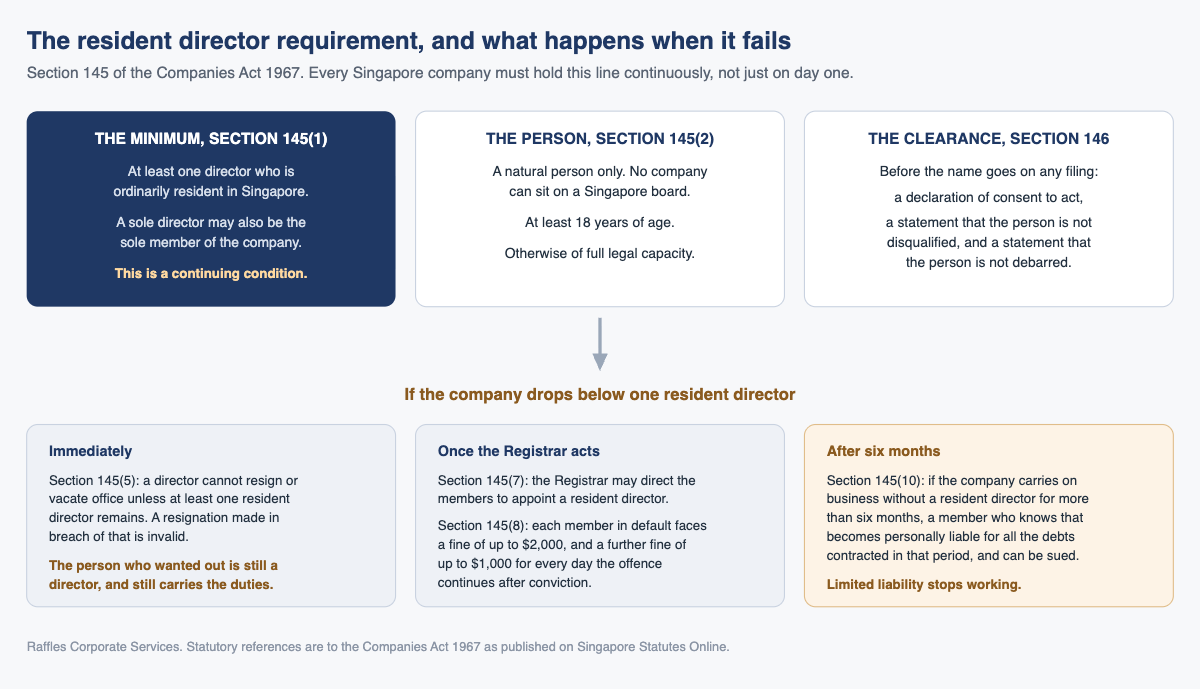
Section 145(1) requires every company to have at least one director who is ordinarily resident in Singapore. It also confirms that where a company has only one member, that sole director may also be the sole member. A one-person company is perfectly lawful.
Section 145(2) says that no person other than a natural person who has attained the age of 18 years, and who is otherwise of full legal capacity, may be a director. Three consequences follow, and the first surprises people who have incorporated elsewhere:
- A company cannot be a director of a Singapore company. If your group structure assumes a corporate directorship, it does not work here. You appoint a named individual instead.
- Eighteen is the floor. There is no upper age limit for a private company.
- Full legal capacity bites far more often at the end of a long directorship than at the start. A person who lacks the mental capacity to make decisions cannot validly hold the office.
Beyond the first one there is no residency requirement at all. Appoint as many non-resident directors as you like, provided one ordinarily resident director is there throughout.
What “ordinarily resident in Singapore” means in practice
The Act does not define it exhaustively, and ACRA applies a practical test. Its published requirements and eligibility guidance treats local residency as met by a Singapore citizen, a Singapore permanent resident, or a valid holder of an Employment Pass, a Personalised Employment Pass or an Overseas Networks and Expertise Pass.
| Status | Can act as the resident director? | The thing people miss |
|---|---|---|
| Singapore citizen | Yes | Nothing. This is the clean case. |
| Singapore permanent resident | Yes | PR status must be current, not merely applied for. |
| Employment Pass holder | Yes, subject to MOM | An EP holder taking a directorship outside the sponsoring employer needs a Letter of Consent from MOM first. |
| Personalised Employment Pass holder | Yes, subject to MOM | PEP conditions are stricter than most holders assume. Check before accepting. |
| Overseas Networks and Expertise Pass holder | Yes, subject to MOM | Confirm with MOM for the specific pass conditions. |
| Dependant’s Pass holder | Not by itself | A Letter of Consent is a separate application with its own outcome. |
| Someone who merely lives here on a long-term visit pass | No | Physical presence is not the test. The pass is. |
The recurring error is treating an immigration status as self-executing. A Foreign Identification Number holder should confirm with the pass issuer before accepting a directorship: taking one without clearance is a work-pass problem as well as a companies problem, and the two regulators do not fix each other’s consequences.
The bars: who cannot be a director even if they want to be
Consent and residency are not enough. The Act disqualifies people outright in several situations, and a disqualified person who acts anyway commits an offence personally.
| Ground | Provision | Length | Penalty for acting anyway |
|---|---|---|---|
| Undischarged bankrupt | Section 148(1) | While undischarged, unless the Court or the Official Assignee permits | Fine up to $10,000, or up to 2 years’ imprisonment, or both |
| Conviction of an offence involving fraud or dishonesty punishable with 3 months’ imprisonment or more | Section 154(1) | 5 years from conviction, or 5 years from release if imprisoned | Fine up to $10,000, or up to 2 years’ imprisonment, or both |
| Court disqualification order after conviction of an offence connected with forming or managing a corporation | Section 154(2) | As ordered by the court | Fine up to $10,000, or up to 2 years’ imprisonment, or both |
| Persistent default in filing with the Registrar | Section 155 | 5 years, triggered by 3 or more relevant convictions or orders in 5 years | Fine up to $10,000, or up to 2 years’ imprisonment, or both |
| Having been a director of 3 or more companies struck off within a 5-year period | Section 155A | 3 years, or 5 years if previously disqualified under that section | Fine up to $10,000, or up to 2 years’ imprisonment, or both |
| Debarment by the Registrar for a company’s unrectified default | Section 155B | Until the Registrar cancels or suspends the order | Fine up to $10,000 on conviction |
Two of these catch ordinary, non-fraudulent people.
Section 155A quietly accumulates, and it is not about wrongdoing. It is about having been a director of three or more companies that ACRA struck off within a five-year window. Anyone who lends their name to dormant vehicles or projects allowed to lapse rather than closed properly can cross that threshold without noticing. If you are asked to be a director of a company nobody intends to maintain, that is the risk you are taking.
Section 155B is a debarment order, which the Registrar can make against a director or secretary of a company in default of a filing requirement, once the default has run three continuous months and after 14 days’ notice with an opportunity to show cause. A debarred person cannot take up a directorship anywhere new until the order is cancelled or suspended. It is administrative, it is fast, and it is why a chronically late annual return is not just a fee problem.
Consent to act, and what actually gets filed
You cannot simply agree to be a director over a call. Section 146 requires that, before a person is named as a director in the incorporation documents or entered in the register of directors, chief executive officers and secretaries, that person must have filed with the Registrar:
- A declaration that he or she has consented to act as a director.
- A statement, in the prescribed form, that he or she is not disqualified from acting as a director under the Act.
- A statement, in the prescribed form, that he or she is not debarred under section 155B from acting as director of the company.
The filing can be made by the person or through a registered qualified individual they authorise, in practice usually the corporate services provider handling the incorporation.
Once appointed, the reporting duty shifts to the company. Section 173 requires the Registrar to keep a register of directors recording each director’s full name and former names, residential address, contact address, nationality, identification, and dates of appointment and cessation. Section 173A requires the company to notify the Registrar within 14 days of a person becoming a director, of any change in the appointment or in those particulars, and of the company becoming aware that a director has ceased to be qualified.
Fourteen days runs from the event, not from the board meeting at which someone gets round to documenting it. Late filings attract ACRA’s late lodgement penalties, charged per transaction.
What goes wrong: the resident director leaves
This is the most expensive failure in this area, and it almost never happens deliberately. A foreign-owned company appoints one Singapore-based director. The relationship ends, or the pass is not renewed, or the person stops replying. The company keeps trading. Nobody files anything.
The Act deals with it in a sequence, and each step is worse than the last.
The resignation may not work at all. Section 145(5) says that despite anything in the Act, the constitution, or any agreement with the company, a director must not resign or vacate office unless at least one ordinarily resident director remains, and a purported resignation in breach of that is invalid. The departing director is still on the register and still carrying the section 157 duties. Resigning from a company you no longer control, with no replacement lined up, is not an exit.
The Registrar can compel an appointment. Under section 145(7) the Registrar may, of his or her own motion or on anyone’s application, direct the members to appoint a resident director. Section 145(8) makes each member in default liable to a fine of up to $2,000, plus a further fine of up to $1,000 for every day the offence continues after conviction. Section 145(9) lets the Court order the appointment if the direction is ignored.
Limited liability stops working. Section 145(10) is the provision that should focus the mind. If a company carries on business without at least one ordinarily resident director for more than six months, a member who knows it is doing so becomes liable for the payment of all the debts of the company contracted during that period, and may be sued for them.
That is the whole point of incorporating, undone by a vacancy nobody dealt with, and it lands on the shareholder rather than the absent director. A holding company that leaves a Singapore subsidiary without a resident director and lets it keep trading is exposing itself.
The fix is unglamorous: line up a replacement before the incumbent leaves, file the appointment and the cessation in the same fortnight, and never sit at exactly one resident director without a contingency. Where a genuine nominee arrangement is the answer, read our guide to the nominee director in Singapore first, and note what the courts now do about nominees who treat the role as passive, in our analysis of Public Prosecutor v Zheng Jia.
The duties that come with the seat
Appointment is the easy part. Section 157(1) requires a director to act honestly at all times and to use reasonable diligence in discharging the duties of the office. Section 157(2) prohibits an officer or agent from making improper use of the position, or of information acquired through it, to gain an advantage or cause the company detriment. A breach makes the officer liable to the company for profits made or damage suffered, and is an offence in its own right.
There is no such thing as a director who is not responsible, and a person never formally appointed can still be treated as one: see our note on shadow directors in Singapore. Directors also carry a standing duty to disclose interests in transactions, covered in our guide to section 156 disclosure, and their protection from personal exposure is narrower than most assume, as we set out in directors’ indemnity and section 172.
Directors are one of three appointments to get right at incorporation, alongside appointing a company secretary and appointing your first auditor.
Frequently asked questions
How many directors does a Singapore company need?
One is enough, provided that person is a natural person aged 18 or over, of full legal capacity, and ordinarily resident in Singapore. Where the company has a single member, that sole director may also be the sole shareholder. There is no maximum, and additional directors need not be resident here.
Can a foreigner be a director of a Singapore company?
Yes. A non-resident foreigner can be an additional director without any pass. What a foreigner cannot be is the company’s only director, unless he or she is a permanent resident or holds a qualifying work pass. Employment Pass holders generally need a Letter of Consent from MOM before taking a directorship outside their sponsoring employer.
Can a company be a director of another company?
No. Section 145(2) of the Companies Act 1967 permits only a natural person to be a director. If your group wants board representation, you appoint a named individual who reports back, not the parent itself. That individual owes duties to the Singapore company, not to whoever nominated them.
How long do I have to tell ACRA about a new director?
Fourteen days from the appointment. The same 14-day window applies to a director’s cessation, to any change in the particulars on the register, and to the company becoming aware that a director has ceased to be qualified. Late filings attract ACRA’s late lodgement penalties, charged per transaction.
What happens if our only Singapore-resident director resigns?
The resignation is invalid if it would leave the company without a resident director, so that person remains a director with full duties. The Registrar can direct the members to appoint a replacement, and fine members who ignore it. After six months of trading without a resident director, a member who knows becomes personally liable for the company’s debts contracted in that period.
Getting the board right, and keeping it right
Almost nobody gets the first appointment wrong. What goes wrong is the second year: a pass expires, a founder relocates, a nominee arrangement lapses, and the register stops matching reality while the company carries on trading.
Raffles Corporate Services handles director appointments, cessations and consent filings, watches the resident director position rather than assuming it, and files inside the 14-day window instead of discovering the gap at year end. If your company sits on exactly one resident director with no contingency, that is a short conversation now rather than an expensive one later.
You can reach us through Raffles Corporate Services, or read more on Singapore corporate secretarial practice at Singapore Secretary Services.
— The Editorial Team, Raffles Corporate Services
Need help with corporate secretarial or compliance matters?
If you would like help with your company's corporate secretarial, governance or compliance requirements, email [email protected] or WhatsApp +65 8501 7133.
Our team can assist with corporate secretarial, accounting and tax matters. Where legal advice is needed, advisers from our associated law firms can assist.