
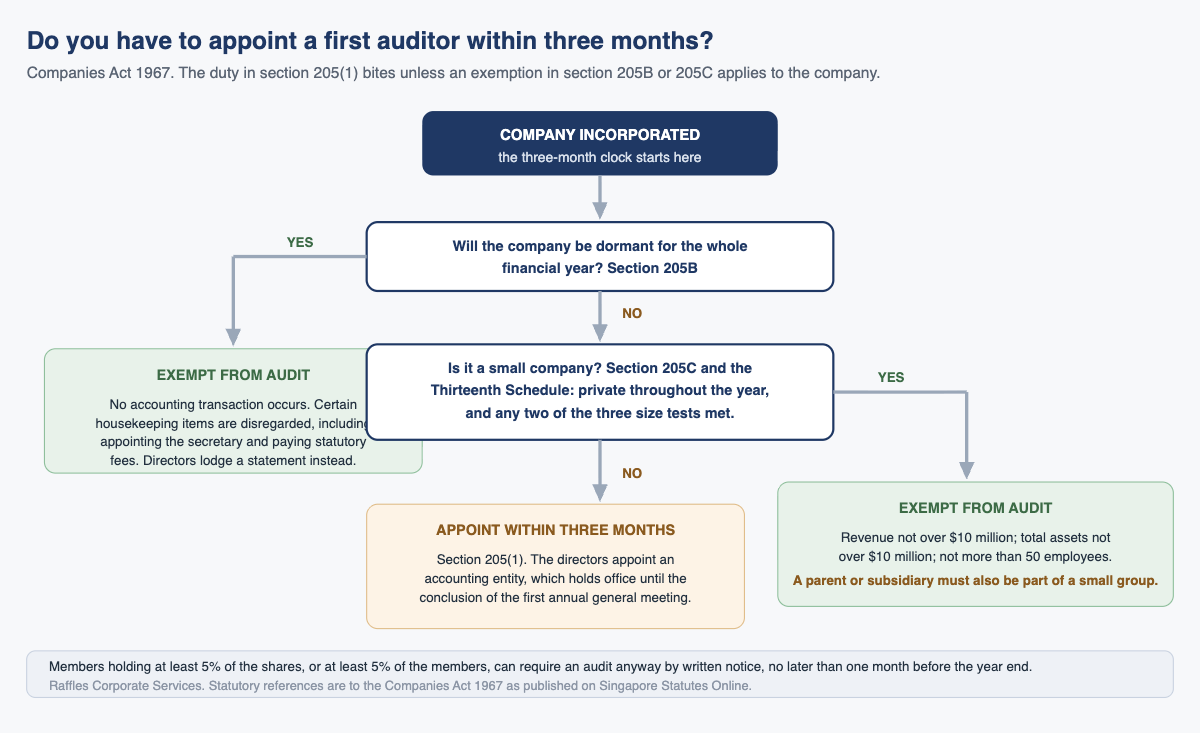
The directors of a Singapore company must appoint an auditor within three months after incorporation, unless the company is exempt from audit. Most new private companies are exempt, either as a small company or because they are dormant, which is why the rule catches out the minority who are not.
The exemption is worth understanding rather than assuming. It is not granted, it is not applied for, and nobody notifies you when you stop qualifying. It is a test the company meets or fails afresh each financial year, and the directors have to know the answer.
The three-month rule
Section 205(1) of the Companies Act 1967 requires the directors, within three months after incorporation, to appoint an accounting entity to be the auditor. That appointment holds until the conclusion of the first annual general meeting, after which section 205(2) hands the appointment to the company in general meeting, each one running to the conclusion of the next such meeting.
Two details matter. The clock runs from incorporation, not from the first financial year end. And failure is an offence: section 205(17) makes the company and every director in default liable to a fine not exceeding $5,000, and section 205(10) lets the Registrar appoint on any member’s written application. If the auditor is lost between meetings, section 205(3) lets the directors fill the casual vacancy.
The small company exemption, section 205C
Section 205C exempts a small company from the audit requirements for a financial year. “Small company” is defined in the Thirteenth Schedule, and the test has two limbs: the company was a private company throughout that financial year, and it satisfied any two of the following three criteria in each of the two immediately preceding financial years.
| Criterion | Threshold |
|---|---|
| Revenue for the financial year | Not more than $10 million |
| Value of total assets at the end of the financial year | Not more than $10 million |
| Number of employees at the end of the financial year | Not more than 50 |
Any two of three, not all three, and not an average. New companies are dealt with separately: under paragraph 3, a company that has not reached its third financial year qualifies on the strength of its first, or second, financial year alone.
Two traps sit inside this.
Losing the status bites a year late. Under paragraph 5, a small company ceases to be one from a financial year if it stopped being a private company at any point in that year, or failed any two of the three criteria in each of the two preceding years. The consequence therefore lands well after the growth that caused it, once the company has stopped thinking about audit.
Groups are tested twice. Section 205C(3) and (4) deny the exemption to a parent or a subsidiary unless it is a small company and part of a small group. A modest Singapore subsidiary of a large foreign group does not qualify just because its own numbers are small.
Our guide to audit exemption for small companies under section 205C works through the mechanics, and ACRA publishes its own audit exemption guidance.
The dormant exemption, section 205B
A separate route. Section 205B exempts a company from audit requirements if it has been dormant from the time of its formation, or since the end of the previous financial year.
A company is dormant during a period in which no accounting transaction occurs, and ceases to be dormant the moment one does. Section 205B(3) then disregards a closed list of transactions that would otherwise break dormancy: taking subscriber shares, appointing the secretary under section 171 or the auditor under section 205, maintaining the registered office, keeping the statutory registers and books, and paying any fee, charge, penalty or interest payable under any written law. That list is the useful part. A genuinely idle holding vehicle does not lose dormancy merely by existing and paying its ACRA fees.
Where the exemption applies, the financial statements need not be audited and the annual return is instead accompanied by a directors’ statement confirming the dormancy and that the accounting records have been kept in accordance with section 199.
A narrower relief is often confused with it. Section 201A exempts the directors of a “dormant relevant company” from preparing financial statements at all, but only where the company is neither listed nor a subsidiary of a listed company and its total assets never exceed $500,000 during the year.
Members can override the exemption
Both exemptions can be switched off from below. Under section 205B(6), applied to small companies by section 205C(2), members holding not less than 5% of the issued shares or any class of them, or not less than 5% of the total number of members, may by written notice require an audit for a financial year. The notice must be given during that year and not later than one month before it ends. Miss the window and the right is gone, so a minority shareholder who suspects a problem should diarise it rather than raise it at the annual general meeting.
Who is legally capable of being your auditor
You cannot appoint a competent bookkeeper, your accountant, or the firm that does your tax. Section 10(1) provides that no person other than an accounting entity may knowingly consent to be appointed as auditor, or knowingly act as one, and preparing any report the Act requires an auditor to prepare counts as acting as one.
An accounting entity means a public accountant registered under the Accountants Act 2004, or an accounting firm, accounting limited liability partnership or accounting corporation approved under that Act. Registration is administered by ACRA, and it is a different qualification from being a chartered accountant.
Consent comes first and it is formal. Section 10(3) prohibits appointing an accounting entity without its prior consent, and section 10(4) requires that consent in writing, signed by the public accountant personally, by a partner of the firm, or by a director of the accounting corporation. Sections 10(5) and 10(6) then treat an appointment in the entity’s name as an appointment of the individual public accountants within it.
If you are approaching a first audit rather than avoiding one, our guide to preparing for a first statutory audit sets out what the auditor will ask for.
How to remove or change an auditor
This is where companies improvise and get it wrong. An auditor is not a supplier you can simply stop instructing.
Removal is a members’ decision, not a board one. Section 205(4) provides that an auditor may be removed by resolution of the company at a general meeting of which special notice has been given, and not otherwise. A board resolution does not remove an auditor.
The auditor gets to answer. Under section 205(5), the company must immediately send a copy of the special notice to the auditor and to the Registrar. The auditor then has seven days to make written representations and ask that they be circulated to every member receiving notice of the meeting. Section 205(6) requires circulation unless the Registrar orders otherwise, and the auditor may require them to be read out.
Replacing at the same meeting takes a supermajority. Section 205(7)(a) allows the meeting, immediately after removal, to appoint another accounting entity nominated at the meeting by a majority of not less than three quarters of the members voting. Otherwise, under section 205(7)(b), the meeting is adjourned to a date between 20 and 30 days later and the replacement appointed by ordinary resolution, provided notice of the nomination reached the company at least 10 days before. Section 205(8) requires immediate written notice of the removal to the Registrar, who may appoint an auditor if the company does not.
Resignation runs on a different track. Section 205AA lets the auditor of a non-public interest company resign by written notice, and the company must notify the Registrar within 14 days. Section 205AF then requires the directors to call a general meeting as soon as practicable, and in any case within three months of the resignation, to appoint a replacement, and to notify the Registrar within 14 days of doing so. Failure carries a fine not exceeding $5,000 for the company and every director in default. None of that applies where the financial statements need not be audited at all.
What goes wrong: assuming the exemption
Three failure patterns account for nearly all of the trouble.
The company grew and nobody re-ran the test. Revenue crosses $10 million in year three, headcount passes 50 in year four, and because the test looks back two years, the obligation to audit lands in year five for a company that stopped being small well before. The comparatives were never audited, and the first audit is harder and dearer than it needed to be.
The company stopped being private. Paragraph 5 of the Thirteenth Schedule removes the status from any financial year in which the company ceased to be private. That is a single event, not a size test, and it can happen by drifting past the fifty-member limit rather than by any decision.
“Dormant” was used loosely. A company that received a single payment, repaid a director’s loan or recognised an intercompany charge has had an accounting transaction, whatever the directors call it.
Each ends the same way: a late realisation and an auditor appointed under pressure. Our note on accounting considerations when restructuring or selling a business covers what unaudited history does to a transaction, and ACRA’s rules on external capital in accounting firms are worth reading if you are choosing between firms.
The auditor is one of three appointments to settle at incorporation, alongside appointing company directors and appointing a company secretary.
Frequently asked questions
Does every new Singapore company have to appoint an auditor within three months?
No. The three-month duty in section 205(1) applies unless the company is exempt. Most new private companies are, either as a small company under section 205C or as a dormant company under section 205B. If neither exemption applies, the directors must appoint an accounting entity within three months of incorporation.
What are the small company audit exemption criteria?
The company must be private throughout the financial year and satisfy any two of three criteria in each of the two preceding years: revenue not over $10 million, total assets not over $10 million, and not more than 50 employees. A company in its first or second financial year is tested against that year alone. Parents and subsidiaries must also be part of a small group.
Who can be appointed as a company’s auditor in Singapore?
Only an accounting entity: a public accountant registered under the Accountants Act 2004, or an approved accounting firm, limited liability partnership or corporation. Their written consent must be obtained before the appointment, signed personally by the public accountant, or by a partner or director of the entity.
Can the directors remove the auditor?
No. Section 205(4) allows removal only by resolution of the company at a general meeting of which special notice has been given. The auditor must be sent a copy of the notice, may make written representations within seven days, and may require them to be circulated to members and read out at the meeting.
We thought our company was dormant. What counts as an accounting transaction?
Any transaction whose record must be kept under section 199 of the Companies Act 1967. A closed list is disregarded, including taking subscriber shares, appointing the secretary or auditor, maintaining the registered office, keeping the statutory registers, and paying statutory fees. Ordinary commercial receipts and payments are not on that list and will break dormancy.
Knowing the answer before ACRA asks
Audit exemption is the most valuable relief a small Singapore company has, and the easiest to lose by inattention. It is not a status you hold. It is a test you pass each year, and the year you fail it is not the year you find out.
Raffles Corporate Services runs the small company and dormancy tests as part of the annual cycle, flags the year the exemption is about to fall away rather than the year after, and handles auditor appointments, resignations and the filings that go with them. If you are not certain whether your company is exempt this financial year, that is a short check with a definite answer.
You can reach us through Raffles Corporate Services, or read more on Singapore corporate secretarial practice at Singapore Secretary Services.
— The Editorial Team, Raffles Corporate Services