

Registering a local company on Bizfile is a single application spread over roughly ten screens. You cannot start it until your company name has been approved, and you cannot finish it until every other officer and shareholder has endorsed. Set aside one uninterrupted sitting.
The form itself is not difficult. What catches people out is that half of it asks for decisions rather than data, and Bizfile does not warn you that a decision is coming. You are three screens in, passport details ready, and suddenly the system wants to know whether your company is exempt from maintaining a register of registrable controllers.
So this is the filing session in the order you will meet it, with the decisions flagged before you reach them. For the wider sequence from first idea to UEN, see how to register a company in Singapore, start to finish. This piece is the narrow bit: the form.
Who is allowed to press submit
Only the person who reserved the name can file the incorporation, and that same person must be taking a position in the new company as either a director or the company secretary.
That is a genuine constraint, not a formality. If your co-founder applied for the name because she happened to be free that afternoon, and she is not going to be a director or secretary, the application is stuck. You either rework who holds what position, or you start the name application again under the right person.
The alternative is a corporate service provider, who files using Corppass rather than Singpass. That route changes the endorsement step materially, as below. Foreigners who are not locally resident must go through a provider.
What to have open before you touch the form
Bizfile will not let you save a half-finished application in a way you can rely on. Collect everything first.
| What you need | Why it holds you up if you do not have it |
|---|---|
| Name application transaction number | This is what auto-fills your entity name and type. Without it you cannot retrieve the reservation. The reservation lasts 120 days from approval. |
| Singpass (or Corppass, for a provider) | The filer logs in as an Individual User unless a provider is filing. |
| Financial year end and first financial period | Bizfile asks for both. Getting this wrong locks in an awkward first tax year. |
| Registered office address and office hours | Must be a Singapore address, open to the public for at least three hours each business day. |
| Company email address | Real and monitored. ACRA’s notifications go here. |
| Each position holder’s NRIC or FIN, full name and date of birth | Bizfile retrieves details from the name, but only if the name matches the identity record exactly. |
| Each position holder’s residential address | Official letters from ACRA go to the residential address, not the office. |
| Each position holder’s contact address | This is the one displayed publicly. Not the same field as residential. |
| Mobile number and email for each position holder | This is how the endorsement request reaches them. |
| A decision on nominee directors and nominee shareholders | Asked as a yes or no with an exemption category. |
| A decision on registrable controllers | Same structure. Part 11A of the Companies Act 1967 sets up the regime. |
| Share capital, currency, class and how the shares are paid for | Bizfile asks for the payment mode, not just the amount. |
| Constitution, either the model or your own file | You upload or select on a dedicated screen. |
Residential address and contact address are not the same box
This is the single most common data error in the form, and it is worth understanding rather than memorising.
Your residential address is where you live. ACRA posts to it, and it is not shown to the public. Your contact address is the one that appears in ACRA’s public records when somebody buys a profile of your company.
The Companies Act 1967 defines a contact address as a physical address where the individual can be found or contacted by post, which is not a post office box, and which sits in the same jurisdiction as that individual’s residential address. That last condition bites: a director living in Jakarta cannot use the Singapore office as a contact address. It has to be an Indonesian one. There is no fee for filing a contact address, so there is no reason to leave your home address on public display if you would rather not.
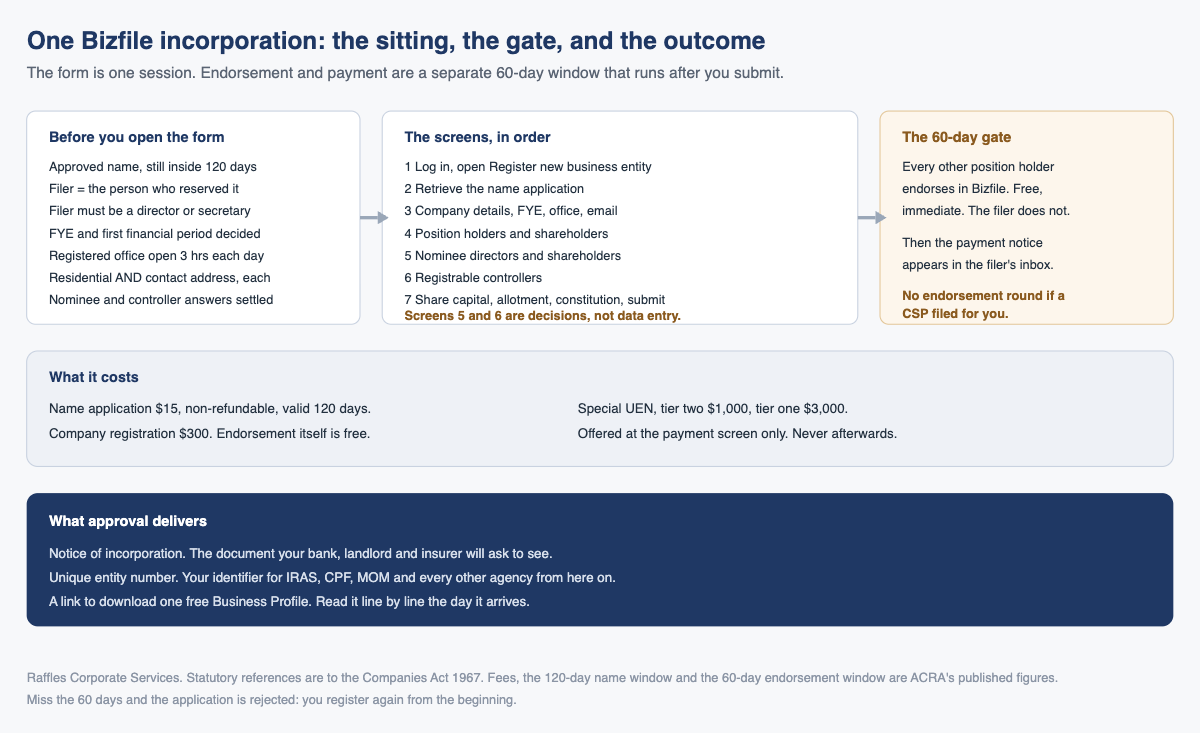
The screens, in order
- Log in and open the eService. Bizfile homepage, Login, Individual User, then Register, Register new entity, Register new business entity. Providers pick the Corporate Service Provider tab and proceed to their dashboard.
- Retrieve your name application. Scroll to Retrieve information and enter the name registration reference. Entity name and type populate automatically. You must register the same entity type you reserved: you cannot reserve a name as a private limited company and then register it as an LLP.
- Company details. Financial year end date, financial year period, registered office address, office hours, company email.
- Position holders and shareholders. For each person, state individual or corporate, tick every position they will hold, then retrieve their details by name. One person can be director, secretary and shareholder, and you tick all three. Bizfile then asks whether the company will have more than fifty shareholders or members: answering yes takes you out of private company territory.
- Nominator information. Are you exempt from maintaining the Registers of Nominee Directors and Nominee Shareholders? If not exempt, do you have any? If you do, each nominee’s nominator has to be named and addressed.
- Controller details. Are you exempt from the Register of Registrable Controllers? If not, can you identify your controllers? If you cannot, you declare that and give details of the individuals with executive control instead.
- Share capital. Currency, class of shares, number of shares, issued capital and paid-up capital, and the mode of payment for the shares.
- Allot the shares. Each shareholder gets either an individual allotment or a place in a group allotment. Shares held in trust are entered separately.
- Constitution. Upload a customised document, or select the model constitution and the version basis you want.
- Review, declare, submit. Read the declaration, tick it, submit.
The three screens that slow people down
The share payment mode. Bizfile offers four options: all in cash, all otherwise than in cash, no consideration, and partly in cash and partly otherwise. Most founders are paying cash and tick the first box without thinking. If you are issuing shares for a transferred asset, for services, or as a bonus issue, the choice matters and has consequences beyond ACRA. The minimum issued share count is one, and the field accepts very large numbers and decimal fractions, so nothing is stopping you from doing something unwise. Our note on how much share capital a Singapore company should start with covers the judgement call.
The exempt private company trap on corporate shareholders. Registering an exempt private company, Bizfile will only let you add a limited liability partnership as a corporate shareholder. That looks arbitrary until you read the definition. An exempt private company is one in which no beneficial interest in the shares is held directly or indirectly by any corporation, and the Companies Act 1967 definition of “corporation” excludes limited liability partnerships. An LLP shareholder does not break exempt private company status. A company shareholder does.
The constitution version basis. Choose the model constitution and Bizfile asks whether you adopt it as in force at the time of adoption, or as in force from time to time. The second option means your constitution changes automatically whenever the regulations change: convenient, and also a standing amendment you did not vote on. We compare the two in model constitution versus tailored constitution.
Endorsement and payment: the sixty-day gate
Submitting is not filing. Once you submit, every other position holder has to log in to Bizfile and endorse their own appointment. The person who filed does not endorse separately.
Endorsements and payment must both be completed within 60 days of submission. Miss that, and the application is rejected and you start again. Endorsement itself is free and takes effect immediately.
If a corporate service provider or a group of companies filed the registration, no endorsement round is required at all. That removes an entire coordination problem involving people who may be in different time zones and who may never have used Bizfile. The mechanics are set out in endorsing a new business registration.
Once the last endorsement lands, a payment notification appears in the filer’s Bizfile inbox.
| Item | Amount | Notes |
|---|---|---|
| Name application | $15 | Paid earlier, non-refundable, reservation valid 120 days |
| Company registration | $300 | Paid after all endorsements are in |
| Endorsement | Free | Approved immediately |
| Special UEN, tier two | $1,000 | Optional, chosen at the payment screen only |
| Special UEN, tier one | $3,000 | Optional, chosen at the payment screen only |
Payment is by credit card, debit card or online banking. The special unique entity number is offered here and only here: you cannot buy one after the company exists, and it is neither refundable nor exchangeable. Decide before you reach the screen. More on receipts and failed payments in our guide to paying ACRA on Bizfile.
What lands in your inbox
Most registrations are approved shortly after payment clears. Complex applications can take up to fifteen working days, and anything routed to a referral authority because of the business activity runs somewhere between fourteen and sixty days.
On approval, three things arrive:
- The notice of incorporation, which is the document your bank, your landlord and your insurer will ask for.
- Your unique entity number, the identifier for every government interaction from here on, including IRAS, CPF and the Ministry of Manpower.
- A link to download a free copy of your company’s Business Profile.
Download the Business Profile immediately and read it line by line. It is the first authoritative statement of what ACRA thinks your company is, and if a director’s name is misspelled or a shareholding is wrong, now is the cheapest moment to notice.
What goes wrong in practice
The endorsement round stalls. Someone is travelling, someone never set up Singpass, someone assumed the accountant was handling it. The sixty days pass and the application dies, with the name reservation clock having run the whole time.
The registered office is not actually open. Section 142(1) of the Companies Act 1967 requires a registered office in Singapore that is open and accessible to the public for not less than three hours during ordinary business hours on each business day. Section 142(2) makes non-compliance an offence for the company and every officer in default, punishable by a fine of up to $5,000 and a default penalty. A shuttered unit that nobody attends is a breach, not a technicality.
The resident director is arranged after submission. Section 145(1) requires at least one director ordinarily resident in Singapore, and section 145(2) requires every director to be a natural person aged at least eighteen with full legal capacity. Not something to solve halfway through the form.
The controller declaration is guessed. The obligation is continuing, and the register has to be kept accurate afterwards. If your ownership runs through a holding company or a trust, work the answer out before you file. Where nominee arrangements are involved, read nominee shareholder arrangements and beneficial ownership disclosure first.
The financial year end is chosen carelessly. One dropdown, and it sets your filing calendar for the life of the company. Changing it later is a separate filing with its own rules, as we set out in changing your company’s financial year end.
Frequently asked questions
Can I save the Bizfile incorporation form and come back tomorrow?
Treat it as a single sitting. The application involves declarations and retrieved identity data, and part-completed applications are a common source of duplicated or abandoned transactions. Gather every detail listed above first, then open the form once and go through to submission.
Who pays the $300 registration fee?
Whoever holds the card at the payment screen, usually the filer. ACRA does not care about the source of funds. The company can reimburse the founder afterwards as a pre-incorporation expense, and your accountant should book it that way from day one.
What happens if one shareholder refuses to endorse?
The application will not proceed to payment, and after sixty days it lapses and must be resubmitted. There is no way to override an endorsement. If a shareholder has gone quiet, resolve it commercially before the clock runs down rather than after.
Can I change the company name after I have submitted the incorporation?
Not within the same application. The name is pulled from the approved reservation and cannot be edited mid-filing, so a change means withdrawing and starting over. Changing it after the company exists is a separate transaction with its own fee, described in our guide to changing your Singapore company name.
Do I need a company secretary in place before I file?
You can register without naming one, but the person who reserved the name must be appointed as a director or secretary, and the Companies Act 1967 requires a secretary to be appointed within six months of incorporation. Deciding late is expensive in its own way, because six months move quickly.
The filing is the easy part
An incorporation form is a snapshot of decisions you have already made. If the decisions are right, the time on Bizfile is clerical. If they are not, the form records the mistake in a public register and builds a compliance calendar around it.
Raffles Corporate Services incorporates Singapore companies as a corporate service provider, so the endorsement round drops out and the filing happens in one pass. More usefully, we make the decisions with you before the form opens: officer structure, share capital, financial year end, constitution, and the controller position. If you are sitting in front of a half-finished application wondering whether one of those boxes will cost you later, that is a short conversation.
You can reach us through Raffles Corporate Services, or read more on Singapore corporate secretarial practice at Singapore Secretary Services.
— The Editorial Team, Raffles Corporate Services