

Three documents do the real work when you incorporate a Singapore company: a consent to act as director from every director, a consent to act as secretary from the secretary, and a constitution. Of those three, only the constitution goes to ACRA.
Raffles Corporate Services works with a panel of experienced Singapore law firms who offer cost-effective and efficient legal service and advice. This article is general information only and is not legal advice.
That last sentence is the part almost everybody gets wrong. ACRA publishes a long list of company forms, most people assume the list is a filing checklist, and it is not. The incorporation forms exist so that the company can prove, later, that the people named in the public register genuinely agreed to be there. They are kept, not lodged.
Get this wrong and nothing happens at incorporation. Your company registers perfectly. The problem surfaces two years later, during an audit, a due diligence exercise, a bank review or a dispute, when somebody asks for the signed consents and nobody can find them.
Here is what each document does, who signs it, and where it has to end up.
Sign, lodge, keep: three different piles
Think of your incorporation paperwork as three piles rather than one.
Sign. Documents that need a wet or valid electronic signature from a named person, before the appointment takes effect.
Lodge. Material that goes into Bizfile and becomes part of ACRA’s record. At incorporation this is a short list: the constitution, plus the particulars you key into the Bizfile incorporation form itself.
Keep. Documents that must exist at your registered office and be producible on request. This is where the consents live.
Section 173C of the Companies Act 1967 is the provision that creates the keeping duty. It requires every company to keep at its registered office, for each director, a signed copy of that person’s consent to act as director, a statement that they are not disqualified from acting as a director under the Act or any other written law, and documentary evidence of any change of name. For the secretary, it requires a signed consent to act as secretary.
Note what the section does not say. It does not say “file with the Registrar”. It says keep.
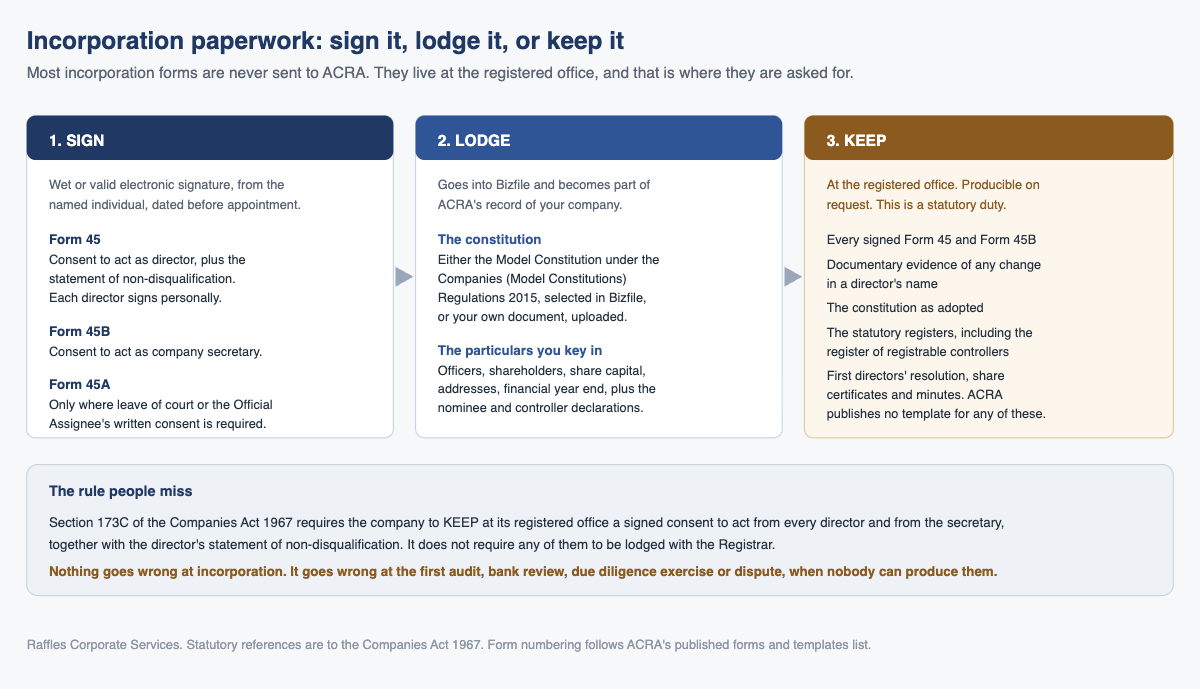
The forms that matter at incorporation
| Form | What it does | Who signs it | Where it ends up |
|---|---|---|---|
| Form 45 | Consent to act as director, combined with a statement of non-disqualification | Each individual director, personally | Registered office, kept under section 173C(a) |
| Form 45A | The same consent where the person acts with leave of court, or with the written consent of the Official Assignee | A director whose appointment requires that permission | Registered office, alongside the permission itself |
| Form 45B | Consent to act as company secretary | The individual appointed as secretary | Registered office, kept under section 173C(b) |
| Model Constitution | The default set of company rules under the Companies (Model Constitutions) Regulations 2015 | Adopted by the subscribers, not signed form by form | Selected in Bizfile, becomes part of ACRA’s record |
| Customised constitution | Your own drafted rules, replacing the model | Adopted by the subscribers | Uploaded to Bizfile, becomes part of ACRA’s record |
Form 45, and the version trap
Form 45 does two jobs in one page. It records that the person agrees to become a director, and it records their positive statement that they are not disqualified from acting as one.
The second job is the serious one. Disqualification in Singapore arises from several sources, including undischarged bankruptcy, certain convictions, and a record of repeated filing defaults. When a director signs Form 45, they are putting their name to a statement about their own status. That is not a formality to be completed by an assistant on the director’s behalf.
ACRA has amended Form 45 recently and flags on its own forms and templates page that the latest version should be used. This is a real trap for anyone working from a saved office template. A consent signed on a superseded form is a weaker document than one signed on the current one, and the fix costs nothing at the time and is annoying to arrange three years later when the director has left the company. Download it fresh each time.
Form 45B, and the six-month problem
Form 45B is the secretary’s equivalent. It is a shorter document because it carries no non-disqualification statement, but the keeping duty is identical.
Where this goes wrong is timing. A company can incorporate without a secretary in place, and the Companies Act 1967 then allows a window within which one must be appointed. Companies use that window, forget about it, and appoint somebody hurriedly at the end of it. The Form 45B is signed in a rush, filed in an email thread, and never reaches the registered office file. Our guide to appointing a company secretary in Singapore sets out the deadline and what happens if you miss it.
Form 45A, the one you hope you never need
Form 45A covers a narrow case: a person who needs the leave of the court, or the written consent of the Official Assignee, before they may act as a director. An undischarged bankrupt is the common example.
If you are being asked to sign this form, or if a proposed director tells you they will need to, stop and take advice before the incorporation goes any further. The permission has to exist first, and the consent has to be consistent with the terms of the permission. A company that appoints somebody who should not be appointed has a problem that outlives the appointment.
The constitution is the only template that actually gets lodged
Every Singapore company must submit a constitution when it incorporates. You have exactly two routes.
Adopt the Model Constitution prescribed under the Companies (Model Constitutions) Regulations 2015, which ACRA publishes as a downloadable PDF and which Bizfile can apply for you at the tick of a box. Or upload your own.
The model is genuinely usable for a simple company, and it is the sensible default for a single-founder business that has no outside shareholders. It stops being the sensible default the moment two or more unrelated people own shares, because the model is thin on the clauses that matter when owners disagree: transfer restrictions, pre-emption on new issues, deadlock, and what happens when a shareholder dies or leaves.
We compare the two in model constitution versus tailored constitution, and cover what a constitution does at all in what a company constitution actually does. If you already have a shareholders’ agreement, read shareholders’ agreement versus company constitution before you tick the model constitution box, because the two documents can and do contradict each other.
One historical note that comes up during acquisitions. Companies incorporated before 3 January 2016 had a memorandum and articles of association rather than a constitution. Those documents were deemed to become the company’s constitution on that date, and they remain in force until amended. If you are buying an older company, read the actual document rather than assuming it looks like the current model.
What ACRA does not give you a template for
This is the gap that costs new companies the most, because it is invisible. ACRA’s forms page is not a company formation kit. Several documents your company needs from day one simply are not there.
- The first directors’ resolution. Appointing the bank signatories, adopting the financial year end, allotting the founder shares, approving the registered office. No ACRA template.
- Share certificates. Every shareholder is entitled to one. No ACRA template.
- The company’s own statutory registers, including the register of registrable controllers and, where relevant, the registers of nominee directors and nominee shareholders. ACRA tells you to maintain them and does not hand you a format.
- Board and shareholder minute templates.
- Director service agreements or employment contracts.
The insolvency and judicial management forms that sit on the same ACRA page (statements of affairs, proofs of debt, notices to creditors and the like) are not incorporation documents at all, and several of them go to the Official Receiver rather than to ACRA. Ignore them unless somebody has told you specifically that you need one.
What goes wrong in practice
The consents are signed after the appointment. The logic runs backwards. Consent precedes appointment. A consent dated after the Bizfile filing is evidence that the director was appointed before they agreed, which is exactly the accusation you do not want on file.
Nobody can find them later. Section 173C requires them at the registered office. If your registered office is your corporate service provider’s address, confirm that the provider actually holds signed originals or proper copies rather than assuming. If your registered office is your own unit, put them in one folder with the constitution and the registers and do not let them scatter into email.
The company is treated as the only party with obligations. It is not. Directors, chief executive officers, secretaries and auditors each have their own statutory duty to give the company the information it needs to keep ACRA’s records correct, within fourteen days. And the company must notify the Registrar of an appointment or a change within fourteen days of it happening. A director who quietly changes address and tells nobody is the cause of a filing breach, not an innocent bystander to one.
Somebody “acting as a director” never signed anything. If a person is habitually directing the board without ever having been appointed, the absence of a Form 45 does not make them safe. Singapore law reaches people who behave like directors regardless of paperwork, as we set out in shadow directors in Singapore.
The registers were never actually opened. Incorporation is the moment to create them, not the moment to intend to. Reconstructing a company’s statutory records years later is a painful and sometimes court-supervised exercise, as our note on restoring statutory registers and records illustrates.
Frequently asked questions
Do I upload Form 45 to Bizfile when I incorporate?
No. Form 45 is not lodged with ACRA. Section 173C of the Companies Act 1967 requires the company to keep the signed consent at its registered office. Bizfile captures the director’s particulars and a declaration during the filing, but that does not replace the signed consent document itself.
Can a director sign the consent electronically?
In practice yes, provided the signature is genuinely that person’s and the document is retained in a form you can produce on request. What matters is that the consent is signed, attributable to the named individual, dated before the appointment, and kept where the Act says it must be kept.
Where do I find the current version of Form 45?
Download it from ACRA’s forms and templates page each time you need it rather than reusing a saved copy. ACRA has amended the form, and a saved version in an office template folder may well be out of date without anybody noticing.
Does a corporate director or corporate shareholder sign a Form 45?
Form 45 is a consent to act as director, and a director of a Singapore company must be a natural person. A corporate shareholder does not sign a consent to act as director. Where a corporate entity holds a position that requires an endorsement in Bizfile, an authorised officer of that entity handles it.
Do I need a lawyer to prepare the constitution?
Not always. A single-owner company with no outside investors can sensibly adopt the model constitution. Once two or more unrelated parties hold shares, or once outside money is involved, the model leaves out the clauses that decide what happens in a disagreement, and a tailored constitution earns its cost.
Paperwork that survives the first audit
The test of an incorporation is not whether the company registered. It is whether, three years later, somebody can open one folder and find every signed consent, the constitution as adopted, the registers, and the resolutions, all consistent with what ACRA shows.
Raffles Corporate Services builds that folder at incorporation and maintains it afterwards, which means the consents are signed on the current forms, dated correctly, and held at the registered office where the Companies Act 1967 requires them to be. If you incorporated yourself and are not sure what exists, we will tell you what is missing before an auditor or an acquirer does.
You can reach us through Raffles Corporate Services, or read more on Singapore corporate secretarial practice at Singapore Secretary Services.
— The Editorial Team, Raffles Corporate Services
Need help with corporate secretarial or compliance matters?
If you would like help with your company's corporate secretarial, governance or compliance requirements, email [email protected] or WhatsApp +65 8501 7133.
Our team can assist with corporate secretarial, accounting and tax matters. Where legal advice is needed, advisers from our associated law firms can assist.