
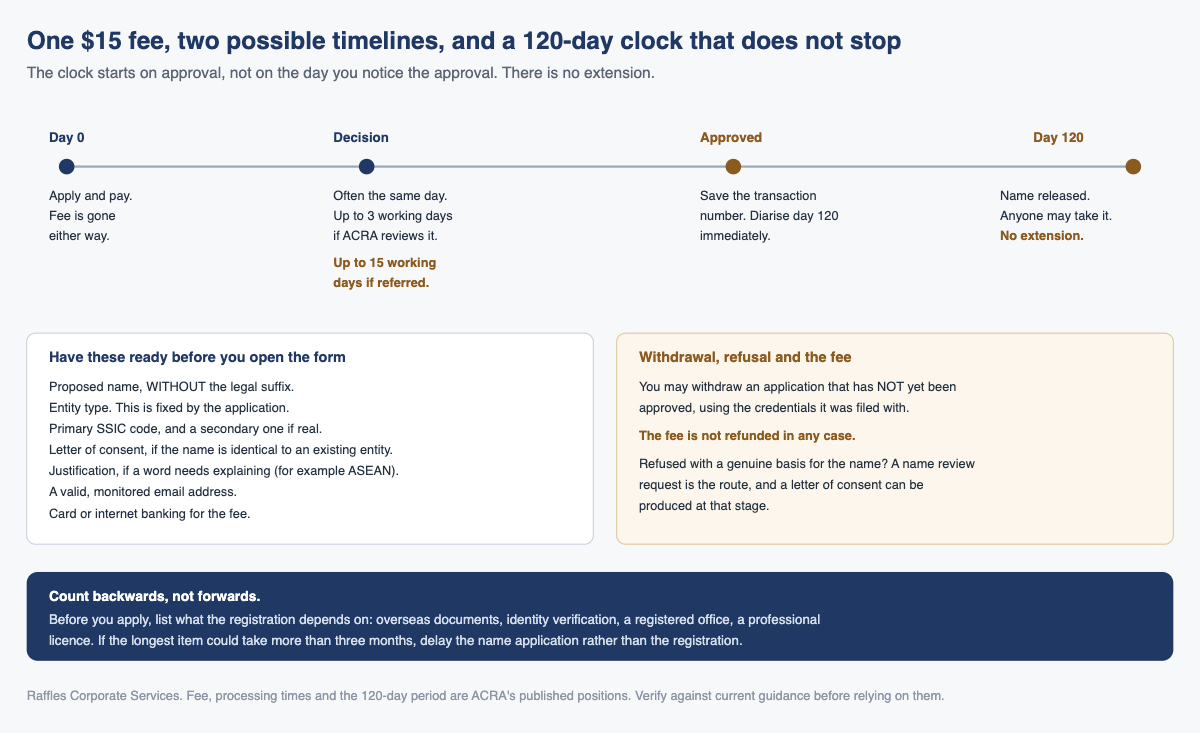
A name application in Bizfile costs $15, is usually decided within three working days, and reserves an approved name for 120 days while you complete the registration. The fee is not refundable if the name is refused or if you withdraw the application.
Read that as a warning rather than a fee schedule. A name application is not a search facility. It is a chargeable application with a binary outcome, and every failed attempt costs you the fee again. Whether you choose a name that will pass is settled before you open the form, and that is covered in how to choose a business name ACRA will actually approve.
This article is about the mechanics: who is allowed to file, what you need in front of you, how payment and processing work, what the 120 days actually means, and what you can do if you change your mind partway through.
Who is allowed to file the application
You can file it yourself using Singpass only if you will hold a qualifying role in the proposed entity. Otherwise you engage a corporate service provider to file it for you.
| Proposed entity | Who may file with Singpass |
|---|---|
| Sole proprietorship or partnership | An owner, or an authorised representative where no owner is locally resident |
| Local company | A proposed director or secretary |
| Limited liability partnership | A proposed partner or individual manager |
| Limited partnership | A general partner, including a general partner acting as nominee or trustee |
| Public accounting firm, corporation or LLP | A qualifying partner, director or public accountant employee under the Accountants Act 2004 |
| Foreign company branch | Anyone holding Singpass, including a foreigner |
Two points that trip people up.
First, a foreigner without local residency cannot register a Singapore business alone and must engage a corporate service provider. The name application will normally be filed by that provider as part of the engagement. Providers themselves operate under the Corporate Service Providers Act 2024, which changed what they must verify about you before they act.
Second, the person who files is the person who can later withdraw. If your accountant’s assistant files the application under her own Singpass, she is the one holding the ability to withdraw it, not you.
What to have in front of you before you start
The form is short. It is the preparation that takes the time.
| Item | Detail |
|---|---|
| Proposed name | Without the legal suffix. Do not type “Pte Ltd”, the system adds the suffix for the structure you select |
| Business structure | Company, sole proprietorship, partnership, LLP or limited partnership. This is fixed by the application |
| Primary SSIC code | A five-digit Singapore Standard Industrial Classification code for your main activity. You can look it up beforehand or search inside the form |
| Secondary SSIC code | Where you have a genuine second activity |
| Letter of consent | Where your proposed name is identical to an existing entity and its owner or director has agreed to your use of it |
| Supporting justification | Where a word in your name needs explaining, such as “ASEAN” |
| Valid email address | ACRA’s notifications about the outcome go here |
| Payment method | Credit card, debit card or internet banking |
The SSIC code deserves more attention than it usually gets. It sits on your business profile where banks and counterparties read it, it shapes what licensing authorities assume about you, and it can route your application to another government agency on its own. Look yours up on ACRA’s SSIC guidance, and read which business names get referred to another government agency before you choose one.
One more preparation point on the name itself: ACRA registration gives you no exclusive rights to the words you have chosen. If the name is going on signage or a product, search the trade marks register at the Intellectual Property Office of Singapore before you pay for anything.
The steps, in order
- Log in to Bizfile. Individuals use Singpass, corporate filers use Corppass. If this is your first visit, your first fifteen minutes in Bizfile will save you some hunting.
- Open the application to register a new business entity name.
- Select the entity type you intend to register. This determines the suffix and it is not something you change later without a fresh application.
- Enter the proposed name without the legal suffix.
- Select your primary SSIC code, and a secondary code if you have one.
- Upload a letter of consent or supporting justification if either applies to your name.
- Enter a valid email address for the outcome notification.
- Pay the $15 fee by card or internet banking. The mechanics of payment, receipts and what ACRA will and will not refund are covered in paying ACRA on Bizfile.
- Save the transaction number. You will need it to register the entity.
How long approval takes
| Scenario | Published timeline |
|---|---|
| Straightforward name, no issues | Often approved shortly after payment |
| ACRA needs to review the name | Up to three working days |
| Application referred to another government agency | Up to 15 working days on ACRA’s referral guidance |
| Complex cases | ACRA will tell you if it needs longer |
The gap between the first row and the third is the planning problem. A founder who signs a lease on the basis of “approval is instant” and then hits a referral has a month of dead rent and no entity. If any word in your name or any part of your activity touches a regulated field, assume the longer timeline and build it into your dates.
Outcome notifications arrive by email and appear in your Bizfile notifications. Checking them is worth a habit, because the clock described in the next section starts on approval, not on the day you notice the approval.
Approved: what the 120 days actually means
Approval reserves the name against your transaction number for 120 days. Within that period you must complete the registration of the entity, which is a separate application with a separate fee. If you do not, the name is released back to the pool and anybody can apply for it.
Can you extend the reservation?
Under ACRA’s current published position, no. The reservation runs for 120 days and the page that sets the period says nothing about an extension mechanism. Treat 120 days as a hard stop, not a starting position for a negotiation.
That is a change in character from the shorter reservation periods founders may remember, and it cuts both ways. You get four months, which is generous. You also get no safety net at the end of them.
Count backwards, not forwards
The failure pattern is consistent. The name is approved, everyone relaxes, and then the registration waits on something outside your control: a notarised document from overseas, a director’s identity verification, a registered office address, a professional licence that has not come through. Four months disappears more easily than it sounds.
Before you apply, list what your registration will depend on and work out the longest realistic lead time in that list. If any item could plausibly take more than three months, delay the name application rather than the registration. There is no penalty for applying later and no remedy for letting an approved name lapse.
One related deadline is worth knowing about now: once the registration itself is filed, any party who must endorse their appointment has a limited window to do so, and the transaction fails if they do not. That is covered in endorsing a new business registration and the sixty-day clock.
Withdrawing a pending application
You can withdraw a name application that has not yet been approved. It is done in Bizfile using the same login credentials the application was filed with, which is why the identity of the filer matters.
The fee is not refunded. Withdrawal is useful in two situations: you have realised the name will not pass and you would rather stop the clock than collect a refusal, or your plans have changed and you do not want a reserved name sitting against your name.
Once a name has been approved, withdrawal is no longer the relevant mechanism. An approved name you do not use simply lapses at the end of the 120 days.
If the name is refused
A refusal is not always final. Where you have a genuine basis for using the name, you can submit a name review request asking ACRA to reconsider, including in cases where the name is identical or would not ordinarily be allowed. A letter of consent from the holder of an identical name can be produced at this stage if you did not have it earlier.
What a review request is not is a free second attempt at a name you never had a claim to. If the refusal is because somebody else got there first and you have no relationship with them, change the name.
If the application has neither succeeded nor failed but has simply stopped moving, why Bizfile name applications and registrations get stuck covers the common causes and the fixes.
What goes wrong
The fee is treated as a search fee. People file three variations to see which one sticks. That is three non-refundable fees and a week of delay, for information that five minutes of checking would have produced for nothing.
The suffix is typed into the name field. Bizfile adds the legal suffix based on the entity type you select. Typing it yourself produces a name that reads oddly or fails validation.
The wrong entity type is selected. The structure is fixed by the name application. Changing from a partnership to a company after approval means a fresh application and a fresh fee.
The email address is wrong or unmonitored. The outcome notification goes to the address on the application. A typo there means you find out about the approval, and about the 120 days that have been running, considerably later than you should have.
The transaction number is lost. You need it to register the entity. It is in your Bizfile transaction history, but retrieving it is an avoidable ten minutes. Save it when you get it.
Nobody diarises day 120. No reminder is a reliable way to lose a name. Put the date in the calendar the day the approval arrives.
Frequently asked questions
How much does it cost to reserve a business name in Singapore?
$15 for the name application. It is not refundable if the name is refused or if you withdraw the application before approval. Registering the business entity itself is a separate application with its own fee, paid after the name is approved.
How long does ACRA take to approve a business name?
Straightforward applications are often approved shortly after payment. Where ACRA reviews the name, its published timeline is up to three working days. Where the application is referred to another government agency, ACRA’s referral guidance puts the additional review at up to 15 working days.
How long is an approved business name reserved?
120 days from approval. You must complete the registration of the entity within that window. After 120 days the name is released and becomes available to anyone else. ACRA’s current guidance does not offer an extension mechanism, so treat the date as fixed.
Can I withdraw a name application and get my money back?
You can withdraw an application that has not yet been approved, using the same login credentials it was filed with. The $15 fee is not refunded. Withdrawal stops the application, it does not undo the payment.
Can a foreigner file a Singapore name application?
Anyone with Singpass, including a foreigner, can file the name application for a foreign company branch. For a local company, partnership or LLP, a foreigner who is not locally resident must engage a corporate service provider, and the provider normally files the name application as part of the engagement.
What happens to my reserved name if I never register the business?
Nothing is refunded and nothing is held. At the end of the 120 days the reservation lapses, the name returns to the pool, and any other applicant can take it. There is no grace period and no priority for the previous applicant.
Filing it once, properly
The name application is a small transaction with a long tail. It fixes your entity type and your SSIC codes, it can route your file to a regulator you did not expect, and it starts a clock that does not stop.
Raffles Corporate Services files name applications as part of incorporations every week, which means we test the name before paying for it, choose the SSIC code with the referral list open, and diarise the 120 days as a matter of course. If you would rather not think about any of that, it is a short conversation.
For the wider picture, see choosing and reserving a business name in Singapore, and for what happens once the name is approved, how to register a company in Singapore. Official guidance sits on ACRA’s own name application pages. You can reach us through Raffles Corporate Services, or read more on Singapore corporate secretarial practice at Singapore Secretary Services.
— The Editorial Team, Raffles Corporate Services