

ACRA refuses a proposed business name on three grounds: it is identical to a name already registered or reserved, it is undesirable, or it is protected by law. Everything else gets through. The catch is that “identical” covers far more than it sounds like it does.
Raffles Corporate Services works with a panel of experienced Singapore law firms who offer cost-effective and efficient legal service and advice. This article is general information only and is not legal advice.
That single word accounts for most rejected name applications in Singapore. Founders test their name by typing it into a search, see nothing that matches character for character, pay the fee, and then get refused because ACRA strips out a list of words before it compares anything. Under that test, a name you think is distinctive can turn out to be the same name as a company registered in 2011.
This article is about the rules themselves: what ACRA is checking, what it ignores, which words will slow you down even when they are allowed, and how to test a name properly before you pay for it. The mechanics of filing the application are covered separately in reserving your business name in Bizfile, and the broader process from decision to registration in choosing and reserving a business name in Singapore.
One thing to settle first. Your name carries the legal suffix of the structure you register, so decide between a company, a partnership and an LLP before you fall in love with a name. If that is still open, start with choosing a business structure in Singapore.
The three grounds of refusal
Section 27 of the Companies Act 1967 governs the names of Singapore companies, and equivalent provisions apply to businesses registered under the Business Names Registration Act 2014 and to limited liability partnerships. The structure of the test is the same across all of them.
| Ground | What it means in practice | How often it bites |
|---|---|---|
| Identical | The same as an existing or reserved name once ACRA disregards a defined set of words | Most refusals |
| Undesirable | Vulgar, obscene, offensive, or otherwise contrary to the public interest | Rare, and usually obvious |
| Protected or restricted | Similar to a government body, or reserved by legislation (Temasek is the standard example) | Rare, but absolute |
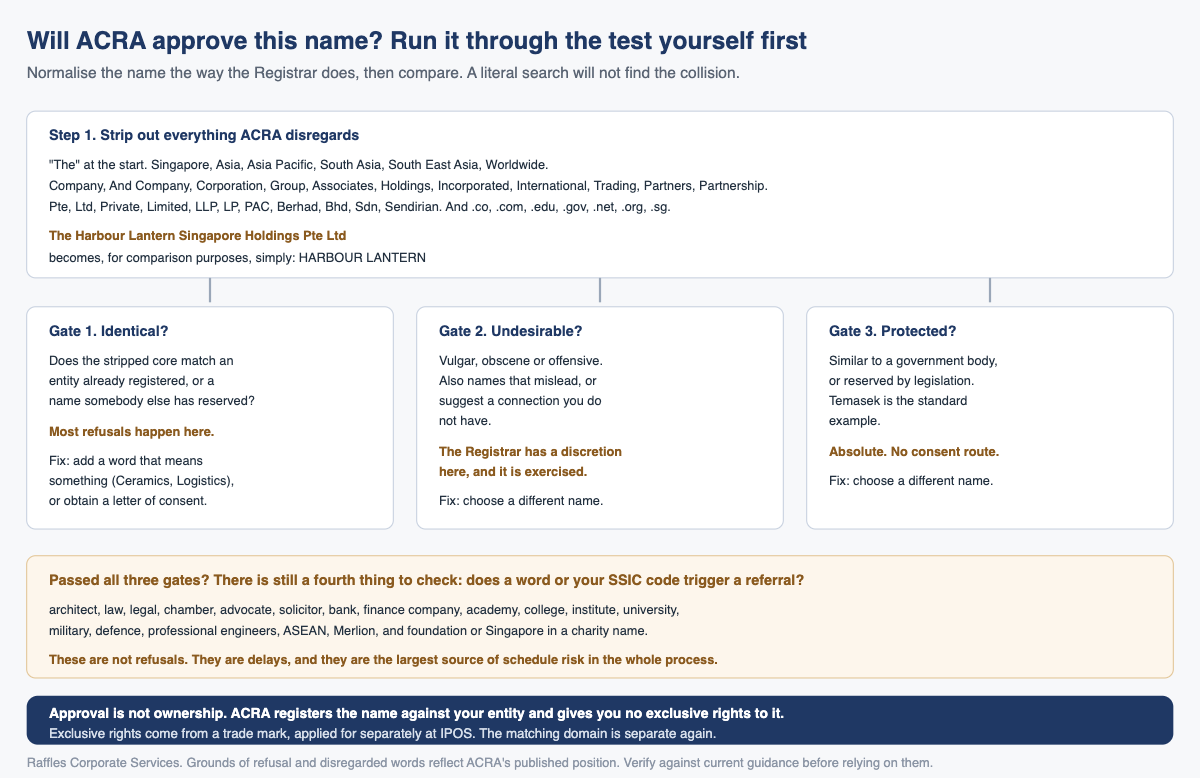
“Identical” is a legal test, not a visual one
ACRA does not compare your proposed name to the register the way your eye would. It normalises both names first, removing words it treats as carrying no distinguishing weight, and only then asks whether what is left matches. Without that rule, anyone could register “Acme Holdings Pte Ltd” the day after “Acme Pte Ltd” opened for business, and the public would have no way of telling the two apart.
The practical effect on you is that you must run the same normalisation in your head before you apply.
“Undesirable” is broader than rude
Most people read undesirable as meaning profane, and it does include that. It also reaches names that suggest a connection you do not have, names that mislead about the nature of the business, and names that would be contrary to the national interest. The Registrar has a discretion here, and it is exercised.
The words ACRA disregards
This is the table to read twice. If two names differ only by items from this list, they are the same name.
| Category | Words ignored | Worked example against “Harbour Lantern Pte Ltd” |
|---|---|---|
| Leading article | “The” at the start of the name | The Harbour Lantern Pte Ltd |
| Geographical and regional | Singapore, Asia, Asia Pacific, South Asia, South East Asia, Worldwide | Harbour Lantern Singapore Pte Ltd, Harbour Lantern Asia Pte Ltd |
| Business descriptors | Company, And Company, Corporation, Group, Associates, Holdings, Incorporated, International, Trading, Partners, Partnership | Harbour Lantern Holdings Pte Ltd, Harbour Lantern International Pte Ltd |
| Entity type variants | Pte, Ltd, Private, Limited, LLP, LP, PAC, Berhad, Bhd, Sdn, Sendirian, Limited Liability Partnership, Limited Partnership, Public Accounting Corporation | Harbour Lantern LLP, Harbour Lantern Sdn Bhd |
| Domain suffixes | .co, .com, .edu, .gov, .net, .org, .sg | Harbour Lantern.com, Harbour Lantern.sg |
Every example in the right-hand column is, for ACRA’s purposes, the same name as “Harbour Lantern Pte Ltd”. If that entity exists, none of them will be approved, and the application fee is gone each time you try.
What actually distinguishes a name
Words that carry meaning. If “Harbour Lantern Pte Ltd” is taken, then “Harbour Lantern Ceramics Pte Ltd”, “Harbour Lantern Logistics Pte Ltd” or “Harbour Lantern Bakery Pte Ltd” are genuinely different names, because each added word tells the reader something about the business rather than about its legal form or its geography.
Two practical rules follow:
- Add a word that describes what you do, not where you are or what legal form you take.
- If the only thing separating you from an existing entity is a descriptor from the table above, assume you will be refused and change the name before you pay.
There is one route around a genuine collision. If the owner of the identical name consents in writing to your use of it, that letter of consent can be submitted with your application. It is not a guarantee, but it is the recognised mechanism, and it is worth asking for where the two businesses are genuinely unrelated or under common ownership.
Words that are allowed but will cost you weeks
A separate category of words will not get your name refused outright, but will route your application to another government agency for review before ACRA decides. That review adds time, and it is the largest source of schedule uncertainty in the whole registration process.
The triggers include words such as “architect”, “law”, “legal”, “chamber”, “advocate”, “solicitor”, “bank”, “finance company”, “academy”, “college”, “institute”, “university”, “military”, “defence”, “professional engineers” and “ASEAN”, along with “foundation”, “international” or “Singapore” in the name of a proposed charity. Your SSIC activity code can trigger a referral on its own, even where the name is completely unremarkable.
Which words go to which agency, and how long each takes, is set out in which business names get referred to another government agency. If any word in your shortlist appears there, plan for it now rather than discovering it after you have told a landlord when you expect to be trading.
How to test a name before you pay
The application fee is not refundable, and a refusal on grounds you could have found in five minutes is an avoidable cost. Run these checks in order.
- Normalise your own name. Strip out “The”, the geography, the descriptors, the entity suffix and any domain suffix. What is left is the name ACRA will actually compare.
- Search the normalised core against existing entities. The GoBusiness e-Adviser for starting a business covers registered business names alongside domains, social handles and trade marks in one pass.
- Search reserved names on Bizfile. A name can be unavailable because somebody reserved it last month and has not registered yet. Bizfile’s business information search has a reserved name option. Our guide to using Bizfile’s search functions explains what each search returns and what it does not.
- Check the trade marks register. A name that clears ACRA can still walk into an infringement claim. See the section below.
- Check the domain. Web addresses are first come, first served, and ACRA approval gives you no claim to a matching one. Singapore domains go through a registrar accredited by SGNIC.
- Check your SSIC code against the referral list. The code is part of the name application and can trigger a referral by itself.
Have two acceptable alternatives ready before you open the form. Founders who apply with a single name and no fallback tend to make a rushed second choice under time pressure, and live with it for years.
The trade mark problem nobody expects
Registering a business name with ACRA does not give you any right to that name. It records the name against your entity. That is all it does.
It does not give you exclusive use, it does not stop a competitor registering something confusingly similar, and it is no defence if somebody else already holds a registered trade mark over the words you have chosen. A company can be trading happily for two years under an ACRA-approved name and then receive a letter from the owner of a mark it never searched for.
Exclusive rights come from a trade mark registration, which is a separate application to the Intellectual Property Office of Singapore. If the name is going on signage, packaging or a product, search the marks register before you commit and consider filing.
What goes wrong
The founder searches for an exact string. No match appears, so the name is assumed clear. ACRA’s normalisation then finds the collision that a literal search never would. This is the single most common cause of a wasted fee.
A descriptor is treated as a differentiator. “We added Holdings, so it is a different company.” It is not. Nor is Group, International, Trading or Singapore.
The name is approved but the brand was never protected. ACRA approval is mistaken for ownership. Two years later somebody with a registered mark asks you to stop using your own company name, and rebranding a business with signage, a website and printed material is an expensive exercise.
A referral is triggered by the SSIC code rather than the name. The name is ordinary, nobody expected a delay, and then the activity code routes the file to a regulator. Check the code as carefully as you check the words.
The refusal is accepted too quickly. Where you have a genuine basis for the name, a name review request can be submitted, and a letter of consent can resolve a collision. Neither is certain, but abandoning a good name at the first refusal is often premature. If your application has stalled rather than been refused, why Bizfile name applications and registrations get stuck covers the usual causes.
Frequently asked questions
Why was my business name rejected when nothing identical came up in my search?
Because ACRA removes certain words before comparing names. “The” at the start, geographical words such as Singapore or Asia, descriptors such as Holdings, Group or International, entity suffixes such as Pte Ltd, and domain suffixes such as .com are all ignored. Strip those out of your name and search again.
Can I use a name that already exists if the other business agrees?
Sometimes. A letter of consent from the owner or director of the entity holding the identical name can be submitted with your application. It is the recognised route where the businesses are related or genuinely unconnected in the market, but ACRA still decides, and consent alone does not guarantee approval.
Does ACRA approval mean I own the name?
No. ACRA registration records the name against your entity and nothing more. It confers no exclusive rights and no intellectual property protection. To stop others using the name you need a registered trade mark from the Intellectual Property Office of Singapore, which is a separate application on a separate register.
Which words should I avoid if I want a fast approval?
Anything suggesting a regulated profession or activity: architect, law, legal, solicitor, chamber, bank, finance company, academy, college, institute, university, military, defence, professional engineers, ASEAN, and Merlion. These are not banned, but they route your application to another agency and add time.
Can I change the name after registration if I get it wrong?
Yes. A company changes its name under section 28 of the Companies Act 1967, which involves a members’ resolution and a filing with ACRA. It is a real process with a real fee, and it means new signage, new stationery and notifying your bank and your counterparties, so it is considerably cheaper to get the name right the first time.
Does a name have to describe what my business does?
No. Your name is not required to match your business activity, and abstract or invented names are approved routinely. Descriptive words are useful mainly because they help you clear the identical-name test where a shorter version is already taken.
Getting it approved on the first attempt
A name application is a chargeable application, not a search. The work that determines whether it succeeds happens before you open the form, and it takes about ten minutes if you know what ACRA is looking at.
Raffles Corporate Services files name applications alongside incorporations every week. That means we know which words attract a referral, which collisions a literal search will miss, and how to add a distinguishing word that survives the identical-name test rather than colliding with it. If you have a shortlist and want it pressure-tested before you pay, that is a short conversation rather than an engagement.
When your name is settled, the next step is reserving it in Bizfile, and after that how to register a company in Singapore. For the wider statutory background, our Companies Act 1967 deep-dive FAQ is a useful companion. You can reach us through Raffles Corporate Services, or read more on Singapore corporate secretarial practice at Singapore Secretary Services.
— The Editorial Team, Raffles Corporate Services
Need help with corporate secretarial or compliance matters?
If you would like help with your company's corporate secretarial, governance or compliance requirements, email [email protected] or WhatsApp +65 8501 7133.
Our team can assist with corporate secretarial, accounting and tax matters. Where legal advice is needed, advisers from our associated law firms can assist.