
An SSIC code is the five-digit number that tells the Singapore government what your business does. You select one for your primary activity, and optionally one for a secondary activity, when you apply for your business name. It is not a formality.
Most founders treat the SSIC field as the last box between them and the payment screen. They type a keyword, take the first plausible result, and move on. The code then sits on the public business profile for years, quietly deciding things: whether your name application gets referred to another agency, which licensing regime a regulator assumes applies to you, which sector benchmark your work pass applications are scored against, and what a bank’s onboarding team thinks you do before they have spoken to you.
None of that is visible on the day you pick it. All of it is expensive to unpick later.
What an SSIC code actually is
The Singapore Standard Industrial Classification is the national system for classifying economic activity. It is maintained by the Department of Statistics, reviewed roughly every five years, and built on the international classification used for cross-border comparison. The current edition, SSIC 2025, was published on 15 April 2025 and replaced SSIC 2020.
The classification is a hierarchy. Broad divisions narrow into groups, groups into classes, and classes into five-digit sub-classes. The five-digit sub-class is the finest level, and it is the level ACRA uses. Every entity on ACRA’s register carries at least one.
Two things follow from that structure, and both matter when you are searching.
First, the codes are defined by what you produce, not by what you call yourself. A company that describes itself as a technology business could sit under software publishing, under information technology consultancy, under wholesale trade, or under retail sale via online marketplaces, depending entirely on where the revenue comes from. The label on your pitch deck is irrelevant to the search.
Second, because the classification is periodically revised, a code you were given years ago may no longer exist in the same form. The Department of Statistics publishes correspondence tables mapping SSIC 2025 against SSIC 2020 precisely because codes get merged, split and renumbered.
Primary, secondary and ancillary
ACRA gives you two slots on your profile: one primary activity and one secondary activity. The distinction between them is not “the big one and the other one”. It has a defined test.
| Type | The test | Does it get a code on your profile? |
|---|---|---|
| Primary activity | The activity contributing most to the value added by the goods and services the business produces. Where value added cannot be worked out, gross output, revenue, or the share of employment or wages can be used instead | Yes, exactly one |
| Secondary activity | A separate activity producing goods or services for third parties, which is not the primary activity | Yes, one on the profile. Further activities need a separate lodgement |
| Ancillary activity | Work done purely to support your own operations: your own bookkeeping, HR, warehousing, cleaning, security, maintenance | No, never |
The ancillary point catches people out regularly. A logistics company that runs its own vehicle workshop does not add a motor repair code. The workshop exists to keep its own fleet running. A retailer that runs its own delivery vans is not a transport business. Only if you start repairing other people’s vehicles, or delivering other people’s parcels for a fee, does a second code become right.
If you genuinely do more than two things
ACRA’s Entity Information page holds one primary and one secondary activity. If your business genuinely carries on additional distinct activities for third parties, those are filed through the General Lodgement (Others) eService with the relevant SSIC code for each. Most small companies never need this. If you find yourself wanting four codes on day one, the more likely diagnosis is that you have described aspirations rather than activities.
How to find the right code, in order
- Write one sentence describing what a customer pays you for. Not your vision. The invoice line.
- Decide where the money will actually come from in year one. If two activities are close, the one that will contribute most value added is the primary.
- Search by the activity, not the industry. “Consultancy” returns dozens of codes across unrelated divisions. “Management consultancy services” narrows it usefully.
- Read the detailed definition before you commit. The Department of Statistics publishes the scope of each five-digit code, with examples and, more usefully, a list of activities specifically excluded from it. The exclusions are where most wrong codes get caught.
- Check the code against the licensing question. Use the GoBusiness e-Adviser for starting a business to see what licences and approvals attach to the activity before you apply for the name, not after.
- Only then open the Bizfile name application and select the code there.
Doing steps 1 to 5 outside Bizfile takes perhaps twenty minutes. Doing them inside the form, under time pressure, with a payment screen waiting, is how the wrong code gets chosen.
The codes that send your application somewhere else
Some SSIC codes are not simply descriptive. Selecting them routes your name application to another government agency for approval before ACRA will decide it, and that can add up to fifteen working days.
The regulated fields are the predictable ones: banking, finance and fund-related codes go to the Monetary Authority of Singapore; legal activities to the Ministry of Law; architectural services to the Board of Architects; real estate agency codes to the Council for Estate Agencies; schools, polytechnics and universities to the Ministry of Education or SkillsFuture Singapore; religious organisations to the Ministry of Home Affairs; certain food manufacturing codes to the Singapore Food Agency.
We cover the full trigger list, and what each agency is actually assessing, in which business names get referred to another government agency. The point to absorb here is narrower: a referral can be triggered by the code alone, with a completely unremarkable name. If your timeline assumes same-day approval, check the code first.
Separately, and more importantly, a licence is not granted by picking a code. Selecting the code for an employment agency does not make you licensed to operate one, as our guide to the employment agency licence in Singapore sets out. The same is true across the regulated sectors, including childcare, where ACRA registration, ECDA licensing and MOM obligations run on separate tracks.
What your SSIC code quietly controls
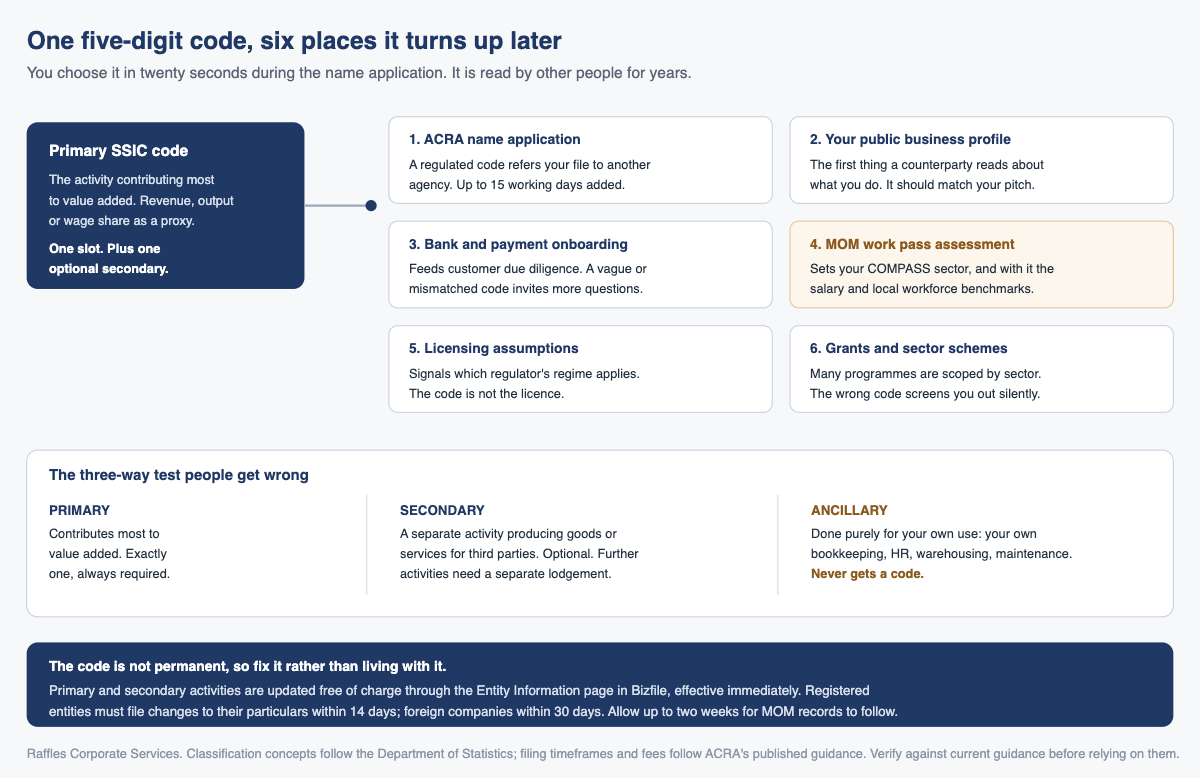
| Where it shows up | What the code does there | What a wrong code costs |
|---|---|---|
| ACRA name application | Can trigger a referral to another agency | Up to 15 working days of delay |
| Your public business profile | First thing a counterparty reads about what you do | Mismatch between the profile and your pitch |
| Bank and payment provider onboarding | Feeds risk classification during customer due diligence | Extra questions, slower account opening, occasional refusal |
| MOM work pass assessment | Determines your COMPASS sector classification | Wrong salary and local workforce benchmarks applied |
| Licensing and sector schemes | Signals which regulator’s regime is assumed to apply | Attention you did not need, or a licence you missed |
| Grants and sector programmes | Many schemes are scoped by sector | Screened out of something you qualify for |
The work pass one deserves a sentence of its own, because it is the most concrete. The Ministry of Manpower groups employers into COMPASS sectors based on the primary business activity declared to ACRA, regardless of whether the business operates across several sectors. That sector determines the salary benchmark your candidate is scored against and the local workforce benchmark your firm is scored against. MOM asks employers to keep their SSIC information current with ACRA and warns that inaccurate or missing information can delay or sink a work pass application. Updating ACRA flows through to MOM automatically, but it can take up to two weeks.
If you hire from overseas, that is not a filing detail. It is a hiring risk. Our note on the EP and S Pass salary increases from January 2027 explains why the sector you sit in is getting more expensive to get wrong.
What goes wrong
The aspirational code. A two-person consultancy selects a manufacturing code because the plan is eventually to make something. Three years later the plan has changed, the code has not, and every bank, insurer and grant assessor starts from the wrong premise.
The vague code. Picking a “not elsewhere classified” catch-all because nothing matched exactly. These codes exist for genuine residual cases, but they tell a reader nothing, and they are disproportionately likely to draw a follow-up question during onboarding.
The copied code. Using whatever a similar company uses, taken off their business profile. Their revenue mix is not yours, and you have no idea whether theirs is right either.
The stale code. The business pivoted, the profile did not. This is the most common of the four, and the one with the widest blast radius, because the profile feeds MOM, feeds banks, and feeds anyone doing diligence on you.
Assuming the code is the licence. Selecting a regulated activity code and treating the approved name as clearance to trade. It is not, and trading without the required licence is a matter for the sector regulator, not ACRA.
Changing your SSIC code later
This is the good news, and it is worth knowing before you agonise: the code is not permanent. You change primary and secondary business activities through the Entity Information page in Bizfile. ACRA does not charge for the update and it takes effect immediately. You enter the effective date of the change as part of the filing.
The obligation is the ordinary one for registered entities: file changes to your particulars within 14 days of the change, or 30 days for foreign companies. Business activity is on that list. So the honest position is that picking a slightly imperfect code on day one is recoverable, and leaving a plainly wrong code in place for years is not a filing error so much as a self-inflicted wound.
Set a reminder to look at your business activity whenever the business materially changes what it sells. Once a year, at the same time you review your registers, is enough for most companies.
Frequently asked questions
Do I have to pick a secondary SSIC code?
No. The secondary activity is optional and should be left blank unless you genuinely carry on a second, distinct activity producing goods or services for third parties. Adding a speculative second code makes your profile less accurate, not more complete, and can trigger a referral you did not need.
Does choosing an SSIC code give me the licence for that activity?
No. The code classifies what you do; it does not authorise it. Regulated activities such as financial services, legal practice, education, childcare and employment agency work require a separate licence from the responsible agency. An approved business name is not clearance to trade.
Can I change my SSIC code after registration?
Yes. You update your primary and secondary business activities through the Entity Information page in Bizfile. ACRA does not charge for this and the change is processed immediately. Registered entities must file changes to their particulars within 14 days, and foreign companies within 30 days.
Which SSIC code should I choose if I do two things equally?
The primary activity is the one contributing most to value added. Where you cannot measure value added, use gross output, revenue, or the share of employment and wages as a proxy. If the two are genuinely equal in year one, pick the one you expect to dominate by year two and record the other as secondary.
Does my SSIC code affect my Employment Pass applications?
Yes. MOM assigns your organisation to a COMPASS sector based on the primary business activity declared to ACRA, and that sector sets the salary and local workforce benchmarks your applications are scored against. Updating ACRA flows through to MOM automatically, but allow up to two weeks.
Where do I look up what a code actually covers?
The Department of Statistics publishes detailed definitions for every five-digit code, including examples and a list of activities excluded from it. The exclusions are usually more informative than the inclusions when you are deciding between two similar codes.
Getting the classification right before it costs you
An SSIC code is a small field with a long tail. It is the cheapest thing on your registration to get right and one of the more irritating things to have wrong, because the consequences arrive months later, through third parties, in the form of a question you cannot answer quickly.
Raffles Corporate Services selects and reviews SSIC codes as part of every incorporation we file, checks them against the referral and licensing triggers before the name application goes in, and revisits them when a client’s business changes shape. If you are not sure the code on your profile still describes what you sell, that is a five-minute conversation and usually a free filing.
You can reach us through Raffles Corporate Services, or read more on Singapore corporate secretarial practice at Singapore Secretary Services.
— The Editorial Team, Raffles Corporate Services