

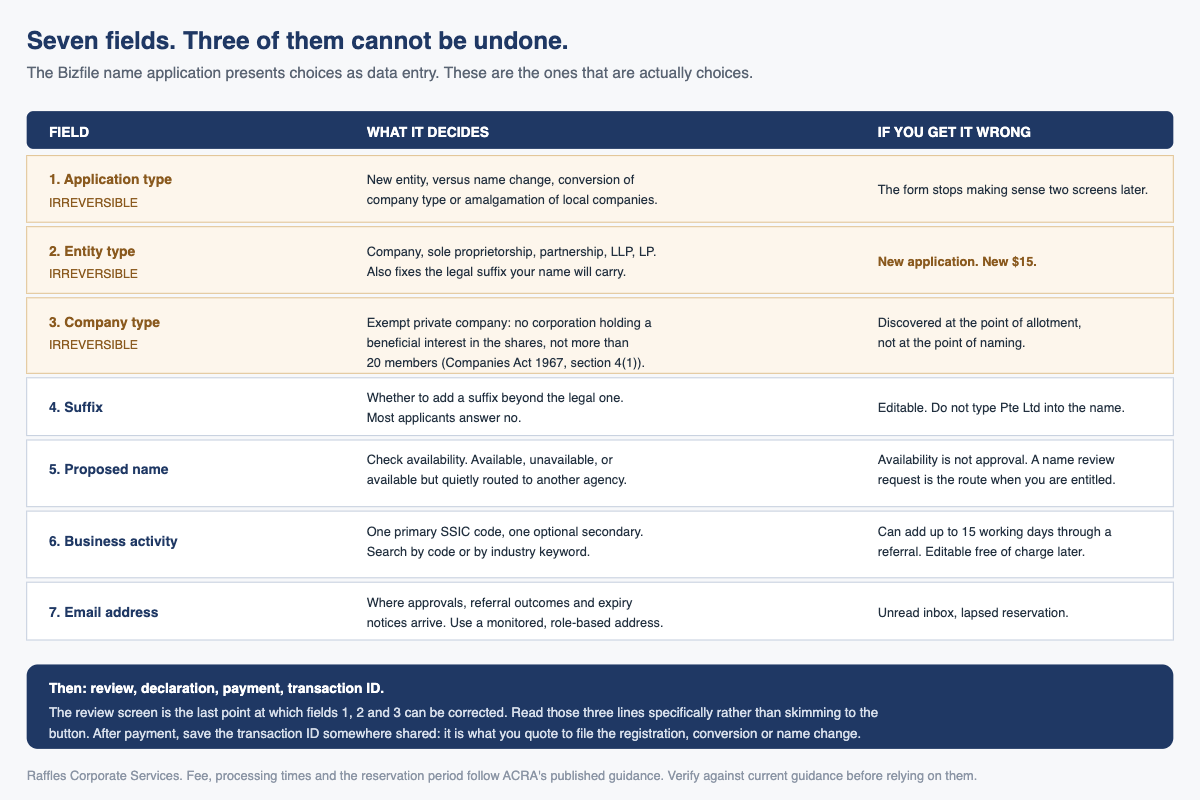
The Bizfile name application is short, but three of its fields are decisions you cannot undo inside the application: the application type, the entity type, and the company type. Get those wrong and the remedy is a fresh application and a fresh $15.
Raffles Corporate Services works with a panel of experienced Singapore law firms who offer cost-effective and efficient legal service and advice. This article is general information only and is not legal advice.
Everything else in the form is data entry. Those three are choices, and Bizfile presents them with no warning that they are choices. That is the gap this article fills.
The questions that come before the form, whether the name will survive ACRA’s test and what the reservation buys you, are covered in how to choose a business name ACRA will actually approve and reserving your business name in Bizfile. What follows assumes you have settled those.
The eService does more than you think
It is called “Apply for new business entity name”, which sounds like it is only for people registering something new. It is not. The same eService is the front door for every transaction that needs an approved name first:
- Registering a new business entity
- Converting a sole proprietorship, partnership or local company into a limited liability partnership
- Converting a public accounting firm or corporation into an accounting LLP
- Applying for, or revoking, public accounting entity status
- Changing the name of an entity that already exists
- Converting a local company from one company type to another, for example private to public
- Amalgamating local companies
That matters at the very first dropdown, because the application type you pick there determines which version of the form you get. If you are renaming an existing company, you are in the right eService but you must not select the new-entity option. We cover that route separately in changing your business name in Singapore.
Decide these four things before you open the form
| Decision | Why it has to be settled first | Cost of changing it later |
|---|---|---|
| Entity type | Fixed by the application. It also fixes the legal suffix your name will carry | A new application and a new fee |
| Company type, if a local company | Fixed by the application. Different types carry different statutory limits | A new application and a new fee |
| Primary SSIC code | Can trigger a referral to another agency before ACRA decides | Up to 15 working days of delay |
| Email address | Every notification and every government agency communication goes here | Missed approvals and expired clocks |
If any of these is still open, close the form. Twenty minutes of deciding is cheaper than a second application.
Getting in: which login do you use?
Three routes, and the right one depends on what you are doing rather than who you are.
Singpass, as an individual user. Use this if the entity does not exist yet and you will hold a qualifying position in it: proposed owner of a sole proprietorship or partnership, proposed director of a local company, proposed partner or individual manager of an LLP, or a general partner of a limited partnership. See logging in to Bizfile as an individual.
Corppass, as a business user. Use this if you are filing on behalf of an entity that already exists, whether that is your own company or a client’s. See logging in to Bizfile as a business user, and if the company is new to Bizfile, setting up Corppass for a new Singapore company comes first.
Through a corporate service provider. Anyone may engage one. Foreigners registering a Singapore business have no choice: a CSP must file for them.
Once you are in, the eService sits under the Register menu on Bizfile, through Register new entity.
Field 1: Application type
The first dropdown separates two entirely different transactions.
Select the new business entity name option only if the entity does not yet exist. The alternative, the long one covering name change by an existing entity, conversion of company type and amalgamation of local companies, is for entities that already have a UEN.
People pick the wrong one more often than you would expect, because the new-entity option sits first and reads more naturally. The symptom appears two screens later.
Field 2: Entity type, and company type
This is the field that deserves a pause.
You select the structure: local company, sole proprietorship, partnership, limited liability partnership, limited partnership, or one of the public accounting entity forms. If you select a local company, you then select the company type.
Neither can be changed during registration. If you decide after approval that you wanted a different structure, you apply again and pay again.
The company type carries real constraints. An exempt private company, the default shape for most small Singapore businesses, is defined in section 4(1) of the Companies Act 1967 as a private company in the shares of which no beneficial interest is held directly or indirectly by any corporation, and which has not more than 20 members. ACRA’s guidance frames this operationally as no more than 20 shareholders and no corporate shareholders, with a narrow exception where the corporate shareholder is an LLP.
The practical consequence: if your cap table already contemplates a holding company or a corporate investor, an exempt private company is the wrong selection, and you will discover that at the point of allotment rather than at the point of naming. If you are still weighing structures, choosing a company type in Singapore and choosing a business structure in Singapore are the two to read first.
Field 3: Suffix
You are asked whether to add a suffix to the entity name, and most applicants correctly answer no.
The distinction worth holding is between the legal suffix and an added one. The legal suffix follows automatically from the entity type: “Pte. Ltd.” for a private limited company, “LLP” for a limited liability partnership. You do not type it into the proposed name field. The suffix question on this screen is about something else, and unless you have a specific reason, answer no.
Field 4: Proposed name, and “Check availability”
Enter the name without the legal suffix and run the availability check.
Three outcomes:
Available. Proceed. Availability at this screen is not the same as approval. The name can still be refused later or referred to another agency.
Unavailable. You have two options in the form. Enter a different name and check again, or submit a name review request.
Available but sensitive. The form lets you through and the referral happens behind the scenes. You will not necessarily be told at this screen that your application has just acquired a fifteen working day tail. See which business names get referred to another government agency.
The name review request
A name review is the route when you believe you are entitled to a name the system has blocked. You provide your reasons, a detailed justification, and supporting documents.
Two things to know. First, this is where a letter of consent belongs: if your proposed name is identical to an existing entity and its director or owner is willing to consent, that letter, in PDF, is your evidence. Second, a review is an application to ACRA’s judgement, not an appeal on a technicality. “We really like this name” is not a justification. “We are the Singapore subsidiary of the group that owns this name, and here is the parent’s consent” is. Words that need explaining, such as a regional or institutional term, are handled here too.
Field 5: Business activity
Under Business activity, you enter a five-digit SSIC code directly or search by industry keyword, and select your primary activity from the results. A secondary activity is optional and should be left empty unless you genuinely carry on a second distinct activity for third parties.
This is the field most likely to be filled in carelessly and most likely to cause trouble later. It sets your public business profile, it can trigger the referral described above, and it determines the sector benchmark MOM applies to your work pass applications. How to find the right SSIC code for your business is the companion piece, and it is worth reading before you reach this screen rather than during it.
Field 6: Email address
You provide a valid email address for application updates and for digital correspondence from government agencies.
Use a monitored, role-based address that will survive a staff departure. Do not use the personal address of whoever happens to be filing. Approval notices, expiry warnings and referral outcomes all land here, and an unread inbox is how a 120-day reservation quietly lapses. Our note on the ACRA alerts companies miss covers what else arrives at this address later.
Field 7: Review, declaration and payment
The review screen is the last point at which any of the three irreversible fields can be corrected. Read the entity type and company type lines specifically. Do not skim to the button.
Then tick the declaration and pay. Cards, Apple Pay, Google Pay and PayPal are accepted. The fee is $15 and it is not refunded if the name is refused or if you withdraw the application.
The transaction ID is the whole point of the exercise
After payment you get an acknowledgement, a downloadable receipt, and a transaction ID under the transaction details.
Save it somewhere shared. The transaction ID is what you quote to file the registration, conversion, amalgamation or name change the approved name exists to enable. Without it, the approval is inert.
What happens next
| Outcome | What you receive | What to do |
|---|---|---|
| Approved immediately | A Bizfile notification confirming approval, the expiry date and the transaction number | File the underlying transaction within 120 days. After that the name is released |
| Referred or under review | Notification of the outcome in your Bizfile inbox once decided | Wait. ACRA’s own review runs up to three working days; a referral to another agency runs up to 15 working days |
| Refused | Notification of the refusal | Choose a different name, or submit a name review request with justification. The fee is not refunded either way |
What goes wrong
The wrong application type, discovered late. Picking the new-entity option when renaming an existing company. The form does not stop you at the first screen; it stops making sense at the third.
The suffix typed into the name field. Entering “Meridian Consulting Pte Ltd” as the proposed name rather than “Meridian Consulting”.
Company type chosen by default. Accepting exempt private company without checking whether a corporate shareholder is coming. This is the most common structural mistake we see at incorporation.
A personal email address on the application. Then the person leaves, and nobody sees the expiry notice.
Treating availability as approval. The availability check compares against the register. It does not run the referral logic or the undesirability test, and it does not bind ACRA.
Frequently asked questions
How much does a Bizfile name application cost, and is it refundable?
The name application fee is $15, payable by card, Apple Pay, Google Pay or PayPal. It is not refundable if ACRA refuses the name or if you withdraw the application before a decision. Each fresh attempt is a fresh $15, which is why the name should be tested before you file.
Can I change the entity type after my name is approved?
No. The entity type and, for a local company, the company type are fixed by the name application. If you need a different structure, you must apply for the name again under the correct type and pay the fee again. Decide the structure before you open the form.
What is a name review request and when should I use one?
It is a request for ACRA to reconsider a name the system has blocked, supported by your reasons, detailed justification and any documents. Use it when you have a genuine basis, such as a letter of consent from the holder of an identical name, or evidence supporting your entitlement to a word that needs explaining.
Do I put “Pte Ltd” in the proposed name field?
No. Enter the name without the legal suffix. The suffix follows automatically from the entity type you selected. The separate question about adding a suffix to the entity name is a different, optional feature, and most applicants should answer no to it.
How long does approval take?
Most applications are decided soon after payment. Where ACRA reviews the name itself, allow up to three working days. Where the name or the SSIC code sends the application to another government agency, allow up to 15 working days. ACRA notifies you if more time is needed.
What do I do with the transaction ID?
Keep it. You quote it when you file the transaction the name was approved for: the entity registration, the conversion, the amalgamation or the change of name. You have 120 days from approval to use it, after which the name is released for anyone else to take.
Filing it once, correctly
A name application is fifteen dollars and about ten minutes. That is exactly why it gets treated casually, and exactly why people end up filing it twice.
Raffles Corporate Services files name applications as part of incorporations, conversions and name changes every week. We check the structure against the cap table, the SSIC code against the referral triggers, and the name against the identical-name rules before anything is paid for. If you would rather the first attempt were the only attempt, that is the service.
You can reach us through Raffles Corporate Services, or read more on Singapore corporate secretarial practice at Singapore Secretary Services.
— The Editorial Team, Raffles Corporate Services
Need help with corporate secretarial or compliance matters?
If you would like help with your company's corporate secretarial, governance or compliance requirements, email [email protected] or WhatsApp +65 8501 7133.
Our team can assist with corporate secretarial, accounting and tax matters. Where legal advice is needed, advisers from our associated law firms can assist.