
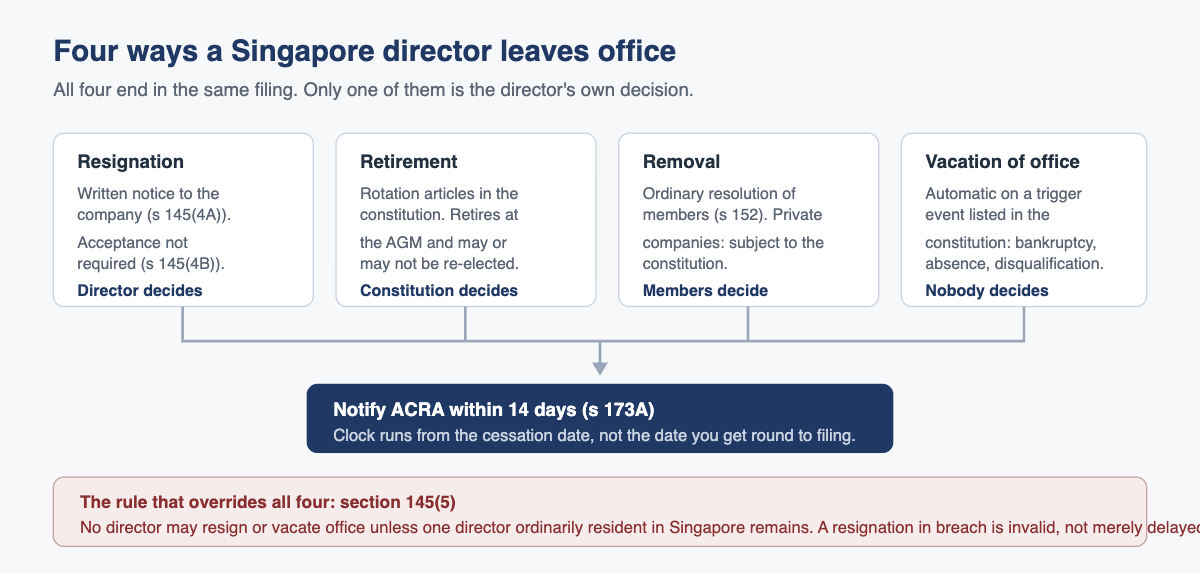
A Singapore director leaves office in one of four ways: they resign, they retire under the constitution, the members remove them, or their office is vacated automatically by an event the constitution treats as disqualifying. Whichever route applies, the company must notify ACRA within 14 days.
The route matters more than most people expect. It decides who has to agree, what paperwork exists afterwards, and what the effective date is. It also decides whether the departure is possible at all, because one rule in the Companies Act 1967 can render a resignation legally invalid no matter how carefully it was drafted.
This article covers leaving office voluntarily or at the members’ hand. Where a director is forced out by law rather than by choice, that is disqualification and it works differently: see director disqualification in Singapore.
The four ways out, side by side
| Route | Who decides | Where the rule lives | Typical effective date |
|---|---|---|---|
| Resignation | The director | Section 145(4A) of the Companies Act 1967, and the constitution | The date stated in the written notice, or the date the notice is given |
| Retirement | The constitution | The company’s constitution (rotation and re-election articles) | The conclusion of the general meeting at which the director retires |
| Removal by members | The members | Section 152 of the Companies Act 1967, and the constitution | When the resolution is passed |
| Vacation of office | Nobody, it happens automatically | The company’s constitution | The date the triggering event occurs |
Resignation: a written notice, not a negotiation
Section 145(4A) of the Companies Act 1967 provides that, unless the constitution says otherwise, a director may resign by giving the company a written notice of resignation. Section 145(4B) then removes the argument that founders most often have about this: the resignation of a director is not conditional upon the company’s acceptance of it.
Read those two together and the position is clear. A resigning director does not need the board’s permission, does not need a resolution accepting the resignation, and does not need the other directors to be pleased about it. The notice is the act.
Two qualifications sit on top. The first is the constitution, because section 145(4A) applies only unless the constitution otherwise provides: it can require a period of notice, a particular form, or delivery to a particular address. Most Singapore private companies do not impose anything unusual, but you have to look rather than assume. The second is the resident director rule in section 145(5), dealt with below, which overrides everything.
Getting the notice right
The notice should say who is resigning, from which company, from which office, and with effect from when. Deliver it in a way you can prove, because the proof is what you will need if the company later fails to file the cessation and you have to notify ACRA yourself. That self-notification route, and the evidence it demands, is set out in our guide to filing a notice of cessation. Ask for the board’s acknowledgement in writing too. Not because the resignation depends on it, but because an acknowledgement is the cleanest evidence of receipt there is.
Retirement: the route the constitution controls
For a private company, retirement is a creature of the constitution rather than of the statute. A constitution adopting rotation provisions will require a proportion of directors to retire at each annual general meeting, with the retiring directors usually eligible to offer themselves for re-election. A director who retires and is not re-elected has left office as surely as one who resigned, and the 14-day filing obligation is identical. The date of cessation is the conclusion of the meeting.
Two things come up repeatedly. Many modern private company constitutions drop rotation entirely, so directors stay in office until something else removes them. And companies that do have rotation articles frequently ignore them, then discover during due diligence that several directors technically retired years ago and were never re-elected. Our note on retirement of directors by rotation covers how to unpick that.
Removal by the members
Section 152 of the Companies Act 1967 gives the members the power to remove a director, and it treats public and private companies differently.
For a public company, section 152(1) allows removal by ordinary resolution before the expiry of the director’s period of office, despite anything in the constitution or in any agreement between the company and the director. That power comes with procedural protection: section 152(2) requires special notice, requires the company to send a copy to the director immediately, and entitles the director to be heard at the meeting whether or not they are a member, while section 152(3) lets the director circulate written representations. Section 152(8) prevents a public company director from being removed by a resolution of the other directors: only the members can do it.
For a private company, section 152(9) provides that, subject to any provision to the contrary in the constitution, a private company may by ordinary resolution remove a director before the expiry of their period of office despite anything in any agreement between the company and the director.
Those words “subject to any provision to the contrary in the constitution” are the ones that matter for owner-managed companies. A constitution can restrict or condition the removal power, and a shareholders’ agreement can make exercising it a breach of contract even where it is effective in company law. That is the classic founder dispute: the removal is valid, and it is also actionable. Section 152(7) makes the related point explicit for public companies, and the same logic applies commercially to private ones: removal does not deprive the director of compensation or damages for the termination of their appointment, and it does not terminate an employment contract.
Vacation of office under the constitution
Most constitutions contain a clause listing events that vacate a director’s office automatically: becoming bankrupt, becoming disqualified under the Act, becoming of unsound mind, being absent from board meetings for a defined period without leave, or giving written notice of resignation.
Nobody votes on a vacation of office. It happens on the date the triggering event occurs, and the company’s job is to notice it and file. The failure mode is obvious once stated: the trigger is often something the company learns about late or not at all, particularly prolonged absence, so the register is wrong from the trigger date rather than from the date anyone realised. If the trigger is a statutory disqualification, the constitution is not doing the work. The Act is, and that is part 2 of this pair.
The effective date, and why it is not the filing date
The date of cessation recorded at ACRA should be the date the director actually left office, not the date the transaction was filed.
That distinction has three consequences worth stating plainly:
- The 14 days runs from the cessation, not from the filing decision. Section 173A of the Companies Act 1967 requires notice within 14 days after the change in appointment. A resignation effective 02 February 2026 filed in August 2026 is six months late, and ACRA’s late lodgement penalties apply per late transaction.
- You cannot file a cessation forward. The transaction records something that has happened. A resignation taking effect in six weeks is filed after it takes effect.
- Duties run to the effective date, not the filing date. A director who resigned in March and whose cessation was filed in November was not a director from April onwards; the register was simply wrong. But a director who thought they had resigned and never delivered the notice was a director throughout, whatever they believed.
The rule that can stop you leaving
Section 145(5) of the Companies Act 1967 is the provision every departing director needs to read before signing anything.
It provides that, despite anything in the Act, in the constitution, or in any agreement with the company, a director must not resign or vacate office unless there remains in the company at least one director ordinarily resident in Singapore. Any purported resignation or vacation of office in breach of that subsection is invalid.
Note what that does. It does not delay the resignation and it does not make it conditional. It makes it a nullity. The person who signed the letter is still a director, still owes the duties in section 157 and elsewhere, and is still exposed to everything a director is exposed to. Our note on directors’ duties under section 157 sets out what that exposure looks like.
The rule bites hardest on the very large number of companies running on exactly one Singapore-resident director with no contingency. If that person wants out, the members have to appoint a qualifying replacement first, and if they will not or cannot, the departing director is stuck in office. Our note on sole director companies covers the structural version of the problem.
The exception: forced exits override the floor
Section 145(6) carves out the case where a director is required to resign or vacate office by virtue of disqualification, removal, or revocation of appointment under the disqualification provisions of the Act, including sections 148, 149, 149A, 154, 155, 155A and 155C, or under the equivalent provisions of the financial services legislation listed in that subsection. It also carves out a failure to obtain a share qualification within the period in section 147(1).
The resident director floor therefore protects the company against voluntary abandonment, not against the law removing someone. A company whose only resident director becomes bankrupt or is disqualified loses that director regardless, and is in breach of section 145(1) until the members fix it.
What happens to a company with no resident director
Section 145(7) allows the Registrar, on the Registrar’s own motion or on the application of any person, to direct the members to appoint a director ordinarily resident in Singapore. Section 145(8) makes each member in default of that direction liable on conviction to a fine not exceeding $2,000, and, for a continuing offence, a further fine not exceeding $1,000 for every day it continues after conviction. Section 145(9) allows the Court to order the appointment where the direction is not given or is ignored.
Then section 145(10) delivers the real consequence. If a company carries on business without at least one director ordinarily resident in Singapore for more than six months, a member who knows the company is trading in that state becomes liable for all the debts contracted during that period, and may be sued for them. That is personal liability for the shareholders, arising out of an unfilled board seat, and it is the most under-appreciated provision in this part of the Act.
What goes wrong in practice
Resigning by email to one director. The notice has to reach the company. An email to a colleague who then leaves himself, or to an address nobody monitors, is not something you will be able to prove later.
Assuming acceptance is needed, and waiting for it. Section 145(4B) says otherwise, and directors who wait to be released spend months believing they are still in office when they are not.
Signing a resignation letter as the only resident director. The letter is worthless and the director is still on the hook. Deal with the replacement first, in that order.
Removing a director without checking the constitution and the shareholders’ agreement. For a private company the statutory power is subject to contrary provision in the constitution, and a valid removal can still be a breach of contract that sounds in damages.
Forgetting that a departing director is often also a shareholder, a signatory and a Corppass user. Bank mandates, the register of members, Corppass assignments, guarantees and employment arrangements all need their own decision. Where the departure is disputed, the individual also has a statutory route to notify ACRA themselves, described in filing a notice of cessation.
Frequently asked questions
Does a Singapore company have to accept a director’s resignation?
No. Section 145(4B) of the Companies Act 1967 states that the resignation of a director is not conditional upon the company’s acceptance. Once written notice is given to the company in accordance with the constitution, the resignation takes effect. The board cannot refuse it, although the resident director rule can invalidate it.
Can the last director of a Singapore company resign?
Not if they are the only director ordinarily resident in Singapore. Section 145(5) makes any such resignation invalid, so the director remains in office with full duties. A qualifying replacement has to be appointed by the members first, and only then can the outgoing director leave.
Can shareholders remove a director of a private company?
Yes, by ordinary resolution under section 152(9) of the Companies Act 1967, subject to any provision to the contrary in the constitution. That power overrides anything in an agreement between the company and the director, but exercising it may still breach a shareholders’ agreement and give rise to a damages claim.
What is the deadline for telling ACRA that a director has left?
Fourteen days from the cessation. Section 173A of the Companies Act 1967 requires the company to notify the Registrar within 14 days after the change in appointment. The clock runs from the effective date of the departure, not from the filing decision. Late filings attract ACRA’s late lodgement penalties, charged per transaction.
Does resigning end my liability as a former director?
No. It ends your tenure from the effective date. Acts, approvals and omissions during your time in office remain yours, and duties that relate to the period you served, including anything later examined in an insolvency, are unaffected by the resignation.
Leaving cleanly
An orderly director exit is a sequence, not a letter: check the constitution, check who is left on the board, get the successor in place if the floor is in play, deliver the notice provably, file within 14 days, then close out the bank, the registers and the access.
Raffles Corporate Services runs that sequence for companies and for individual directors, including the awkward departures where the parties are no longer speaking. If you are the only resident director of a company you want to leave, that is worth a conversation before you sign anything.
You can reach us through Raffles Corporate Services, or read more on Singapore corporate secretarial practice at Singapore Secretary Services.
— The Editorial Team, Raffles Corporate Services