

Disqualification is automatic in most cases. It happens by operation of the Companies Act 1967 when a triggering event occurs, without a hearing, without a letter, and without anyone asking whether you intended it. You then cannot act as a director of, or take part in the management of, any company until the period ends or a court gives you permission.
Raffles Corporate Services works with a panel of experienced Singapore law firms who offer cost-effective and efficient legal service and advice. This article is general information only and is not legal advice.
That is the part that catches people. Everybody expects a court order to be preceded by a court, and several of the most common grounds are not court orders at all: they attach to bankruptcy, to a pattern of late filings, or to having been a director of three companies that ACRA struck off.
This is part 2 of a pair. If you are leaving a board voluntarily or at the members’ hand rather than by force of law, read how a director leaves office in Singapore instead.
Disqualified, debarred, removed: three different things
The words get used interchangeably and they are not interchangeable.
Disqualification is a statutory bar on acting as a director of, or being concerned in the management of, any company. It runs for a fixed period and applies across the board, not to one company.
Debarment is narrower. Under section 155B of the Companies Act 1967, where the Registrar is satisfied that a company is in default of a filing requirement, the Registrar may make a debarment order against a person who is a director or secretary of that company at the time. A debarred person may not act as a director or secretary of any other company, but may continue where they already hold office. The default must have persisted for three months or more, the Registrar must give at least 14 days’ notice and an opportunity to show cause, and the order lifts when the Registrar cancels or suspends it.
Removal is the members exercising a power. It has nothing to do with fitness and is covered in part 1.
The grounds, and how long each one lasts
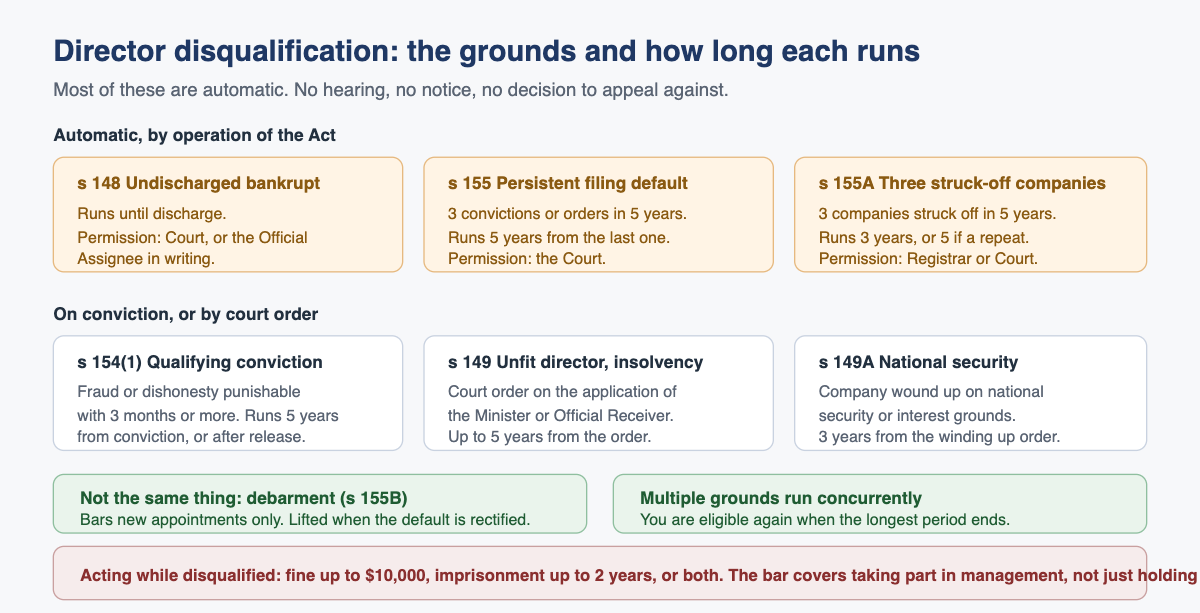
| Ground | Provision | How long it runs |
|---|---|---|
| Undischarged bankruptcy | Section 148 | Until discharge, unless the Court or the Official Assignee gives permission |
| Unfit director of an insolvent company | Section 149 | A period specified by the Court, not exceeding 5 years from the date of the order |
| Director of a company wound up on national security or interest grounds | Section 149A | 3 years from the date the winding up order is made |
| Conviction of a qualifying offence, no imprisonment imposed | Section 154(1), (4)(a) | 5 years from conviction, or a shorter period if the court so orders |
| Conviction of a qualifying offence, with imprisonment | Section 154(1), (4)(b) | From conviction, and continuing for 5 years after release from prison |
| Civil penalty under section 232 of the Securities and Futures Act 2001 | Section 154(1)(b), (4)(c) | 5 years from the imposition of the civil penalty |
| Court disqualification order on conviction of a management-related offence | Section 154(2) | As ordered by the court |
| Persistent default in filing documents with the Registrar | Section 155 | 5 years from the last conviction or order |
| Director of 3 or more companies struck off within 5 years | Section 155A | 3 years from the last striking off; 5 years for a person previously disqualified under that section |
| Disqualification under the Limited Liability Partnerships Act 2005 | Section 155C | For the period of the LLP disqualification |
| Disqualification under the VCC Act | Section 155D | For the period of the VCC disqualification |
Where more than one disqualification applies, the periods run concurrently, so the person becomes eligible again when the longest of them ends.
What counts as a qualifying offence under section 154
Section 154(1) catches a conviction for any offence, whether in Singapore or elsewhere, involving fraud or dishonesty punishable with imprisonment for three months or more. The threshold is the offence’s punishability, not the sentence imposed, and three months is a low bar. It also catches offences under Part 12 of the Securities and Futures Act 2001 where the conviction was on or after 01 July 2015, and, following the 2025 amendments, specified money laundering offences under the Corruption, Drug Trafficking and Other Serious Crimes (Confiscation of Benefits) Act 1992. That last limb feeds into the declarations a director now has to sign, covered in our note on ACRA’s amended Form 45.
Section 154(2) is different in character. It is a discretionary power: a court that convicts a person in Singapore of an offence in connection with the formation or management of a corporation, of an offence under section 157 or section 396B of the Companies Act 1967, or of an offence under section 237 or 239 of the Insolvency, Restructuring and Dissolution Act 2018, may make a disqualification order in addition to any other sentence.
The two that catch ordinary directors
Fraud convictions and national security windings up are rare. The two grounds that catch people running perfectly ordinary businesses are sections 155 and 155A, and neither requires anyone to have behaved dishonestly.
Section 155: persistent default in filing
Section 155 disqualifies a person who has been persistently in default in relation to “relevant requirements” of the Act. A relevant requirement, under section 155(2), is any provision requiring a return, account or other document to be filed with the Registrar, or notice of any matter to be given to the Registrar. Annual returns. Notices of change. The routine traffic of corporate secretarial work.
Persistent default may be conclusively proved by showing that, within a period of five years, the person has been adjudged guilty of three or more offences in relation to those requirements, or has had three or more orders made against them under section 13 or section 399. Section 155(4) makes clear the three convictions can arise from failures on the part of a company, not just the individual. The bar then runs for five years from the last conviction or order.
Three filing offences across five years is not exotic. It is what happens to a director who runs several small companies and treats compliance as something to catch up on later.
Section 155A: three struck-off companies in five years
Section 155A bars a person who has been a director of three or more companies whose names were struck off the register under section 344(4) read with section 344(1) within a period of five years, and who was a director of each at the time it was struck off. The bar runs three years from the date the last of them was struck off, or five years where the person has previously been disqualified under the same section.
This one is almost entirely a consequence of housekeeping. Companies that stop trading and are left to go dormant get struck off by the Registrar, and the directors often regard that as the tidy outcome. Three of them inside five years, and the director is barred from every board, including the profitable one they were keeping. Where an entity is heading for strike-off because its owners have disengaged rather than because the business failed, our note on the trapped nominee director’s exit covers the sequencing.
What “acting as a director” means while you are disqualified
The statutory language is deliberately wider than the job title. Sections 148, 154, 155, 155A, 155C and 155D each bar the person from acting as a director and from taking part, directly or indirectly, in the management of a company. Section 148 goes further still and refers to being “concerned in” the management of any corporation.
So resigning the directorship and continuing to run the business does not cure the problem. Neither does giving instructions through a family member who holds the seat, nor taking a general manager title while exercising the same authority. A person who directs the board from outside it is exposed both under these provisions and under the separate doctrine covered in our note on shadow directors in Singapore.
The penalty is consistent across the grounds. Acting in contravention of section 148(1), 149A(1), 154(3), 155(1), 155A(1), 155C(1) or 155D(1) is an offence carrying, on conviction, a fine not exceeding $10,000 or imprisonment for a term not exceeding two years, or both. A debarment order under section 155B carries the same maximum. There is a second cost that does not appear in the Act: a disqualified status is visible on ACRA’s register, on the individual’s people profile and in the company’s business profile, which banks and counterparties search as a matter of routine.
Telling the company, and the company telling ACRA
ACRA does not tell a company that one of its directors has been disqualified. The duty to speak up sits on the director.
Section 173E(1) requires a director who ceases to be qualified under section 148(1), 154(1), 155(1), 155A(1), 155C(1) or 155D(1), or by a disqualification order made by the Court under section 149, 149A or 154(2), to notify the company as soon as practicable and no later than 14 days after the disqualification. The same subsection lets the director give notice to the Registrar directly if they have reasonable cause to believe the company will not.
Section 173A(1)(d) then requires the company, within 14 days after it becomes aware, to tell the Registrar three things: that the person has ceased to be qualified, the provision under which that happened, and the date it happened. Default is an offence under section 173H, carrying a fine not exceeding $5,000 for the company and for every officer in default, plus a default penalty. The mechanics of that filing are set out in our guide to filing a notice of cessation.
One structural point deserves emphasis. Section 145(5), which normally makes a resignation invalid if it would leave the company without a resident director, does not apply to a director required to go because of disqualification. A company whose only Singapore-resident director is disqualified loses that director immediately, and is in breach of section 145(1) until the members appoint a replacement.
Applying for permission to act
An automatic disqualification is not appealed, because there is no decision to appeal against. What exists instead is a route to ask for permission to act despite the bar, and it depends on the ground.
| Ground | Who you apply to | Notice requirement |
|---|---|---|
| Section 148, undischarged bankruptcy | The Court, or the Official Assignee in writing | Notice of intention to apply to the Court must be served on the Minister and the Official Assignee, either of whom may oppose |
| Section 154, conviction or court order | The Court | Not less than 14 days’ notice to the Minister, who may be represented and may oppose |
| Section 155, persistent default | The Court | Not less than 14 days’ notice to the Minister, who may oppose |
| Section 155A, struck-off companies | The Registrar, or the Court | If applying to the Court, not less than 14 days’ notice to the Minister. A Court application cannot be made while a Registrar application is pending |
| Section 155B, debarment | The Registrar, to cancel or suspend the order | An aggrieved person may appeal to the Minister, but the appeal does not suspend the order |
Permission may be granted subject to conditions. Section 148(4) requires a person granted permission by the Court or written permission by the Official Assignee to lodge a copy of the order or written permission with the Registrar within 14 days. Where the permission relates to another ground, proof of the approval is lodged with ACRA so the register reflects it. Two practical notes: permission is usually sought to continue with one identified company rather than as a general licence, and the 14 days’ notice to the Minister is a real step with a real lead time that belongs in the timetable from the start.
What goes wrong in practice
Nobody knows the disqualification has happened. Automatic disqualifications under sections 148, 155 and 155A operate whether or not anyone writes to tell you. A director who assumes silence means safety can spend months in office unlawfully, and every one of those months is an offence.
The company finds out and does nothing for a quarter. The 14 days in section 173A(1)(d) runs from when the company becomes aware, not from when it decides to deal with it, and every officer in default is separately exposed.
Stepping back from the title but not from the business. The bar is on taking part in the management, however indirectly. Retaining the authority while giving up the label is the version that ends in prosecution.
Treating a bankruptcy discharge as automatic re-entry. Discharge ends the section 148 bar, but a person also caught by section 155 may still be running a separate clock. Check every ground, not the one you remember.
Assuming the register self-corrects. It does not. If your disqualification has ended and ACRA’s records still show it, somebody has to file. Our Companies Act 1967 deep-dive FAQ covers the everyday version of that repair.
Frequently asked questions
Does ACRA notify a director that they have been disqualified?
Not as a precondition. Several disqualifications operate automatically by law once the triggering event occurs, and individuals are expected to know their own position. ACRA does write to disqualified directors about the start and end dates in practice, but the bar takes effect regardless of whether a letter arrives.
How long does a director disqualification last in Singapore?
It depends on the ground. Bankruptcy lasts until discharge. A conviction under section 154 runs five years from conviction, or five years after release where a prison sentence was imposed. Persistent filing default runs five years from the last conviction. Three struck-off companies runs three years, or five for a repeat.
What happens if I act as a director while disqualified?
It is an offence carrying a fine of up to $10,000 or imprisonment of up to two years, or both. The bar covers not just holding the office but taking part, directly or indirectly, in the management of a company, so running the business without the title does not avoid it.
Can a disqualification be appealed?
An automatic statutory disqualification is not appealed, because there is no discretionary decision behind it. The route is to apply for permission to act: to the Court in most cases, to the Court or the Official Assignee for bankruptcy, and to the Registrar or the Court for the struck-off companies ground.
Our only resident director has just been disqualified. What now?
The company is immediately short of the section 145(1) requirement, because the resident director rule does not preserve a disqualified director in office. The members need to appoint a qualifying replacement quickly, and the company must notify ACRA within 14 days of becoming aware. A disqualified status is publicly visible in ACRA’s register in the meantime.
Staying on the right side of it
Almost nobody sets out to be disqualified. The two grounds that catch ordinary business owners, persistent filing default and three struck-off companies, are both the product of drift rather than decision, and both are preventable by someone watching the calendar.
Raffles Corporate Services keeps filings inside their deadlines for several hundred Singapore companies, closes dormant entities deliberately rather than letting them be struck off, and handles the notification filings when a disqualification does land. If you hold directorships across several entities and are not certain all of them are current, that is worth checking now rather than after the third conviction.
You can reach us through Raffles Corporate Services, or read more on Singapore corporate secretarial practice at Singapore Secretary Services.
— The Editorial Team, Raffles Corporate Services
Need help with corporate secretarial or compliance matters?
If you would like help with your company's corporate secretarial, governance or compliance requirements, email [email protected] or WhatsApp +65 8501 7133.
Our team can assist with corporate secretarial, accounting and tax matters. Where legal advice is needed, advisers from our associated law firms can assist.