
If your company changes its registered office, its office hours, its business activities, its email address or its constitution, you have 14 days to tell ACRA. Foreign companies get 30 days. The filing itself is free and takes effect immediately.
That short answer hides the part that actually catches companies out, which is scope. “Entity information” does not mean everything ACRA holds about you. It means the facts about the entity itself, as distinct from the facts about the people in it. Directors, secretaries, auditors and shareholders sit in different transactions with different rules, and trying to change one from the other is the commonest reason a filing fails.
What counts as “entity information”
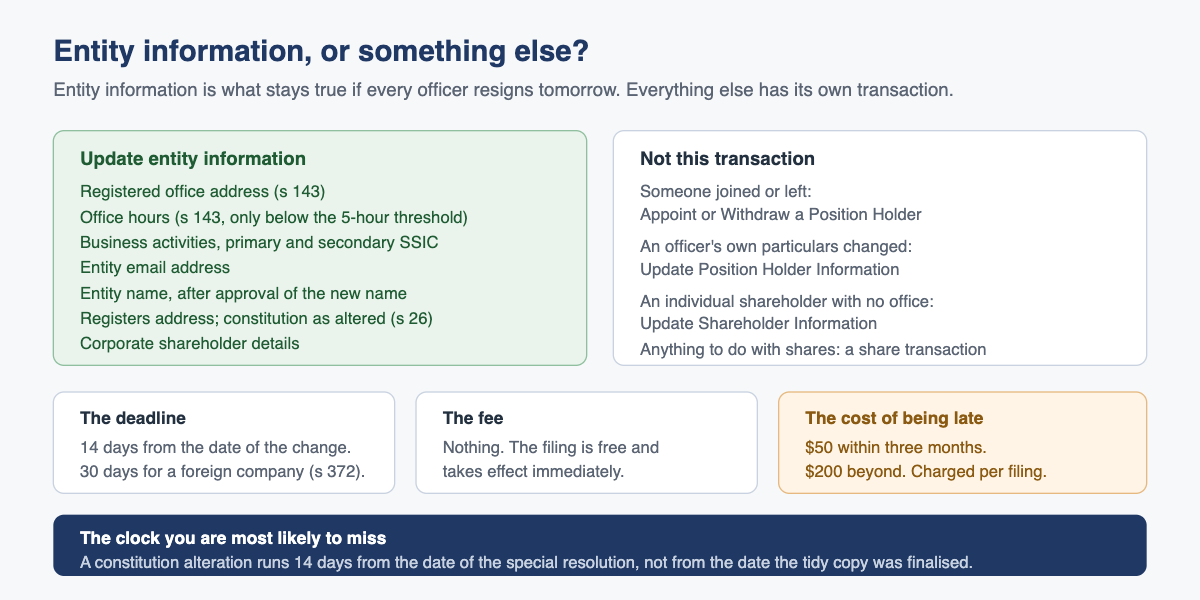
Think of it as the facts that would still be true if every officer resigned tomorrow:
- The entity’s name, after a name change has been approved.
- The entity’s email address, which is where ACRA’s correspondence lands.
- The business activities carried on, expressed as primary and secondary SSIC codes.
- The registered office address, and the office hours during which it is open to the public.
- The registers address, if statutory registers are kept somewhere other than the registered office.
- The constitution, once altered.
- For limited partnerships, branch information and a conversion out of Regulation 12 status.
- For foreign companies, the charter, statute, memorandum and articles or other constitutional instruments.
What is not entity information: the appointment, resignation or particulars of a director, chief executive officer, secretary or auditor; the particulars of an individual shareholder who holds no office; and anything to do with shares. Those have their own transactions, and we cover them separately in appointing or removing a position holder and changing an officer’s particulars.
The one genuine overlap is worth knowing: a corporate shareholder is maintained through the entity transaction rather than the shareholder one, because what is changing is another entity’s details.
The deadlines, the authority and the fee
| What changed | Deadline | Where the duty comes from | Fee | What you need before you file |
|---|---|---|---|---|
| Registered office address | 14 days | Section 143(1), Companies Act 1967 | Free | The new postal code, and the effective date |
| Office hours | 14 days | Section 143(1), Companies Act 1967 | Free | Nothing, unless the change takes you below the threshold |
| Business activities (SSIC) | 14 days | General 14-day notification rule | Free | The correct primary code, and any secondary code |
| Entity email address | 14 days | General 14-day notification rule | Free | A monitored mailbox, not a personal one |
| Entity name | 14 days from the change | Section 143 and the name change regime | Free to file | Approved name application, plus the special resolution as a PDF |
| Registers address | 14 days | General 14-day notification rule | Free | The address where the registers are actually kept |
| Constitution, after alteration | 14 days from the resolution | Section 26(2), Companies Act 1967 | Free | The special resolution and a copy of the constitution as altered |
| Foreign company: any of the above | 30 days | Section 372, Companies Act 1967 | Free | Notarised or certified true copies of constitutional documents |
Two things to take from that table. None of it costs money to file, so the expense is entirely in getting it wrong or late. And the deadline runs from the date of the change, not from the date you noticed, not from the date the paperwork was signed, and not from the date the landlord handed over keys.
The registered office rules people forget
A Singapore company must have a registered office in Singapore from the date of incorporation, to which all communications and notices may be addressed, and it must be open and accessible to the public for at least three hours during ordinary business hours on each business day. That is section 142 of the Companies Act 1967, and breaching it is an offence carrying a fine of up to $5,000 plus a default penalty.
Two practical consequences follow.
A residential address can be a registered office, but it still has to be accessible. The three-hour rule does not evaporate because the address is a flat. If you are using a home address and you are never there, you are not compliant, and the failure only becomes visible when something is served and nobody receives it.
Office hours are a separate filing, with a threshold. Notice of the days and hours during which the registered office is open is part of the same section 143 notification, but no notice of hours is required if the office is open for at least five hours during ordinary business hours on each business day. Companies that keep a normal working day therefore do not file office hours at all. Companies that restrict access to, say, three hours on weekday mornings do.
Our note on registered office requirements goes into the address itself in more detail.
Business activities: the filing with the longest tail
Changing your SSIC code takes two minutes and costs nothing. Getting it wrong quietly costs companies far more than any late penalty.
The primary SSIC code is what the rest of government reads when it wants to know what you do. It is visible on your Business Profile, so it is read by banks during onboarding, by IRAS, by agencies assessing grant eligibility, by insurers, and by counterparties running due diligence on you. A company whose registered activity says “management consultancy” while its invoices say “recruitment” has created a discrepancy that somebody will eventually ask about, usually at the least convenient moment.
The mechanics:
- Open the entity information page and select business activities.
- Enter the SSIC code, or search by keyword and pick from the list.
- Add a secondary activity if the business genuinely has one. Secondary is optional, not decorative.
- Enter the effective date of the change, which is when the business actually changed, not today.
- Review, tick the declaration and submit.
There is a limit worth knowing in advance. The entity information page maintains a primary and a secondary activity. If your business genuinely carries on more activities than that and you need them all on the record, the additional codes go through a general lodgement rather than through the standard update, with the relevant SSIC code stated for each.
Choosing the code in the first place is its own exercise, and we cover the choice and its knock-on effects in finding the right SSIC code.
Changing the constitution, and the deadline that runs from the resolution
The constitution is altered by special resolution, under section 26(1) of the Companies Act 1967. The filing deadline is the part companies miss: under section 26(2), a copy of the resolution, together with a copy of the constitution as altered, must be lodged with the Registrar within 14 days after the resolution is passed. Default is an offence carrying a fine of up to $1,000 and a default penalty.
Note where that clock starts. It is the date of the resolution, not the date the amended constitution was finalised and circulated. In practice the resolution is passed first and the tidy copy produced afterwards, which is exactly how companies end up filing on day 20.
Two further points trip up first-timers. An alteration adopting part of the model constitution can be done by reference rather than by setting out the text in full, but you still lodge. And if what you are altering is the objects clause, a different and slower regime applies, with a 21-day window for dissenting members or debenture holders to apply to Court, and lodgement timed around it. Do not treat an objects change as a routine amendment.
For the wider picture of what a constitution does and when it binds, see our explainer on the Companies Act 1967.
The name change sequence, in the only order that works
An entity name change is not a single filing. It is a sequence, and doing it out of order means starting again.
- Apply for the new name and get it approved. Nothing else can start until you hold an approved name application.
- Pass the special resolution authorising the change, and save it as a PDF. Local companies need this document at the filing stage.
- Name the PDF carefully. Spaces, special characters and non-English characters in the filename will cause the upload to fail, which is a maddening way to lose an afternoon.
- File the update, entering the transaction number from your approved name application.
- Deal with everything downstream: bank accounts, licences, contracts, invoices, the company seal if you use one, and your own letterhead.
The downstream step is the one that bites. ACRA changes its record instantly; your bank, your insurer and your licensing agency will not.
What goes wrong, and what it costs
The penalty structure is mild per item and unpleasant in aggregate. A late filing attracts a late lodgement penalty of $50 where the default is within three months, and $200 where it runs beyond three months, charged per filing rather than per visit. A company that lets four changes drift past the quarter is paying $800 for nothing.
But the penalty is rarely the real damage. Three scenarios we see repeatedly:
Correspondence sent to an address you left. ACRA, IRAS and the courts are entitled to serve documents at the registered office on the record. If that is a former office, the notice is validly served whether or not anybody read it. Statutory demands and enforcement notices do not care that your mail was not forwarded.
An email address belonging to someone who left. ACRA’s alerts and reminders go to the entity email address. If that is a founder’s personal account or a departed employee’s mailbox, you will miss annual return reminders and enforcement warnings alike. Put a monitored, role-based address on the record.
A constitution amended in a board pack and never lodged. The members resolved to change the share transfer provisions two years ago, the amended constitution sits in a folder, and ACRA still holds the old one. When an investor’s lawyer pulls the lodged constitution during diligence, the version mismatch becomes a condition precedent and a delay.
None of those is expensive to prevent, and all three are expensive to discover late. The pattern matches the one behind restoring statutory registers and records: the cost is never in the filing, it is in the reconstruction.
Frequently asked questions
How long do I have to tell ACRA my company moved office?
Fourteen days from the date of the change, under section 143(1) of the Companies Act 1967. Foreign companies have 30 days under section 372. The filing is free and takes effect immediately. Filing late attracts a penalty of $50 within three months of the due date, or $200 beyond that.
Do I have to file my company’s office hours?
Only if the registered office is open for less than five hours during ordinary business hours on each business day. Above that threshold no notice of hours is required. The underlying obligation still stands: the office must be open and accessible to the public for at least three hours on each business day.
Can I change my company name directly in the entity information page?
Not on its own. You must first apply for and obtain approval of the new name. Only then can you file the change, quoting the transaction number from the approved name application and uploading the special resolution as a PDF. Local companies always need that resolution.
How many business activities can my company have on the record?
The standard entity information update maintains a primary activity and one secondary activity. If the business genuinely carries on more and you need them all recorded, the additional SSIC codes are filed through a general lodgement instead, with the relevant code stated for each activity.
I altered the constitution three weeks ago. Am I already late?
Yes. Section 26(2) requires a copy of the resolution and a copy of the constitution as altered to be lodged within 14 days after the resolution is passed, and default is an offence carrying a fine of up to $1,000 plus a default penalty. File it now rather than waiting for the next annual cycle.
The quiet version of this problem
Almost nobody sets out to keep a stale record at ACRA. What happens is that the office move, the activity shift and the constitutional amendment each belonged to a different person, none of whom thought of themselves as responsible for the filing.
Raffles Corporate Services holds the entity record for several hundred Singapore companies, files these updates inside the 14-day window, and reconciles what ACRA holds against what the company actually does before each year end. If you are not certain what address, email or activity code is showing against your company, we can tell you in a few minutes and fix it in a few more.
You can reach us through Raffles Corporate Services, or read more on Singapore corporate secretarial practice at Singapore Secretary Services.
— The Editorial Team, Raffles Corporate Services