

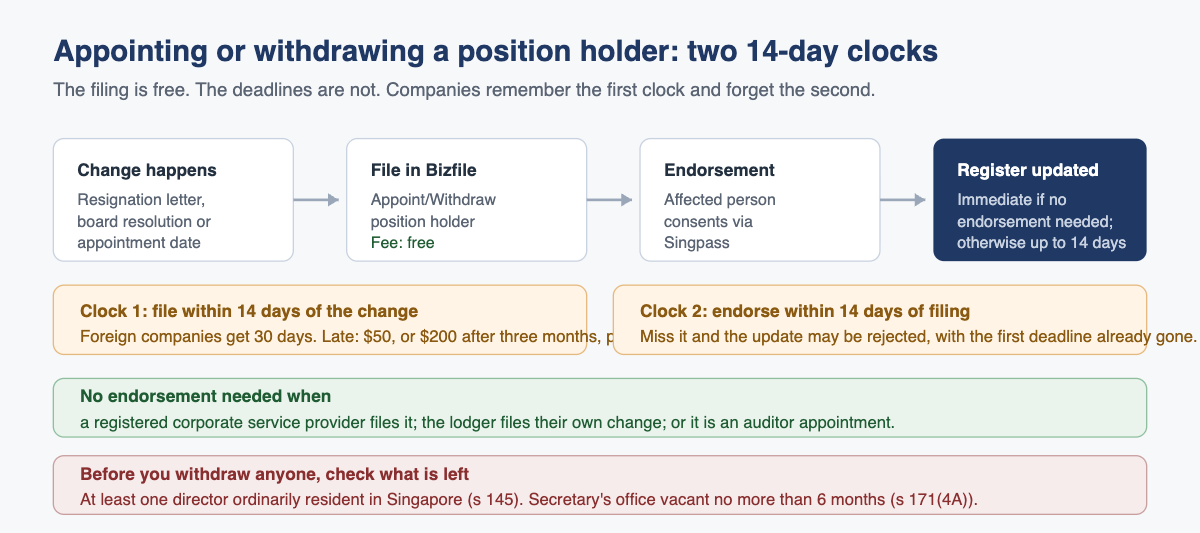
Adding or removing a position holder is free, takes one Bizfile transaction, and must reach ACRA within 14 days of the change. Most appointments and withdrawals then need the affected person to endorse them electronically, within a further 14 days, before the register is updated.
Raffles Corporate Services works with a panel of experienced Singapore law firms who offer cost-effective and efficient legal service and advice. This article is general information only and is not legal advice.
Those two 14-day clocks are the whole of the problem. Companies remember the first one and forget the second, and the transaction sits in limbo until it is rejected. Then the change is late, the penalty attaches, and somebody has to file it again.
Here is who can file, what you need in hand before you start, how endorsement works, and what it costs when it slips.
What ACRA means by a “position holder”
A position holder is anybody whose name ACRA records as holding an office in your entity. The list depends on the entity type.
| Entity type | Positions ACRA records |
|---|---|
| Local company | Director, managing director, alternate director, secretary, chief executive officer, auditor |
| Foreign company branch | Director, authorised representative |
| Limited liability partnership | Partner, manager |
| Limited partnership | General partner, general partner as nominee or trustee, limited partner, manager |
| Sole proprietorship or partnership | Owner, nominee or trustee, authorised representative |
| Public accounting firm, accounting LLP, public accounting corporation | Partners, directors, secretary, public accountant employees and the specific statutory categories that apply to each |
Shareholders are not position holders. Changes to share ownership go through a different transaction entirely, and so do changes to an existing officer’s own particulars: for that, see our guide to updating a position holder’s information.
Who can actually file it
Three categories of filer can submit the transaction: an authorised officer of the entity itself, a registered corporate service provider acting for the entity, or a Group of Companies user where the entity sits inside a group filing arrangement.
If you are filing in-house, the person doing it needs Corppass access to the entity with the right e-service assigned. If that is not in place yet, sort that first: our guides to logging in to Bizfile as a business user and to deciding who gets which e-service role cover it.
One category is not optional. If the person being appointed or withdrawn is a foreigner, the filing must go through a registered corporate service provider. That is a licensing matter under the corporate service provider regime, not a Bizfile preference, and it applies however simple the change looks.
You cannot remove yourself
A company officer cannot file their own withdrawal through this transaction. Another authorised position holder has to submit it for them.
That is fine when the board is functional. It is a genuine trap when it is not, which is exactly when directors want out. The Companies Act 1967 anticipates this: under section 173E, a director or secretary who has resigned, been removed or retired may give the notice to the Registrar themselves if they have reasonable cause to believe the company will not do so. A director who has become disqualified must notify the company within 14 days and may likewise notify the Registrar directly.
So the practical answer to “the company will not file my resignation” is not to wait. It is to document the resignation, give the company a reasonable opportunity, and then use the statutory self-notification route.
What to have in hand before you start
For an appointment, you need the incoming person’s full name, identification type and number, nationality or citizenship where they hold a passport or FIN, residential address and contact details. If the incoming position holder is a corporate entity rather than an individual, you enter its entity details instead.
Two pre-conditions catch people out:
- Outstanding MediSave. A new owner or partner of a sole proprietorship, partnership, limited partnership or limited liability partnership must have cleared any outstanding MediSave liability with the CPF Board first. The transaction will not go through until they have.
- Pass holders. If the incoming person holds a Foreign Identification Number, you need consent from the relevant pass issuing authority, typically the Ministry of Manpower or the Immigration & Checkpoints Authority, before the appointment is made.
For a withdrawal, you need the outgoing person’s name, the effective date of withdrawal and the reason for it. Pick the date carefully. It is the date the change took effect, not the date you got round to filing, and it is what starts the 14-day clock.
Separately, and often forgotten, section 173C of the Companies Act 1967 requires the company to keep at its registered office a signed consent to act for each director and each secretary, plus a statement that the director is not disqualified. That document is not uploaded to ACRA. It lives in your own records, and it is the first thing anyone asks for in a dispute about whether an appointment was ever valid.
The filing, in order
- Log in to Bizfile as a business user through Corppass, using the profile for the correct entity.
- Open the Appoint/Withdraw position holder transaction from the Manage menu, and choose whether to start a new transaction or continue a saved draft.
- To appoint, add the position holder, specify whether they are an individual or a corporate entity, and enter the required particulars. Save each person before adding the next.
- To withdraw, find the existing position holder in the list, expand their record, select the position being given up, then enter the withdrawal date and reason.
- Review and submit. You can do appointments and withdrawals in the same transaction, which is what you want when one director is replacing another.
- If endorsement is required, you will see a confirmation that the change is pending endorsement rather than complete.
- Track the transaction status afterwards. It is not done until the status says so.
Endorsement: the second clock
Most changes need the affected position holder to endorse them. They log in to Bizfile as an individual user through Singpass, find the request under pending actions on their dashboard, answer the declaration questions and submit their consent.
They have 14 days. If they do not endorse in time, the update may be rejected outright, and you are back at the beginning with the original deadline already gone.
Endorsement is not required in three situations: where the transaction is filed by a registered corporate service provider, where the lodger is submitting their own appointment or withdrawal, and for auditor appointments.
That first exception is the reason many companies simply route officer changes through their corporate secretary. It removes an entire failure point.
The fee, the deadline and the penalty
| Item | Position |
|---|---|
| ACRA fee for the transaction | Free |
| Processing time, no endorsement needed | Immediate |
| Processing time, endorsement needed | Up to 14 days |
| Filing deadline, most entity types | Within 14 days of the change |
| Filing deadline, foreign companies | Within 30 days of the change, under section 372 of the Companies Act 1967 |
| Late lodgement penalty, within 3 months of the due date | $50 |
| Late lodgement penalty, more than 3 months late | $200 |
| Offence for default, companies | Fine up to $5,000 plus a default penalty, under section 173H |
The penalty applies per late transaction. Two directors resigning and one appointed, filed six months late, is three late transactions and $600, not $200. ACRA’s late lodgement penalty schedule sets out the arithmetic.
What goes wrong in practice
The endorsement that never happens. An outgoing director leaves on bad terms, or an incoming one is travelling, and nobody chases the endorsement. The transaction lapses quietly. The company only notices when a bank or an auditor pulls the ACRA register months later and the board composition is wrong.
Filing the resignation date wrong. People file the date the board met rather than the date stated in the resignation letter, or the date the replacement was found. The date on the register is the date the law treats as effective, and it drives the late lodgement calculation.
Losing the resident director. Section 145 requires at least one director ordinarily resident in Singapore. Withdraw the only one who qualifies and the company is instantly non-compliant, whatever the commercial logic. Check the composition before you file, not after. Our note on appointing company directors sets out the eligibility rules.
Leaving the secretary’s office vacant. Section 171(4A) says the office must not be left vacant for more than 6 months at a time, and the secretary must be a natural person resident in Singapore who is not debarred. See appointing a company secretary.
Forgetting the auditor. Directors must appoint the first auditor within 3 months of incorporation unless the company is exempt, under section 205. That appointment is filed through this same transaction and it does not need endorsement. Our guide to appointing your first auditor covers when the exemption applies.
Frequently asked questions
How long do I have to tell ACRA about a new or departing director?
Fourteen days from the date of the change, under section 173A(1) of the Companies Act 1967. Foreign companies registered in Singapore get 30 days under section 372. Missing the deadline attracts a late lodgement penalty of $50 within three months of the due date and $200 after that, charged per transaction.
Does it cost anything to appoint or remove a director?
No. ACRA charges no fee for the appoint or withdraw position holder transaction, whether you are adding someone, removing someone, or doing both in the same filing. The only money involved is the late lodgement penalty if you miss the 14-day deadline, which is $50 within three months and $200 after that, plus whatever your corporate secretary charges for handling it.
Can I resign as a director if the company refuses to file it?
Yes. Under section 173E of the Companies Act 1967, a director who has resigned, been removed or retired may lodge the notice with the Registrar directly if they have reasonable cause to believe the company will not. Keep evidence of the resignation and of the company’s failure to act.
Why is my appointment still showing as pending?
Almost always because the affected person has not endorsed it. They need to log in to Bizfile with Singpass, open the request under pending actions, and consent. They have 14 days, after which the update may be rejected and you have to file again.
Do I need a corporate service provider to appoint a foreigner as a director?
Yes. Where the person being appointed or withdrawn is a foreigner, the transaction must be filed by a registered corporate service provider. That is a regulatory requirement, not a Bizfile setting, and it applies regardless of how straightforward the change is.
Closing the loop
The filing itself is trivial. What is not trivial is noticing that a change happened, getting the right consent signed before the appointment takes effect, choosing the right effective date, and chasing an endorsement out of somebody who has already mentally left the company.
That is where Raffles Corporate Services earns its keep. We file officer changes for several hundred Singapore companies, and because a registered corporate service provider’s filings do not require endorsement, the second clock stops being your problem. If you have a board change coming, or you suspect an earlier one never completed, we can check the ACRA register against your own records in an afternoon. There is more on Singapore corporate secretarial practice at Singapore Secretary Services.
— The Editorial Team, Raffles Corporate Services
Need help with corporate secretarial or compliance matters?
If you would like help with your company's corporate secretarial, governance or compliance requirements, email [email protected] or WhatsApp +65 8501 7133.
Our team can assist with corporate secretarial, accounting and tax matters. Where legal advice is needed, advisers from our associated law firms can assist.