
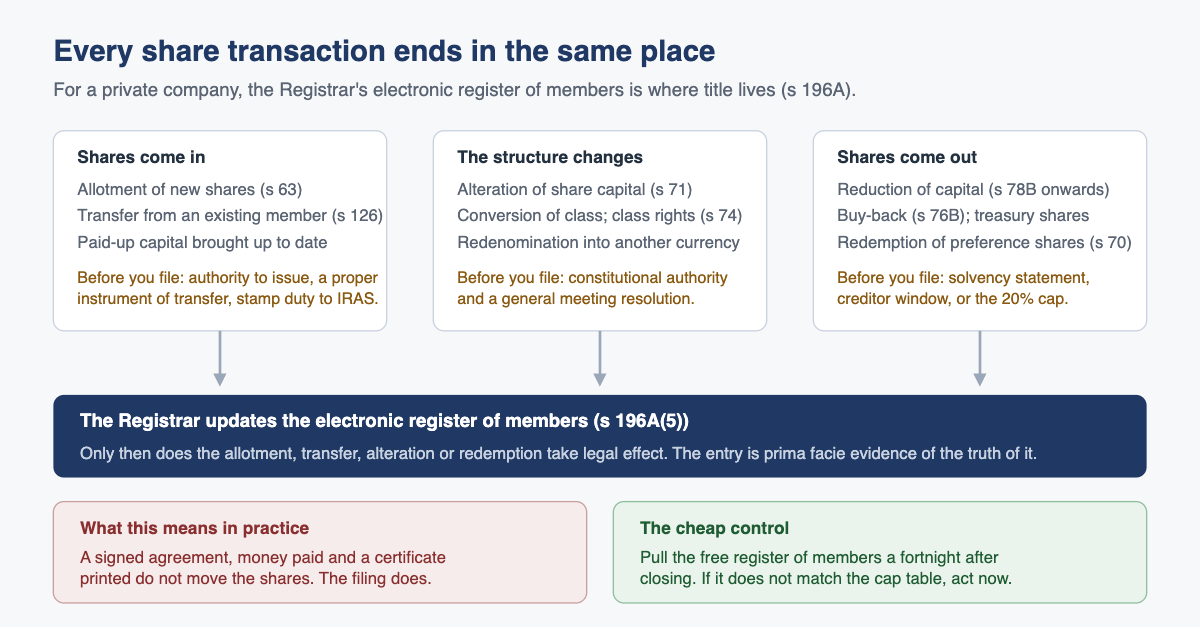
In a Singapore private company, a share transaction is not a piece of paperwork that follows the deal. It is the deal. An allotment, a transfer, an alteration of capital and a redemption all take legal effect only when the Registrar updates the company’s electronic register of members, and nothing you sign gets you there on its own.
That single rule, in section 196A(5) of the Companies Act 1967, explains most of what confuses business owners about shares. You can sign a share purchase agreement, transfer the money, issue a certificate and shake hands, and still not own the shares. The buyer becomes a member when ACRA’s register says so.
This article is the map: every share transaction ACRA recognises, what each requires before you can file it, and where the traps are. The individual transactions are covered in depth elsewhere in this series, so what follows is the overview rather than the walkthrough.
Why the register is the transaction
For a private company, the Registrar keeps and maintains the electronic register of members. It records who the members are, their addresses, the shares each holds and the amount paid or treated as paid on them, the date of each allotment, and the date each person became or ceased to be a member.
Section 196A(5) then does the important work. It requires the Registrar to update that register in line with the lodgements the Act requires or permits, and it lists them: the allotment return, the notice of transfer, the notice of alteration of share capital, the redemption notice, the buy-back notice and several others. An entry in the register is prima facie evidence of the truth of what it records.
So when people ask whether they need to file the share transfer with ACRA as well, the question has a false premise. There is no “as well”. The filing is the mechanism by which title moves.
Public companies work differently, and the distinction matters if you ever convert. A public company maintains its own register of members and lodges notice of transfers rather than depending on the Registrar’s register for effectiveness.
Every share transaction, and what it actually needs
| Transaction | What must happen first | What is lodged | The catch |
|---|---|---|---|
| Allotment of new shares | Members’ authority to issue, and a board resolution | Return of allotment with the prescribed particulars, including every member’s holding | Takes effect only on the register update, under section 63 |
| Transfer of shares | A proper instrument of transfer delivered to the company, board approval if the constitution requires it, and stamp duty paid to IRAS | Notice of transfer | Takes effect only on the register update, under section 126 |
| Conversion of shares to another class | Class rights process under section 74, and constitutional authority | Notice of conversion | A variation of class rights can be challenged by holders of 5% of the class |
| Redenomination into another currency | The required resolution | Notice of redenomination | The historical figures in your accounts do not restate themselves |
| Alteration of share capital | Constitutional authority and a general meeting resolution, under section 71 | Notice of alteration | Consolidation, subdivision, conversion into stock and cancellation of untaken shares all sit here |
| Update to paid-up share capital | Money actually received against partly paid shares | Notice to update paid-up capital | Issued capital and paid-up capital are different numbers and both are public |
| Reduction of share capital | Special resolution, solvency statement where required, and prescribed publicity | Resolution and the prescribed documents | Creditors have six weeks to object; you lodge after six weeks and before eight |
| Buy-back of shares | Express permission in the constitution, and the correct authorising resolution | Notice of purchase or acquisition | Ordinary shares bought in a period are capped, generally at 20% of the class |
| Cancelling or disposing of treasury shares | A board decision on what to do with them | Notice of cancellation or disposal | Treasury shares carry no votes and no dividends while held |
| Redeeming redeemable preference shares | The shares must be fully paid; a solvency statement is needed if redeemed out of capital | Notice of redemption | A public company gives notice within 14 days of redeeming |
| Financial assistance for share purchases | The conditions in the Act must be satisfied | Depends on the route used | The general prohibition is the rule; the exceptions are narrow |
| Fixing an error in a share filing | Identify what was actually filed | Notice of Error | Not a substitute for a transaction you never filed at all |
The four transactions a normal private company will actually use
Most Singapore private companies never touch treasury shares, redenomination or financial assistance. Four transactions cover almost everything.
Allotting new shares
New shares are created and issued to someone, whether a founder, an investor or an employee exercising an option. The company needs authority to issue, the directors resolve to allot, and a return of allotment is lodged carrying the number and class of shares, what was paid, what remains unpaid, and the full membership position afterwards. Until the Registrar updates the register the allotment has not taken effect, which is why a subscription agreement dated Friday does not make anyone a shareholder on Friday.
If the shares are going to employees under an option or award plan, the tax treatment is a separate question from the filing, and our note on employee share option schemes covers that side.
Transferring existing shares
Nothing new is created. An existing shareholder sells or gives shares to somebody else. Three things must happen before the filing, and all three are routinely missed by people doing it themselves:
- A proper instrument of transfer must be delivered to the company. Section 126 is explicit that the company must not lodge a transfer without one.
- The constitution may require directors’ approval, or give existing members pre-emption rights. Check before, not after.
- Stamp duty on the transfer is payable to IRAS. That is a separate obligation with its own deadline, and ACRA’s filing does not discharge it.
Then the notice of transfer is lodged, and the transfer takes effect when the register is updated. A share purchase agreement that never became a lodgement is a contract, not a change of ownership. If new shareholders are joining an existing shareholders’ agreement, the deed of adherence is the document that ties them into it.
Updating paid-up capital
Shares can be issued without being fully paid. Issued capital is the amount subscribed; paid-up capital is the amount actually received. Both appear on your Business Profile, and the gap between them is visible to anyone who looks.
When the balance is paid, a notice updating the paid-up amount brings the record into line. Companies that raised capital on paper at incorporation and paid it in later frequently forget this step, then discover it during a bank onboarding or a tender. The accounting treatment of the same money is covered in our note on share capital, share premium and reserves.
Altering share capital
Section 71 covers the structural changes that do not involve anybody putting money in or taking it out: consolidating shares, subdividing them, converting paid-up shares into stock and back, and cancelling shares that were never taken up. The company needs constitutional authority and a general meeting resolution, then lodges a notice of alteration. As with everything else, the alteration takes effect when the register is updated.
A cancellation under this section is not a reduction of capital. Reducing capital is a different and much slower process, and it is worth knowing the shape of it before you start: special resolution, solvency statement where cash or assets are leaving the company, a six-week window in which creditors may apply to Court, and lodgement only after those six weeks and before eight weeks have passed from the resolution date. A reduction planned two weeks before a year end will not complete in time.
What goes wrong: the deal that never reached the register
The pattern is the same every time, and it is almost never caused by ignorance of the law. It is caused by the transaction feeling finished.
The parties negotiate, sign, pay and move on. The certificate is printed. Everyone behaves as though the shares have moved: the new shareholder attends meetings, receives dividends, is described as a shareholder in a grant application. Nobody lodges anything, because the person who would have lodged it was not in the room when the deal closed.
Years later it surfaces. An acquirer’s lawyers pull the register of members from ACRA and it does not match the cap table. Or a founder dies and their estate finds that shares transferred in 2023 are still registered in their name. Or the company applies for a scheme with a shareholding condition and cannot evidence it. The fix is possible but slow, it involves reconstructing evidence of intention from years back, and it is frequently contested by whoever benefits from the old position.
The cheap control is to treat the filing as part of closing, not as follow-up. Pull the free register of members a fortnight afterwards and read it. If it does not say what you think it says, you have found the problem while it is still small.
Two related exposures are worth checking at the same time. A change in shareholding almost always changes who controls the company, which engages the register of registrable controllers. And where shares are held by someone other than the true owner, the nominee shareholder rules carry disclosure obligations the share filing does not satisfy.
Where the rest of this series goes
This page is the overview. Each transaction gets its own treatment later in the series, because each has its own document set and its own way of failing:
- Share types and what a shareholding percentage actually controls
- Share transactions in detail, and when ACRA must be notified
- Filing a return of allotment
- Filing a transfer of shares, and the stamp duty and certificate steps around it
- Updating shareholder information
- Filing a notice to update paid-up share capital
- Altering share capital
If you need one of those before it publishes, the underlying provisions are all in the Companies Act 1967, and ACRA’s own overview of share transactions lists the filing requirements.
Frequently asked questions
When does a share transfer in a Singapore private company actually take effect?
When the Registrar updates the company’s electronic register of members, under sections 126 and 196A(5) of the Companies Act 1967. Signing the instrument of transfer, paying the consideration and issuing a certificate do not move legal title on their own. Until the register is updated, the transferor remains the member.
Do I pay stamp duty to ACRA when I transfer shares?
No. Stamp duty on a share transfer is payable to IRAS and is entirely separate from the ACRA filing. Filing the transfer with ACRA does not discharge the duty, and paying the duty does not update the register. Both steps are required, and each has its own timing.
Can my company buy back its own shares?
Only if its constitution expressly permits it, and only using one of the authorised routes with the correct resolution. There is also a cap on how many ordinary shares of a class may be bought or acquired in the relevant period, generally 20% of that class. Buy-backs are not a substitute for a capital reduction.
How long does a reduction of share capital take?
Longer than most people plan for. After the special resolution, creditors have a six-week window in which they may apply to Court to cancel it, and the documents are lodged only after that six weeks has expired and before eight weeks have passed from the resolution date. A reduction is a two-month exercise at best.
What if I filed a share transaction with the wrong figures?
A Notice of Error is the route for correcting clerical, typographical and similar errors in share filings already lodged. It is not the route for a transaction you simply never filed. If an allotment or transfer was never lodged at all, you file the transaction itself, late, and deal with the consequences of the delay.
Keeping the register and the cap table in the same place
A surprising number of Singapore companies run two versions of who owns them: the spreadsheet the founders maintain, and the register ACRA maintains. For as long as nothing happens, the difference does not matter. The moment somebody wants to buy, lend to or invest in the company, only one of them counts.
Raffles Corporate Services files share transactions for Singapore private companies, checks the constitution before the transfer rather than after it, coordinates the stamp duty step, and reconciles the ACRA register against the company’s own records before each year end. If you are not certain your register matches your cap table, that check takes a few minutes and is worth doing before someone else does it for you.
You can reach us through Raffles Corporate Services, or read more on Singapore corporate secretarial practice at Singapore Secretary Services.
— The Editorial Team, Raffles Corporate Services