
More than 50% lets you carry an ordinary resolution and run the company day to day. 75% lets you carry a special resolution and change the company’s structure. More than 25% blocks a special resolution. Below that, your rights come from the Act, not from your votes.
That summary explains most shareholder disputes in Singapore private companies. Founders negotiate percentages as though they were only about money: who gets what slice of an exit. In practice a percentage is a bundle of statutory rights, and the bundle changes sharply at four or five points on the scale.
What follows is the ladder, with the provision behind each rung. It assumes one class of ordinary shares carrying one vote each. If your company has multiple classes, read this alongside the companion article on ordinary versus preference shares, because the percentages below track votes, not share numbers.
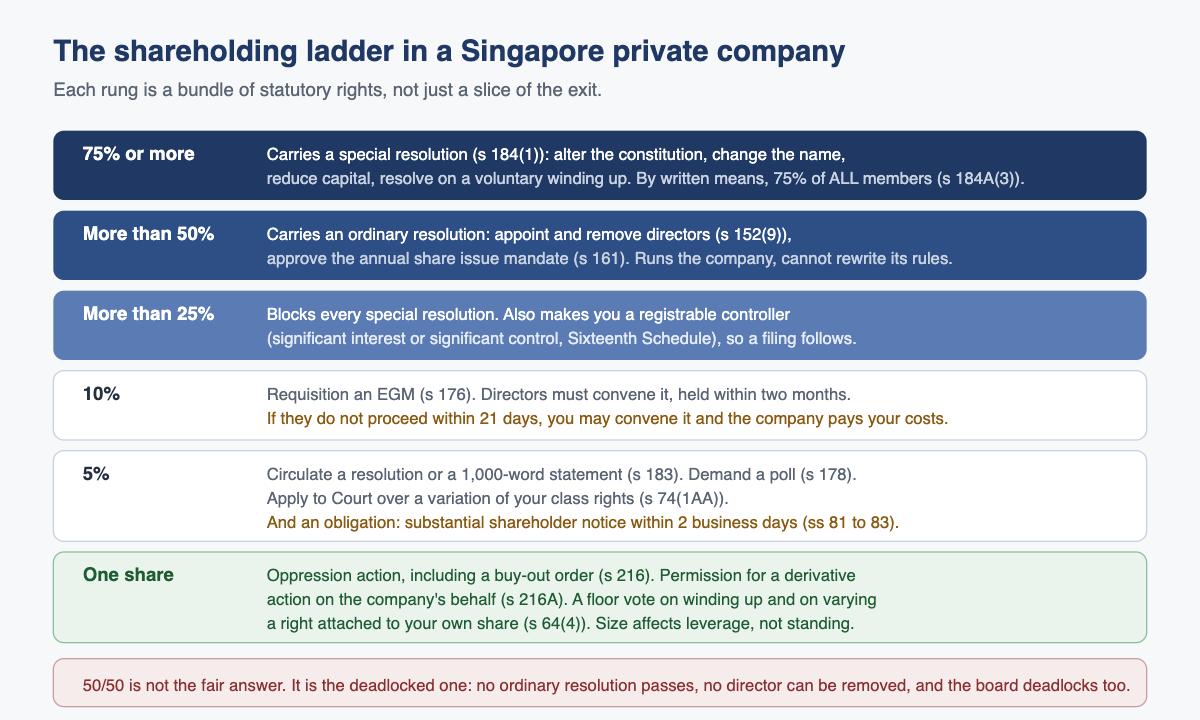
The whole ladder, at a glance
| Your holding | What it unlocks | Where it comes from |
|---|---|---|
| One share | Standing to bring an oppression action, to seek permission for a derivative action, and a floor vote on winding up and on varying your own class rights | Sections 216, 216A and 64(4) |
| 5% | Circulate a resolution or statement; demand a poll; apply to Court over a variation of your class rights; substantial shareholder notification duties | Sections 183, 178, 74(1AA) and 81 to 83 |
| 10% | Requisition an extraordinary general meeting the directors must convene | Section 176 |
| More than 25% | Blocks any special resolution. Also makes you a registrable controller | Section 184(1) and the Sixteenth Schedule |
| More than 50% | Carries any ordinary resolution: appoint and remove directors, authorise share issues | Sections 152(9) and 161 |
| 75% or more | Carries any special resolution: alter the constitution, change the name, reduce capital, wind up voluntarily | Sections 184(1) and 184A(3) |
| 90% or more | Opens the route to compulsorily acquire dissenting shareholders under an approved scheme or contract | Section 215 |
| 100% | Removes every notice and timing problem, and is the only way to insert or alter an entrenching provision | Section 26A |
More than 50%: control of the company day to day
An ordinary resolution needs a simple majority of the votes cast. If you hold more than half the voting shares and you turn up, you decide.
That covers what determines who runs the business. You appoint directors and you remove them: under section 152(9), and subject to any provision to the contrary in the constitution, a private company may remove a director by ordinary resolution before the end of their term, despite anything in any agreement between the company and the director. You authorise the directors to issue shares under section 161, and that authority lapses at the conclusion of the next annual general meeting.
Two qualifications. A bare majority controls the board but not the constitution: you cannot change the rules of the game with 51%. And “subject to any provision to the contrary in the constitution” means a well-drafted constitution, or an entrenching provision under section 26A, can put a director beyond the reach of a simple majority. That is why the constitution is read before the shareholders’ agreement in any dispute, as our note on shareholders’ agreement versus constitution explains.
75%: control of the company’s structure
Section 184(1) defines a special resolution: passed by a majority of not less than three-fourths of the members who, being entitled to do so, vote in person or by proxy at a general meeting of which not less than 14 days’ written notice (21 days for a public company) specifying the intention to propose it as a special resolution has been given. Under section 184(2), shorter notice is possible if agreed by a majority in number of the members entitled to attend and vote, together holding not less than 95% of the total voting rights.
Special resolutions are the structural ones: altering or adding to the constitution under section 26(1), changing the company’s name under section 28(1), reducing share capital, and resolving on a members’ voluntary winding up.
The 75% that is not the same 75%
At a meeting, the 75% in section 184(1) is 75% of the members who actually vote. Someone who does not attend and does not appoint a proxy is simply not counted.
Pass the same resolution by written means under section 184A, which is how most private companies do it, and the arithmetic changes. Section 184A(3) requires agreement from members representing at least 75% of the total voting rights of all members who would have the right to vote at a general meeting. Not 75% of those who reply. The same asymmetry applies to ordinary resolutions under section 184A(4).
So a shareholder holding 26% who never signs can defeat a written special resolution by doing nothing, where at a meeting they would have had to attend and vote against it. If a written resolution is not coming back signed, convene the meeting.
More than 25%: the blocking stake, and the controller line
More than 25% is not a positive power. It is a veto. No special resolution can pass over your objection, because the other side cannot reach three-quarters. The constitution cannot be changed, the name cannot be changed, capital cannot be reduced, and a voluntary winding up cannot be resolved without you. Founders give away 26% surprisingly often, usually to an early investor, without realising they have handed over a permanent structural veto rather than a passive stake.
The same line does something else. Under the Sixteenth Schedule to the Companies Act 1967, a person has a significant interest if they have an interest in more than 25% of the shares or of the voting power, and significant control if they hold more than 25% of the rights to vote on matters decided by the members. Either makes them a registrable controller under Part 11A, which the company must record in its register of registrable controllers and lodge with ACRA. Where shares are held by one person for another, the nominee shareholder rules sit on top and are routinely missed.
10%: the right to force a meeting
Section 176(1) is the minority’s most practical weapon, and almost nobody uses it. On the requisition of members holding not less than 10% of the paid-up shares carrying the right to vote at general meetings, the directors must, despite anything in the constitution, immediately proceed to convene an extraordinary general meeting, to be held as soon as practicable and in any case not later than two months after the requisition is received. It must state the objects of the meeting, be signed by the requisitionists, and be deposited at the registered office.
If the directors do not proceed within 21 days, the requisitionists, or any of them representing more than 50% of the total voting rights of all of them, may convene the meeting themselves, to be held within three months. The company must reimburse their reasonable expenses, and may recover those sums out of fees or remuneration owed to the directors in default.
That last sentence is the bit that concentrates minds. Ignoring a valid 10% requisition is personally expensive for the directors who ignore it.
5%: four distinct rights, three of them forgotten
Put a resolution on the agenda. Under section 183, members representing not less than 5% of the total voting rights (or not less than 100 members holding shares on which an average of at least $500 per member has been paid up) can require the company to give notice of a resolution to be moved at the next annual general meeting, and to circulate a statement of up to 1,000 words on it. Deposit deadlines apply: not less than six weeks before the meeting for a resolution, one week for anything else.
Force a poll. Section 178 voids any constitutional provision that would make ineffective a demand for a poll by not less than five members entitled to vote, or by members representing not less than 5% of the total voting rights. A show of hands gives one vote per person; a poll gives one vote per share. If you are outnumbered in the room but not on the register, the poll is how you win.
Challenge a variation of your class rights. Under section 74(1AA), holders of not less than 5% of the shares of a class may apply to Court to cancel a variation or abrogation of that class’s rights, and it does not take effect until the Court confirms it.
And an obligation, not a right. Under section 81, a person with an interest in voting shares carrying not less than 5% of the total votes is a substantial shareholder. Sections 82 and 83 require written notice to the company within two business days of becoming one and of any change in percentage level, and section 88 requires the company to keep a register of substantial shareholders open to inspection, with a fine of up to $5,000 and a daily penalty for default. Very few Singapore private companies keep this register. Very few know they should.
One share: what the Act protects regardless of size
Percentage is irrelevant to the two most important minority remedies.
Section 216, oppression. Any member may apply to the Court on the ground that the company’s affairs are being conducted, or the directors’ powers exercised, in a manner oppressive to members or in disregard of their interests, or that an act or resolution unfairly discriminates against or is otherwise prejudicial to them. The Court may cancel or vary a transaction or resolution, regulate the company’s affairs in future, authorise proceedings in the company’s name, order the shares to be bought out by the other members or by the company itself, or order a winding up. Any order must be lodged with the Registrar within 14 days.
The buy-out order is the one that matters commercially. A minority shareholder squeezed out of information, dividends and employment is not asking the Court to run the company. They are asking for a fair price and an exit.
Section 216A, the derivative action. A member may apply for permission to bring or defend proceedings in the company’s name. The Court must be satisfied that the complainant gave the directors 14 days’ notice of the intention to apply, is acting in good faith, and that it appears prima facie to be in the company’s interests.
The distinction matters: section 216 is for a wrong done to you as a member, section 216A for a wrong done to the company. Suing in the wrong capacity is a common and expensive error, as our note on the ‘no reflective loss’ rule explains.
What goes wrong: the 50/50 company
The most damaging shareholding structure in Singapore is not a lopsided one. It is the perfectly fair one.
Two founders, 50% each, equal directors, no chairperson’s casting vote in the constitution and no shareholders’ agreement. While they agree, it is ideal. When they stop agreeing, nothing can be decided. No ordinary resolution passes, because neither side has a majority. No director can be removed. The board deadlocks the same way, and requisitioning a meeting achieves nothing because the meeting deadlocks too.
What is left is unattractive: a section 216 application, or a petition to wind the company up on the just and equitable ground under the insolvency legislation. Both are slow, public and expensive, and both usually destroy more value than the disagreement was worth.
The fixes are cheap and must be done in advance: a casting vote in the constitution, a deadlock mechanism in a shareholders’ agreement, or simply 51/49 with compensating protections for the 49. Our note on specific performance of a shareholders’ agreement shows what enforcement looks like, and drag-along and tag-along rights cover the exit side.
Frequently asked questions
What percentage do I need to control a Singapore private company?
More than 50% of the voting shares carries any ordinary resolution, which covers appointing and removing directors and authorising share issues. For structural changes you need 75%, the threshold for a special resolution under section 184(1). A holder of more than 25% can block every special resolution, so majority control and structural control are different things.
Can a 51% shareholder change the company constitution?
No. Altering or adding to the constitution requires a special resolution under section 26(1), which needs not less than three-fourths of the votes. Where the constitution contains an entrenching provision under section 26A, even 75% is not enough: those provisions can only be altered or removed if all the members agree.
How many shares do I need to call a shareholders’ meeting?
Members holding not less than 10% of the paid-up shares carrying voting rights may requisition an extraordinary general meeting under section 176. The directors must then convene it, to be held no later than two months after the requisition is received. If they fail to proceed within 21 days, the requisitionists may convene it themselves at the company’s expense.
What can a minority shareholder do if they are being frozen out?
Any member, regardless of size, may apply to the Court under section 216 for relief against oppression or unfair prejudice. The Court can cancel resolutions, regulate the company’s future conduct, order the other members or the company to buy the applicant’s shares, or order a winding up. Percentage affects your bargaining position, not your standing.
Getting the percentages right while it is still cheap
Every threshold above is decided at the moment shares are issued, and almost never revisited until there is a problem. By then the shareholder whose consent you need is the shareholder you are arguing with.
Raffles Corporate Services advises on shareholding structures for Singapore private companies, drafts the constitutional provisions that make the thresholds behave the way founders expect, and handles the resolutions and ACRA filings that give effect to them. If you are about to admit an investor, split a founding team, or issue shares to employees, an hour on the percentages now is worth more than the same hour later.
You can reach us through Raffles Corporate Services, or read more at Singapore Secretary Services. The provisions are in the Companies Act 1967, and the wider map of share filings is in our overview of shares and share filings in Singapore.
— The Editorial Team, Raffles Corporate Services