

An ordinary share gives you a vote, a share of whatever profit the directors decide to distribute, and whatever is left at the end. A preference share gives you a defined dividend and an earlier place in the queue, usually in exchange for the vote.
Raffles Corporate Services works with a panel of experienced Singapore law firms who offer cost-effective and efficient legal service and advice. This article is general information only and is not legal advice.
Everything else on the standard list of share types is a variation on those two. Redeemable and convertible preference shares are preference shares with an exit bolted on. Treasury shares are not really a class at all: they are the company’s own shares, in the company’s own hands after a buy-back, stripped of every right they used to carry.
What matters before any of the detail is where those rights come from. The Companies Act 1967 sets a default and then stands back. In a Singapore private company, your constitution does almost all of the work.
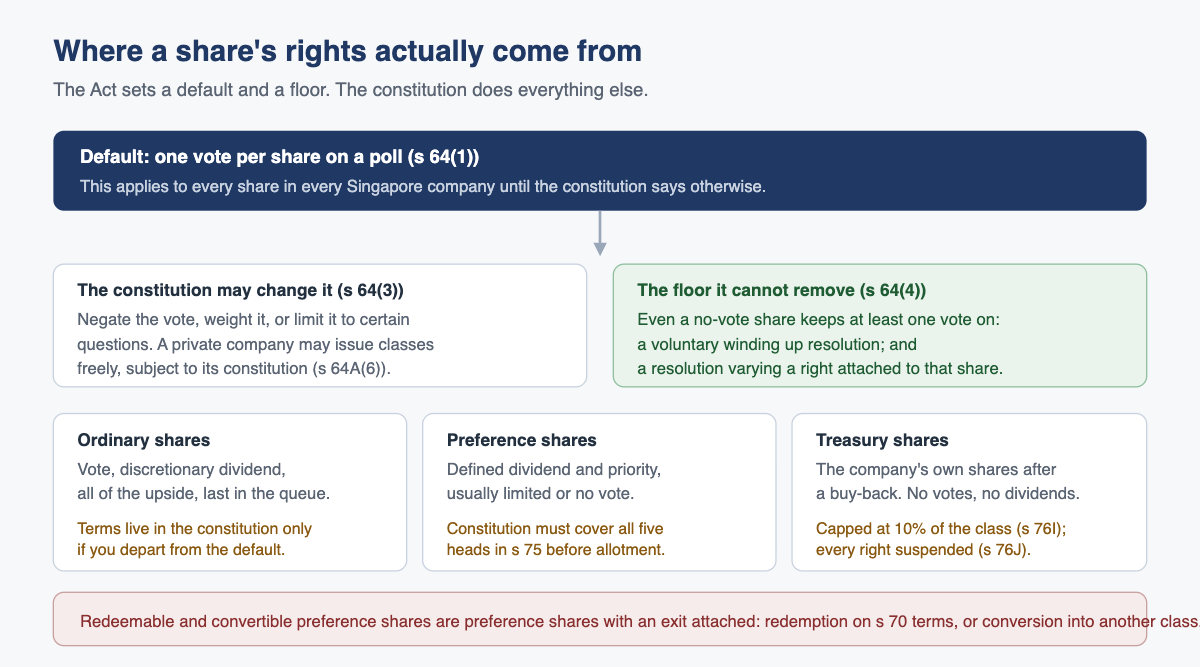
Where a share’s rights actually come from
Section 64(1) of the Companies Act 1967 supplies the default: a share confers on its holder the right to one vote on a poll, on any resolution. Section 64(3) then allows that right to be negated, altered or added to by the constitution, and section 64A(6) puts it beyond argument that a private company may, subject to its constitution, issue shares of different classes, including shares with special, limited or conditional voting rights, or none.
So the honest answer to “what does this share entitle me to” is almost never found in the Act. It is found in the constitution, and occasionally in the resolution that created the class. If you are being offered shares in a Singapore private company and nobody has shown you the constitution, you do not yet know what you are buying. Our note on what a company constitution actually does covers why that document carries so much weight.
The vote a constitution cannot take away
There is a floor. Under section 64(4), even a share that otherwise carries no vote at all gives its holder at least one vote on a poll on two resolutions: a resolution to wind the company up voluntarily, and a resolution to vary any right attached to that share.
That is the protection non-voting investors usually do not realise they have, and the one founders forget when they promise somebody “no votes, just the dividend”. You cannot quietly restructure a class over the objection of its holders because you labelled it non-voting.
Preference shares carry a harder requirement
Section 75 is blunt. A company must not allot preference shares, or convert issued shares into preference shares, unless its constitution sets out the holders’ rights on all of the following: repayment of capital, participation in surplus assets and profits, whether dividends are cumulative or non-cumulative, voting, and priority of payment of capital and dividend relative to other shares and other classes of preference shares.
Five headings, all of them, in the constitution, before the allotment. Default is an offence with a fine of up to $2,000. The fine is not the real cost. The real cost is a preference shareholder and a founder disagreeing, two years later, about whether the unpaid dividend from a loss-making year rolls forward.
The five share types, side by side
| Share type | What the holder gets | Votes | Where the terms must live |
|---|---|---|---|
| Ordinary | Discretionary dividends, full upside, last in line on a winding up | One per share by default (s 64(1)) | Constitution, if you depart from the default |
| Preference | A defined dividend ahead of ordinary holders, and priority on return of capital | Usually limited or none, but s 64(4) still applies | Constitution, on all five heads in s 75 |
| Redeemable preference | The above, plus the company can or must buy the shares back on set terms | As for preference shares | Constitution must authorise redemption and set the terms (s 70(1)) |
| Convertible preference | The above, plus a right to convert into another class on a trigger | As for preference shares, until conversion | Constitution and terms of issue; conversion is filed with ACRA |
| Treasury | Nothing at all while held by the company | None, and the company must not exercise any right | Arise only from a buy-back under ss 76B to 76G |
Redeemable preference shares: the conditions people miss
Section 70 sets out a short list of conditions, and every one catches somebody.
The constitution must authorise the issue, and redemption may be effected only on the terms and in the manner the constitution provides, so you cannot agree redemption terms in a side letter and rely on them. The shares must be fully paid up before they can be redeemed. If the redemption is funded out of capital rather than out of profits or the proceeds of a fresh issue, all the directors must make a solvency statement and the company must lodge a copy with the Registrar.
And the point that catches private companies every time: under section 70(7), a redemption does not take effect until the Registrar updates the electronic register of members. Paying the investor out does not, on its own, cancel their shareholding. The lodgement does.
Convertible preference shares: not a separate statutory animal
There is no section of the Companies Act 1967 headed “convertible preference shares”. A convertible preference share is a preference share whose terms include a right, or an obligation, to become something else, normally an ordinary share, on a trigger such as a funding round or a date.
Because there is no bespoke regime, the drafting carries all the weight: conversion ratio, triggers, the fate of accrued but unpaid dividends, and whether conversion is automatic or at the holder’s option. Conversion is then filed with ACRA, and if it alters the rights of an existing class you are also in section 74 territory.
Treasury shares: the company’s own shares, holding nothing
Treasury shares arise one way only: the company buys back its own ordinary shares under sections 76B to 76G and holds rather than cancels them. The company is then entered in the register of members as the holder. Three rules govern them.
A 10% ceiling. Under section 76I, treasury shares must not exceed 10% of the total shares of the company, or 10% of the class where capital is divided into classes. Breach it and the company has six months, or such longer period as the Registrar allows, to dispose of or cancel the excess.
No rights whatsoever. Section 76J says the company must not exercise any right in respect of treasury shares, and any purported exercise is void. No voting, no dividends, no distribution on a winding up.
A limited menu of exits. Section 76K lets a private company sell them for cash, transfer them under a share scheme, transfer them as consideration for an acquisition, or cancel them. Nothing takes effect until the register is updated.
For most private companies, treasury shares solve a problem they do not have. If a buy-back is on your agenda, the approval requirements for selective buy-backs are the part to read first.
How class rights are set, and how they are varied
Setting the rights is the easy half: put them in the constitution, and for preference shares cover all five heads in section 75.
Varying them later is the half that goes wrong. Where the constitution specifies how class rights may be varied or abrogated, that mechanism must be followed. Where it is silent, section 74 sets a default of a resolution passed by holders of not less than 75% of the shares of that class, disregarding treasury shares. Holders of not less than 5% of the class may then apply to the Court to cancel the variation, within one month or such further time as the Court allows, and it does not take effect until confirmed.
Section 74 was amended with effect from 06 May 2026, so older commentary on the default threshold may be out of date. Our note on variation of class rights under section 74 works through it.
Creating a new class, in order
- Settle the commercial terms: dividend, priority, votes, redemption or conversion, and what happens on an exit.
- Check whether the constitution already permits the class. Most model constitutions do not.
- Alter the constitution by special resolution under section 26(1) to create the class and, for preference shares, to satisfy section 75.
- Obtain the members’ authority for the directors to issue shares if the existing mandate does not cover it. Under section 161 that approval lapses at the next annual general meeting.
- Pass the board resolution to allot, and lodge the special resolution with the Registrar within 14 days as section 186 requires.
- Lodge the return of allotment. It takes effect only when the Registrar updates the register of members.
- Issue certificates and bring the company’s own records into line.
What a founder should actually issue
For the overwhelming majority of Singapore private companies, the right answer at incorporation is one class of ordinary shares, fully paid, and nothing else.
That is not a lack of ambition. Every additional class costs you something permanent: constitutional drafting, a section 74 process every time the terms move, a messier cap table, dearer due diligence, and a standing risk that the paperwork and the commercial understanding drift apart.
Create a second class only where nothing else will do. An investor who wants yield and downside protection rather than control is a good reason: preference shares drafted under section 75 do that cleanly. Money that must come back out on a timetable is another. Employees holding equity without a vote is a third, though an option scheme is often the better instrument, and the structuring is covered in our note on employee share option schemes.
What does not qualify: wanting a founder to keep control while holding a minority stake. Get the percentages right instead, which is the subject of the companion article on what each shareholding percentage actually controls.
What goes wrong: the class that exists in the term sheet and nowhere else
The commercial terms get agreed in a term sheet: a 6% cumulative preferred dividend, redemption at year five, conversion on a qualifying round. Everybody signs and the money arrives.
Nobody alters the constitution. The shares are allotted as ordinary shares, because that is the only class the company has and the filing has to go in. The register records an ordinary shareholder.
For a while it does not matter. It starts to matter when a profitable year arrives and the preferred dividend is claimed, or when year five arrives and redemption is demanded, or when an acquirer’s lawyers ask for the constitutional basis of a class the register says does not exist. At that point you are reconstructing a share class retrospectively, which needs the cooperation of the very shareholders it would dilute.
The fix happens before the money moves: alter the constitution first, allot second. Our note on admitting new investors sets out the order, and the accounting side is in share capital, share premium and reserves.
Frequently asked questions
Do preference shares in a Singapore company have voting rights?
Usually limited or none, but that depends entirely on the constitution, which section 75 requires to set out the voting position for the class. Even a wholly non-voting share keeps a floor under section 64(4): at least one vote on a resolution to wind the company up voluntarily, and on a resolution to vary any right attached to that share.
Can a Singapore private company issue different classes of shares?
Yes. Section 64A(6) confirms that a private company may, subject to its constitution, issue shares of different classes, including shares with special, limited or conditional voting rights or no voting rights. The constitution must provide for the class and record its rights. Public companies face a stricter regime, including a special resolution requirement.
What is the difference between redeemable and convertible preference shares?
A redeemable preference share can be bought back by the company on terms set in the constitution, returning the investor’s money. A convertible preference share instead turns into another class, normally ordinary shares, on an agreed trigger. One is an exit in cash, the other an exit into equity, and a share can be drafted to do both.
Can my company hold its own shares?
Only as treasury shares arising from a buy-back under sections 76B to 76G, and only up to 10% of the total shares or of the class. While held, the company must not exercise any right in respect of them: no votes, no dividends, no distribution on a winding up. They must eventually be sold, transferred under a share scheme or for an acquisition, or cancelled.
Getting the class right before the money moves
Share classes are cheap to create and expensive to unpick. Nearly every class dispute we see started as a sensible commercial agreement that was never written into the constitution, and was discovered by somebody else at the worst possible moment.
Raffles Corporate Services drafts and alters constitutions for Singapore private companies, sets up preference and redeemable classes so section 75 is actually satisfied, and runs the allotment, conversion and redemption filings in the right order. If you are about to take on an investor on terms your constitution does not support, have that conversation before the funds arrive rather than after.
You can reach us through Raffles Corporate Services, or read more at Singapore Secretary Services. The provisions are in the Companies Act 1967, and the wider map of share filings is in our overview of shares and share filings in Singapore.
— The Editorial Team, Raffles Corporate Services
Need help with corporate secretarial or compliance matters?
If you would like help with your company's corporate secretarial, governance or compliance requirements, email [email protected] or WhatsApp +65 8501 7133.
Our team can assist with corporate secretarial, accounting and tax matters. Where legal advice is needed, advisers from our associated law firms can assist.