
If your company appointed someone as a director mainly to satisfy the resident director requirement, that person is almost certainly a nominee director, and your company must keep a register of nominee directors recording who they answer to. Since 16 June 2025 that information also goes to a central register kept by ACRA, and the fact of nominee status appears publicly on the company’s business profile.
That last point is the change most companies have not absorbed. The nominator’s identity stays private. The label does not.
This article covers the register of nominee directors. Its companion covers the register of nominee shareholders, which is a separate register with a separate test.
What makes a director a “nominee”
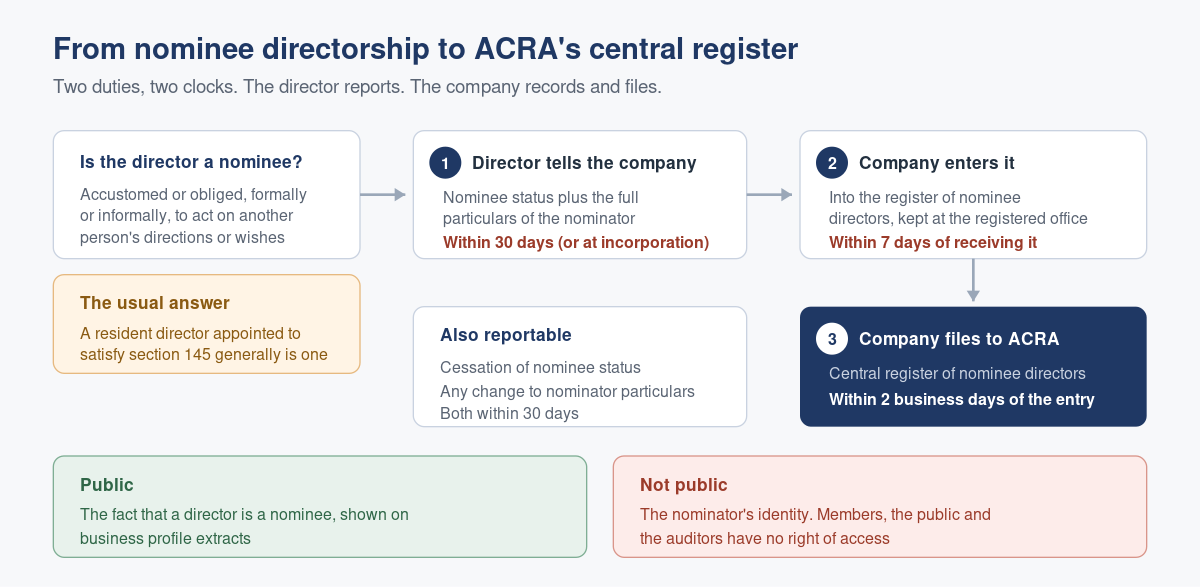
A director is a nominee if the director is accustomed, or under an obligation whether formal or informal, to act in accordance with the directions, instructions or wishes of another person.
Three things to notice in that sentence.
“Informal” is in there. There does not need to be a nominee director agreement. A settled practice of asking the founder before signing anything is enough.
It is about the pattern, not the title. Nobody has to be called a nominee. The question is whether the director, in fact, acts on someone else’s instructions.
The person giving the instructions is the “nominator”. It is the nominator’s particulars that go into the register, not the director’s beyond their name.
The resident director point
Every company incorporated in Singapore must have at least one director ordinarily resident here. Foreign-owned companies routinely solve this by appointing a local individual, often through a corporate service provider, who takes no part in running the business.
A person appointed for that purpose will generally fall within the definition of a nominee director. So the typical foreign-owned Singapore private company with one overseas founder and one local resident director has a register of nominee directors that is not empty, whether or not anyone has ever set one up.
If you have been treating the ROND as a formality that does not apply to you, start there. The related risks of that arrangement are covered in our notes on nominee director sentencing in Public Prosecutor v Zheng Jia and on the trapped nominee director’s exit.
Who has to do what
The obligation splits between the director and the company, and both halves are commonly missed.
The nominee director must tell the company. They must inform the company that they are a nominee, and provide the prescribed particulars of their nominator. They must also tell the company when they cease to be a nominee, and whenever the nominator’s particulars change.
The company must keep the register. It enters the information it receives, keeps it current, files it to ACRA’s central register, and produces it on request.
A company cannot use the director’s silence as an excuse indefinitely, but equally the company’s register only works if directors report. If your board includes anyone appointed at another party’s request, ask them in writing.
The deadlines
| Obligation | Deadline |
|---|---|
| Director is a nominee at incorporation, company incorporated on or after 16 June 2025 | Inform the company on the date of incorporation |
| Director is a nominee at incorporation, company incorporated on or after 31 March 2017 and before 16 June 2025 | Within 30 days after incorporation |
| Director becomes a nominee after incorporation (any company) | Within 30 days after becoming a nominee |
| Director ceases to be a nominee | Within 30 days after cessation |
| Change to the nominator’s particulars | Within 30 days after the change |
| Company entering information received into its register | Within 7 days after receiving it |
| Company filing to ACRA’s central register after any entry or update | Within 2 business days |
| Companies incorporated on or after 16 June 2025, first central filing | At the time of incorporation |
| Existing companies, first central filing | By 31 December 2025 |
That final row is now a date in the past. If your company existed before 16 June 2025 and has never filed its nominee director information to ACRA’s central register, the filing is overdue rather than pending, and the sensible move is to do it and document why it was late.
What goes into the register
The register records the particulars of the nominator, against the name of the nominee director.
If the nominator is an individual
Full name, any aliases, residential address, email address, contact number, nationality, identity card or passport number, date of birth, and the date on which the director became that individual’s nominee.
If the nominator is a legal entity
Name, unique entity number if it has one, registered office address, email address, contact number, legal form, the jurisdiction where and statute under which it was formed, the name of the corporate register in that jurisdiction and the entity’s number on it where applicable, and the date the director became its nominee.
Email address and contact number were added to both lists in 2025. Registers built before then are incomplete by definition, and a register that predates that change and has never been revisited is one of the easier things for an inspection to pick up.
Dates entered must be the actual date the person became or ceased to be a nominator, and cannot be earlier than 31 March 2017, when the requirement commenced.
If you genuinely have none
A company that has received no information from any nominee director may record a statement to that effect in the register, dated. An empty register with a dated statement is a compliant register. A register that does not exist is not.
Where the register lives, and who can see it
The register may be kept electronically or on paper, at the company’s registered office or at the registered office of a registered corporate service provider appointed to keep it. The company declares in its annual return where the register is kept, but does not have to lodge the address itself.
If a corporate service provider keeping the register resigns, it should hand the register back to the company, which can then appoint someone else to keep it.
On access, the rule is strict and runs the opposite way to most registers:
- The public cannot see it. A company must decline requests for access or inspection, including from its own members.
- Auditors cannot see it either. They are not entitled to access.
- The Registrar, ACRA officers and public agencies can. That includes the Police, the Commercial Affairs Department, CPIB and IRAS, and they may inspect, examine and copy the register and the supporting documents behind it.
What ACRA does make public is narrower and newer: once nominee director information is disclosed to ACRA, the nominee status of the director is displayed publicly, including on business profile extracts. Anyone buying a business profile can see that a director is a nominee. They cannot see for whom.
Which companies are exempt
A locally incorporated company is exempt from keeping a register of nominee directors if it is listed on the Singapore Exchange, is a Singapore financial institution, is wholly owned by the Government, is wholly owned by a statutory body established under a public Act for a public purpose, is a wholly-owned subsidiary of one of those, or is listed on a foreign securities exchange subject to disclosure and beneficial ownership transparency requirements.
Two clarifications that matter for ordinary companies:
Winding up, receivership, judicial management and striking off are not exemptions. A company being struck off still keeps the register unless it fits one of the categories above.
The exemption covers the company’s register, not the director’s duty. If an exempt company is the nominator of a nominee director of a non-exempt company, the nominee director must still report it, and the exempt company’s particulars still go into that other company’s register.
What goes wrong in practice
Nobody asks the director. The company assumes it has no nominee directors because nobody has said otherwise. The duty to report sits with the director, but the missing register sits with the company.
The resident director is treated as an exception. It is the most common nominee directorship in Singapore, not an exception to it.
The register stops at the company’s own front door. Companies maintain the internal register and forget the central register, which must mirror it within two business days of every entry or update, and which existing companies were required to populate by the end of 2025.
Cessation is never recorded. Directors resign, arrangements end, nominators change, and the register keeps showing an arrangement that stopped two years ago. Cessation must be reported within 30 days and entered within 7 days of the company being told.
The three registers are conflated. The register of nominee directors, the register of nominee shareholders and the register of registrable controllers are separate registers with different definitions. A person can be in all three, one, or none. Being a nominee director does not make someone a controller, and a controller is not automatically a nominee.
Frequently asked questions
Is our corporate service provider’s resident director a nominee director?
Almost certainly yes. A person appointed as a director so the company satisfies the requirement to have at least one Singapore-resident director generally falls within the definition, because they act in accordance with the wishes of the party who appointed them. The nominator’s particulars go into your register.
Will our shareholders or the public be able to see who the nominator is?
No. The register is not open to the public, to members, or to the company’s auditors, and only public agencies can access the full information held centrally by ACRA. What is public is the fact that the director is a nominee, which now appears on business profile extracts.
Our company has no nominee directors. Do we still need a register?
Yes, unless you fall within one of the exemptions. Where no nominee director has reported anything, the register can carry a dated statement that as at that date the company has received no information on nominee directors. That statement is the register.
How quickly must we act once a nominee director tells us something?
Enter the information in the company’s register within 7 days of receiving it, then file the same information to ACRA’s central register within 2 business days of making that entry. Both clocks run, and the second is the one usually missed.
Does a nominee director have to be paid or formally appointed to count?
Neither is required. The test is whether the director is accustomed or under an obligation, formal or informal, to act on another person’s directions, instructions or wishes. An unwritten, unpaid, long-standing practice of following the founder’s instructions is enough.
What happens if we never kept one?
Failing to maintain the register is an offence under the Companies Act 1967, and ACRA has been active in this area. The practical step is to build the register now, obtain written confirmations from every director, enter what you receive, file to the central register, and keep the correspondence that shows when and how you did it.
Making this someone’s job
The register of nominee directors fails for an unglamorous reason: it depends on directors volunteering information about themselves, on a deadline nobody diarises, to a register nobody can see.
Raffles Corporate Services puts the question to every director in writing, maintains the register, files to ACRA’s central register inside the two-business-day window, and keeps the evidence trail that makes the register defensible if an agency asks. If your company has a resident director appointed for compliance reasons and no register to match, that gap is worth closing this month.
Further reading: ACRA’s page on the registers of nominee directors and nominee shareholders, the Companies Act 1967 on Singapore Statutes Online, our Companies Act 1967 deep-dive FAQ, our note on shadow directors and liability, and the Corporate Service Providers Act 2024 compliance FAQ.
— The Editorial Team, Raffles Corporate Services