

A shareholder is a nominee if they vote as another person instructs, or receive dividends on another person’s behalf, or both. If you have one, your company must keep a Register of Nominee Shareholders recording that shareholder and the person standing behind them.
Raffles Corporate Services works with a panel of experienced Singapore law firms who offer cost-effective and efficient legal service and advice. This article is general information only and is not legal advice.
Most companies that breach the RONS requirement are not hiding anything. They simply never asked the question, or they asked it and got an honest “no” from a shareholder who did not realise the definition reached them.
That definition is broader than people expect, and it got broader again in 2025. This guide covers the legal test, what goes into the register, who is exposed if it is wrong, and the arrangements that catch companies out. The companion piece on the Register of Nominee Directors deals with the director side.
What the Register of Nominee Shareholders is
The RONS is a private register your company keeps under Part 11A of the Companies Act 1967. Section 386ALA requires a company, and a foreign company registered in Singapore, to keep a register of its shareholders who are nominees, in the prescribed form and at the prescribed place.
It is not a public document. Section 386ALA(5) prohibits the company from disclosing the register, or any particulars in it, to any member of the public, subject to the Registrar’s enforcement powers. The same particulars are separately lodged with ACRA’s Central RONS, which is also not open to the public.
So the register records two things. The shareholder who is acting as a nominee, and the nominator: the person or entity whose instructions or economic interest sit behind the shareholding.
The legal test: when is a shareholder a nominee?
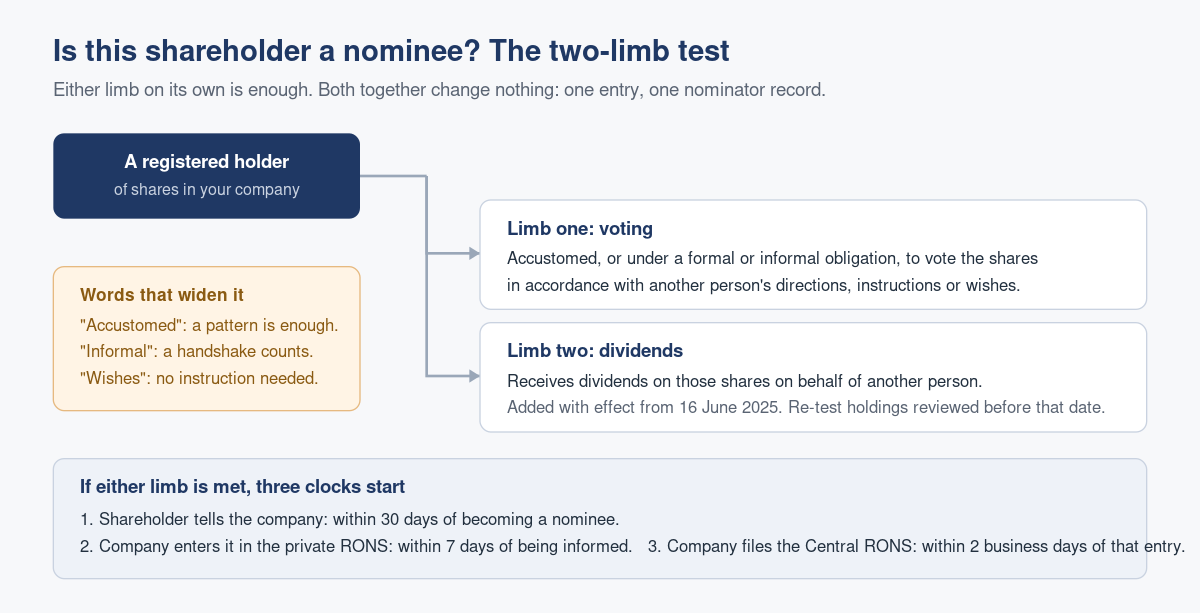
Section 386ALB(7) sets out a two-limb test. A registered shareholder is a nominee if either limb is satisfied, or both.
Limb one, the voting limb. The shareholder is accustomed, or under an obligation whether formal or informal, to vote their shares in accordance with the directions, instructions or wishes of another person.
Limb two, the dividend limb. The shareholder receives dividends in respect of those shares on behalf of another person.
Read those words slowly, because three of them do most of the damage.
Accustomed means a pattern of behaviour is enough. There need be no agreement at all.
Informal means a handshake counts. An undocumented family understanding counts.
Wishes is weaker than instructions. A shareholder who habitually votes the way the family patriarch would want, without ever being told to, is within the limb.
The dividend limb was added later, and it caught people mid-stream
The dividend limb came into the definition with effect from 16 June 2025, under the Companies and Limited Liability Partnerships (Miscellaneous Amendments) Act 2024.
Parliament anticipated the transition problem. Section 386ALB(7A) provides that a shareholder who was not a nominee under the old definition, but is a nominee under the new one, is treated as having become a nominee on that appointed day. In other words, the clock started running on the amendment date rather than years earlier.
That matters because a shareholder who receives dividends for someone else, and votes entirely as they please, was outside the old definition and is inside the new one. If nobody reviewed the register against the amended test, the disclosure and the filing are both overdue.
Arrangements that are nominee shareholdings, and ones that are not
The test looks at the registered holder’s actual behaviour and obligations, not at the label on the arrangement.
| Arrangement | Nominee shareholder? | Why |
|---|---|---|
| Shares held for a foreign investor who directs how they are voted | Yes | Voting limb, squarely |
| Shares held in a family member’s name, dividends passed to the parent | Yes | Dividend limb, even if voting is free |
| Declaration of trust over shares for a beneficial owner | Usually yes | The trustee votes and receives income for another |
| A shareholder bound by a shareholders’ agreement to vote a certain way on specified matters | Consider carefully | Turns on whether they are under an obligation to follow another person’s direction |
| An outright owner who holds and votes for themselves | No | Neither limb is satisfied |
| A shareholder who took advice from a fellow shareholder before voting | No | Advice is not direction or obligation |
| A custodian or depository holding on account for clients | Consider carefully | Depends on the voting and dividend arrangements in the mandate |
Where a case sits near the line, record it and file it. There is no penalty for over-disclosure into a private register. There is a penalty for the opposite.
Who must tell whom, and by when
The obligation starts with the shareholder, not the company. The company cannot register what it has not been told.
- A shareholder who is already a nominee when the company is incorporated must inform the company of that fact, and provide the prescribed particulars of their nominator, on the date of incorporation for companies incorporated on or after 16 June 2025.
- A shareholder who becomes a nominee later must inform the company within 30 days of becoming a nominee.
- A shareholder who ceases to be a nominee, or whose nominator’s particulars change, must inform the company within 30 days of the cessation or the change.
- The company must enter the fact and the particulars in its RONS within 7 days of being informed, under section 386ALA(2).
- The company must then lodge the same information with ACRA’s Central RONS within two business days of updating the private register.
The two-business-day clock runs from the private register update, not from the underlying event. Treating steps 4 and 5 as one task on the same day is the only reliable way to stay inside both windows. Our guide to adding a nominator to the Central ROND and RONS covers that filing in detail.
What the register has to contain
The nominee themselves is recorded by name. The heavy data requirement attaches to the nominator.
For an individual nominator: full name and any aliases, residential address, email address, contact number, nationality, identity card or passport number, date of birth, the date the shareholder became a nominee, and the cessation date if the arrangement has ended.
For a corporate nominator: name, unique entity number if it has one, registered office address, email address, contact number, legal form, the jurisdiction and law under which it was formed, the corporate registry and registration number where applicable, and the same nomination and cessation dates.
Supporting documents stay with your private register. You do not upload them to ACRA.
If the company has no nominee shareholders at all, the register does not sit empty. Record a statement to the effect that the company has not received any information on nominee shareholders. A register with nothing in it and a register that positively records a nil position look identical to you and very different to an inspector.
Where the RONS sits among your other registers
Three registers in this area are routinely confused with each other, and they do different jobs.
| Register | Records | Held by |
|---|---|---|
| Register of Members | Legal title to shares | The Registrar, electronically, for a private company |
| Register of Registrable Controllers (RORC) | Persons with significant control or significant interest | The company, privately, plus a central register with ACRA |
| Register of Nominee Shareholders (RONS) | Registered shareholders acting as nominees, and their nominators | The company, privately, plus a central register with ACRA |
A nominator will very often also be a registrable controller, but the two registers are not interchangeable and one filing does not satisfy the other. Our guide on registrable controllers in practice works through the overlap, and the registers every Singapore company must keep maps the full set.
What goes wrong in practice
Nobody ever asks. The single most common failure. A share transfer completes, the register of members is updated, and no one puts the nominee question to the incoming shareholder. Ask it in writing at the point of transfer and at every annual review, and keep the answer on file.
The shareholder answers honestly and wrongly. People hear “nominee” and think of a formal nominee agreement. Ask the question in operational terms instead: do you vote these shares as someone else asks you to, and does anyone else receive the dividends on them?
The 2025 change was never applied. If your last review of the RONS predates 16 June 2025, it was done against a narrower test. Shareholders who pass dividends on may have become disclosable without anybody noticing.
The personal exposure is overlooked. Under section 386ALB(6) the shareholder who fails to tell the company commits an offence in their own right, punishable by a fine not exceeding $25,000. The company and every officer in default face the same ceiling under section 386ALA(6) for failures on the register side. This is not a liability that stays with the company.
Delegation is mistaken for transfer. Your corporate service provider can maintain the register and make the filings, and should. The statutory obligation stays with the company and its officers. The service provider’s own regime is covered in our Corporate Service Providers Act 2024 compliance FAQ.
Frequently asked questions
Does having a nominee shareholder mean the company has done something wrong?
No. Nominee shareholdings are lawful in Singapore and common in cross-border structures, family holdings and custodial arrangements. What is unlawful is failing to record and file the arrangement. The register exists so that the beneficial position is traceable by regulators, not so that the arrangement is prohibited.
Will my nominator’s name become public if I file?
No. The nominator’s identity, the date of nomination and historical arrangements all remain private. The only public consequence is that a current shareholder’s nominee status shows as “NS” against their name in the company’s Business Profile, which anyone can buy. Members of the public cannot purchase RONS information itself.
Is a trustee holding shares for a beneficiary a nominee shareholder?
In most ordinary cases yes, because the trustee votes according to the trust arrangement and receives distributions for another person. Either limb of the section 386ALB(7) test is enough on its own. Record the position and file it, and take advice where the trust instrument gives the trustee genuinely independent discretion.
Who is fined if the RONS is wrong, the company or the shareholder?
Potentially both, under separate provisions. A shareholder who fails to inform the company is liable to a fine not exceeding $25,000. The company, and every officer in default, face the same ceiling for failing to keep or update the register properly. They are distinct offences with distinct defendants.
We have no nominee shareholders. Is there anything to do?
Yes. Record a positive nil statement in the register rather than leaving it blank, and make the corresponding declaration to ACRA. The requirement to maintain the register applies whether or not the company has nominees, and it continues while the company is dormant or in the middle of striking off.
Does updating the register of members also update the RONS?
No. They are separate registers holding separate information, and a change in one does not propagate to the other. If a nominee shareholder transfers out, you update the members side and separately record the cessation in the RONS and the Central RONS.
Asking the question before a regulator does
The RONS is one of the few compliance obligations where the company depends entirely on someone else volunteering information. That is precisely why it fails so often, and why the fix is a question asked routinely rather than a register reviewed annually.
Raffles Corporate Services puts the nominee question to every incoming shareholder at the point of transfer, captures the nominator’s particulars while the parties are still engaged, and files both the private and central registers inside the statutory windows. If your RONS has not been tested against the amended definition, that is a short review and usually a simple correction.
You can reach us through Raffles Corporate Services, or read more on Singapore corporate secretarial practice at Singapore Secretary Services. The statutory text sits at Part 11A of the Companies Act 1967, and ACRA sets out its compliance expectations on its ROND and RONS page.
— The Editorial Team, Raffles Corporate Services
Need help with corporate secretarial or compliance matters?
If you would like help with your company's corporate secretarial, governance or compliance requirements, email [email protected] or WhatsApp +65 8501 7133.
Our team can assist with corporate secretarial, accounting and tax matters. Where legal advice is needed, advisers from our associated law firms can assist.