
Every Singapore company and registered foreign company must keep a Register of Nominee Directors and a Register of Nominee Shareholders, unless it falls within a narrow exemption. The obligation applies even if the company has no nominees at all, and even if it is dormant.
That last sentence is where most of the non-compliance lives. Directors hear “register of nominee directors” and conclude, reasonably enough, that a company with no nominee directors has nothing to keep. The Act does not read that way.
This guide covers when the registers must exist, who is exempt, what goes inside them, where they are kept and what triggers an update. The mechanics of lodging the same information with ACRA are covered separately in our guide to filing with the Central ROND and RONS.
What the ROND and RONS are for
Part 11A of the Companies Act 1967 builds a chain of visibility over who actually controls and benefits from a Singapore company. The Register of Registrable Controllers captures significant control. The ROND and RONS sit alongside it and capture something narrower and more specific: the people who appear on the face of the company as directors or shareholders while acting on someone else’s behalf.
The policy purpose is straightforward. Nominee arrangements are lawful and often commercially sensible, but they are also the classic vehicle for concealing ownership. Recording them centrally lets law enforcement follow the line from the registered name to the person behind it.
Section 386AKA requires the register of nominee directors. Section 386ALA requires the register of nominee shareholders. Both are private registers: the company is prohibited from disclosing them, or any particulars in them, to any member of the public.
Who must comply
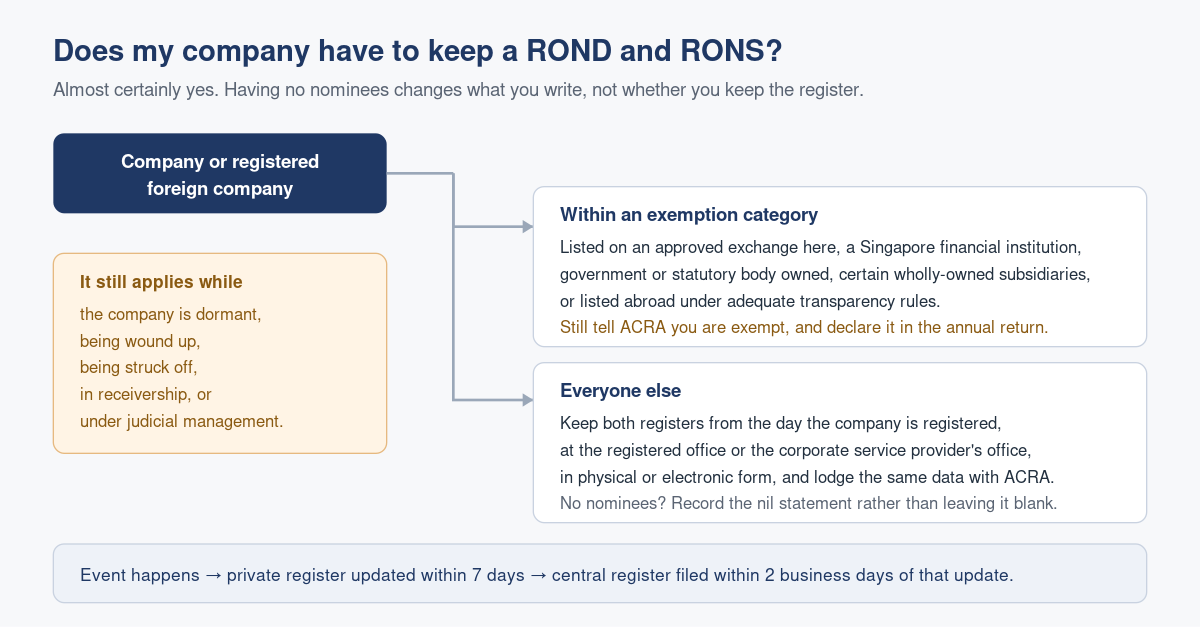
Unless exempt, all companies and all foreign companies registered in Singapore must set up and maintain both registers, and file the information with ACRA’s central registers.
The requirement does not switch off because the company is quiet. It applies where the company:
- has no nominee directors and no nominee shareholders;
- is dormant;
- is being wound up, struck off, or is in receivership or under judicial management.
A company in the middle of striking off still owes the obligation until it is struck off. This is a common oversight in the final months of a company’s life, when attention has moved on.
Who is exempt
The exemptions are narrow and structural. They turn on the entity being regulated or transparent by some other route.
| Entity | Exempt if it is |
|---|---|
| Local company | A public company listed on an approved exchange in Singapore |
| Local company | A Singapore financial institution |
| Local company | Wholly owned by the Singapore Government |
| Local company | Wholly owned by a statutory body established under a public Act for a public purpose |
| Local company | A wholly-owned subsidiary of any of the above |
| Local company | Listed on a securities exchange outside Singapore that is subject to regulatory disclosure and adequate beneficial ownership transparency requirements |
| Foreign company | A Singapore financial institution, or the wholly-owned subsidiary of a foreign company that is one |
| Foreign company | Listed on a foreign securities exchange subject to regulatory disclosure and adequate beneficial ownership transparency requirements |
| Foreign company | Listed on an approved exchange in Singapore as a primary listing |
Exemption removes the register, not the paperwork. An exempt entity must still inform ACRA of its exemption status through the nominee registers eService, and declare the exemption when it files its annual return.
When the registers must be set up
For a company incorporated today, the answer is simple: on the same day you register the company. The register is a day-one obligation, not a first-year one.
For companies and foreign companies already in existence, the obligation began on different dates as Part 11A was extended.
| Register | Requirement began |
|---|---|
| Private ROND, local companies | 31 March 2017 |
| Private ROND, foreign companies | 16 June 2025 |
| Private RONS, all companies | 4 October 2022 |
The foreign company extension came in under the Companies and Limited Liability Partnerships (Miscellaneous Amendments) Act 2024. If you registered a branch in Singapore before that date and have not revisited your register position since, that is the gap to close first.
Where the registers are kept, and in what form
Physical or electronic, either is acceptable. What matters is the location. The register must be kept at:
- the company’s registered office address; or
- the office of the company’s corporate service provider.
That second option is the one most SMEs use in practice, and it is where a quiet failure often sits. When a company changes corporate secretary, the RORC, ROND and RONS should move across with the rest of the register pack. They frequently do not, because they are private registers that nobody has needed to produce. The handover checklist should name them explicitly.
Supporting documents stay with the register. You do not upload them to ACRA when you file.
What goes into the registers
The nominee is recorded by name. The detailed particulars attach to the nominator, the person or entity on whose behalf the nominee acts.
| Recorded person | Particulars required |
|---|---|
| The nominee director or nominee shareholder | Name |
| An individual nominator | Full name, aliases if any, residential address, email address, contact number, nationality, identity card or passport number, date of birth, the date the director or shareholder became a nominee, and the cessation date if applicable |
| A corporate nominator | Name, unique entity number if any, registered office address, email address, contact number, legal form, the jurisdiction and law under which it was formed, the corporate registrar and registration number where applicable, and the same nomination and cessation dates |
If the company has no nominee directors and no nominee shareholders, do not leave the register blank. Record a statement to the effect that the company has not received any information on nominee directors or nominee shareholders. A positive nil record is evidence that the question was asked. An empty page is evidence of nothing.
For the substantive test of who counts as a nominee, see our guides on the Register of Nominee Directors and the Register of Nominee Shareholders.
How the information reaches you
The company cannot enter what it has not been told, and the Act places the first duty on the nominee.
A director or shareholder who is already a nominee at incorporation must tell the company on the date of incorporation. One who becomes a nominee later must tell the company within 30 days. The same 30-day window applies to telling the company that the arrangement has ended, or that the nominator’s particulars have changed.
A nominee who fails to do this commits an offence in their own right. The fine ceiling is $25,000, and it attaches to the individual, not to the company.
Maintaining the registers: the seven-day rule
There is no annual refresh obligation. If nothing changes, nothing is due. The registers are event-driven.
You must update the private register within seven days of being informed that:
- a director has become a nominee;
- a director has ceased to be a nominee;
- a shareholder has become a nominee;
- a shareholder has ceased to be a nominee;
- a nominator’s particulars have changed.
Then the second clock starts. You must lodge the same update with the Central ROND or RONS within two business days of updating the private register. The two-day window runs from your own entry, not from the underlying event, which means a slow private update does not buy you time: it just moves the deadline for the filing.
Failure on the register side is an offence for the company and for every officer in default, with a fine not exceeding $25,000 under sections 386AKA(6) and 386ALA(6). Our note on the 14-day rule for filing company changes sets out the more familiar deadlines this one sits alongside, and it is worth noticing how much shorter the ROND and RONS windows are.
What goes wrong in practice
The nil position is never recorded. The company genuinely has no nominees, so nobody opens a file. Years later there is no register, no nil statement and no evidence the question was ever asked. Creating the register takes ten minutes. Reconstructing a defensible history afterwards does not.
The registers do not travel with the secretarial pack. They are private, so nobody misses them at handover. Name them on the transfer list alongside the register of members and the minute book.
The seven-day window is treated as approximate. It is not. Seven days from being informed, then two business days to file. A single update that drifts for a fortnight is two breaches, not one.
Dormant and striking-off companies are treated as out of scope. They are not. The obligation runs until the company is off the register.
Exemption is assumed rather than checked. Being a subsidiary of a listed group is not automatically an exemption: the wording turns on the specific relationships listed above. And even a genuinely exempt entity must tell ACRA it is exempt. Silence is not exemption.
Frequently asked questions
Does my company need a ROND and RONS if it has no nominee directors or shareholders?
Yes. Unless the company falls within an exemption, the registers must exist regardless. Where there are no nominees, record a statement that the company has not received any information on nominee directors or nominee shareholders, and make the corresponding declaration to ACRA rather than doing nothing.
Where must the registers be kept?
At the company’s registered office address, or at the office of its corporate service provider. Physical or electronic form is acceptable. Supporting documents are kept with the register rather than uploaded to ACRA, so the location matters for inspection purposes.
How often do I have to update the registers?
There is no annual cycle. You update within seven days of being informed of a relevant event: a director or shareholder becoming or ceasing to be a nominee, or a change in a nominator’s particulars. You then have two business days from that entry to file the update with ACRA’s central registers.
My company is dormant. Can I skip this?
No. The requirement applies to dormant companies and to companies undergoing winding up, striking off, receivership or judicial management. The obligation continues until the company is removed from the register, which is precisely the period when it is most often forgotten.
What happens if a nominee director never tells us they are a nominee?
The nominee commits an offence in their own right, with a fine ceiling of $25,000. That does not discharge the company’s own duty to maintain the register, so the practical answer is to ask the question in writing at appointment and at each annual review, and keep the reply on file.
Can our corporate service provider keep the registers for us?
Yes, and most do. The Act expressly contemplates the registers being kept at the provider’s office. The statutory obligation, and the liability for getting it wrong, stays with the company and its officers. Delegation moves the work, not the responsibility.
The ten minutes that prevent the problem
Of all the register obligations in the Companies Act, this is the cheapest to comply with and one of the easiest to overlook. A company with no nominees can satisfy it with a single properly dated nil statement and a declaration to ACRA.
Raffles Corporate Services sets up the ROND and RONS at incorporation, records the nil position where that is the answer, puts the nominee question to every incoming director and shareholder, and files inside the seven-day and two-business-day windows. If you are not certain your registers exist, or that they came across at your last change of secretary, that is worth checking now rather than at your next due diligence exercise.
You can reach us through Raffles Corporate Services, or read more on Singapore corporate secretarial practice at Singapore Secretary Services. The governing provisions sit in Part 11A of the Companies Act 1967, and ACRA sets out its compliance expectations on its ROND and RONS pages.
— The Editorial Team, Raffles Corporate Services