

A Singapore LLP must lodge its first annual declaration within 15 months of registration, and after that once in every calendar year, at intervals of no more than 15 months from the last one. That is section 30(3) of the Limited Liability Partnerships Act 2005, and it is the whole rule.
Raffles Corporate Services works with a panel of experienced Singapore law firms who offer cost-effective and efficient legal service and advice. This article is general information only and is not legal advice.
It reads simply, and it causes an unusual number of missed deadlines, for one reason: the deadline is not fixed. It moves every time you file. A company director knows the annual return is due seven months after financial year end, the same month every year. An LLP manager has a target that slides.
Here is how the clock actually works, with worked dates, and what to do when you are going to miss it.
The two limbs of section 30(3)
The Act imposes two requirements that operate together, not alternatively.
First filing. Not later than 15 months after the registration of the LLP.
Every filing after that. Once in every calendar year, at intervals of not more than 15 months.
So two tests apply on an ongoing basis: at least one declaration in each calendar year, and no gap of more than 15 months between consecutive declarations. Whichever bites first is your deadline.
| Situation | Deadline | Worked example |
|---|---|---|
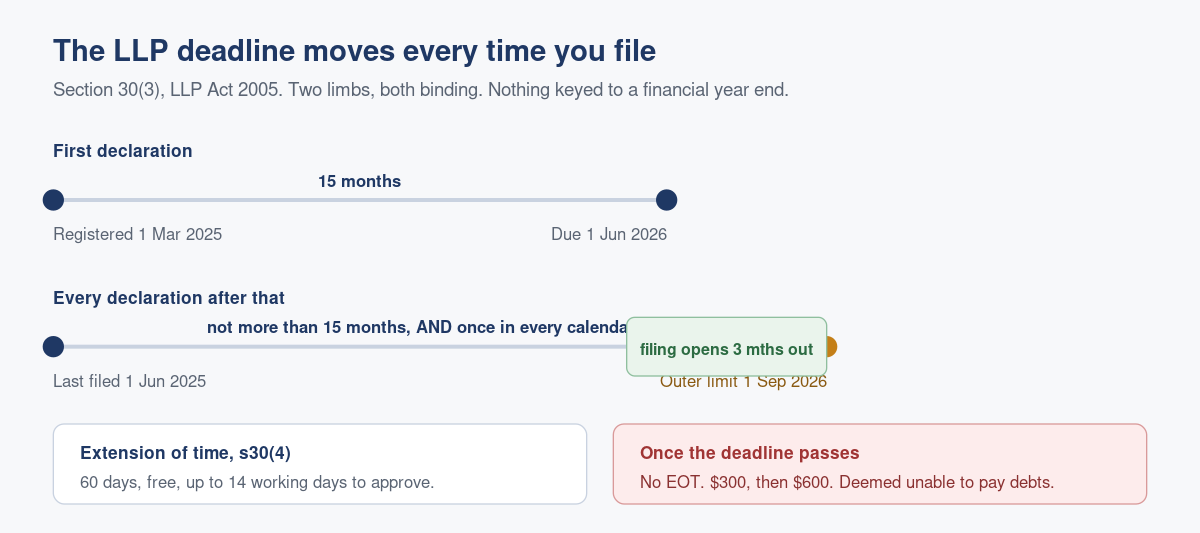
| First declaration, new LLP | Within 15 months of the registration date | Registered 1 March 2025, so due by 1 June 2026 |
| Every subsequent declaration | Once in each calendar year, and not more than 15 months after the previous declaration | Last filed 1 June 2025, so the 15-month limb runs to 1 September 2026 |
| Earliest you may file | Three months before the deadline | Deadline 1 September 2026, so filing opens 1 June 2026 |
Why the deadline drifts, and why that is a trap
Notice what the second limb does. The 15-month interval runs from the date you last filed, not from a fixed anniversary.
File in March one year and the next 15-month window runs to June the following year. File in that June, and the window after that runs to September. Every time you file late in your window, you push the next deadline later and you lose the mental anchor of “we do this in March”.
Two consequences fall out of that.
The calendar-year limb catches up with you. Because you must also file at least once in every calendar year, the drift cannot run indefinitely. At some point the calendar-year requirement becomes the binding constraint rather than the 15-month interval, and if you were only watching the 15-month figure you will be late without noticing.
Nobody knows the date off the top of their head. With a company, everybody can recite it from the financial year end. With an LLP the answer is “check Bizfile”, and in practice nobody does until a reminder arrives.
The fix is unfashionably simple: pick a month and file in it every year. Anchor on a fixed month sitting comfortably inside both limbs and the drift disappears.
What you need before you can file
The declaration itself takes minutes. What holds people up is the entity information behind it, because Bizfile asks you to confirm that before you can proceed. Check and correct, in advance:
- The LLP’s registered office address.
- The SSIC code, if the business has changed what it actually does.
- Partners and managers, with current particulars.
- Your Corppass access to the entity, which is not a same-day fix if it has lapsed.
Changes to partners and managers carry their own 14-day filing deadline under section 34 of the LLP Act 2005, entirely separate from the annual declaration and with its own late lodgement penalty of $50 or $200. If you discover at declaration time that a manager left eight months ago and was never filed, you have found a second, older problem. Our note on what your LLP must tell ACRA, and how fast sets out those parallel clocks.
The filing fee for the annual declaration is $30, and the register updates immediately on successful submission. For what the declaration itself means and who is allowed to sign it, see our companion piece on what the LLP manager is actually signing, and for each Bizfile screen, how to file the LLP annual declaration.
If you are going to miss it: the extension of time
Section 30(4) allows the Registrar, on application by the LLP and if the Registrar thinks fit, to grant an extension of time for lodging the declaration. ACRA administers this as a 60-day extension applied for through Bizfile.
The rules around it are strict, and most of the pain comes from ignoring them.
| Point | Detail |
|---|---|
| Length | 60 days |
| Statutory basis | Section 30(4), Limited Liability Partnerships Act 2005 |
| Who may apply | Partners, or a corporate service provider acting for the LLP |
| Fee for the first extension | Free |
| Processing time | Up to 14 working days |
| When to apply | Before the deadline. Applications cannot be made once the due date has passed |
| Further extension | $200, non-refundable even if rejected or withdrawn, and granted only on strong supporting reasons |
You will need the LLP’s UEN and a reason for the extension, and you cannot lodge a second application while one is still pending review.
Two things to take from that table. First, because processing takes up to 14 working days, applying the day before your deadline is not a plan. Apply at least a fortnight out. Second, and this is the one that hurts: once the deadline passes, the EOT route closes entirely. There is no retrospective extension. You file late, you pay the penalty.
One drafting point if you go looking for the authority yourself: the extension power for LLPs is section 30(4) of the LLP Act 2005. Published references occasionally attribute it to the Companies Act, which is the wrong statute for an LLP. Our full guide to the LLP extension of time covers the application itself.
What it costs when you miss it
ACRA’s late lodgement penalties for LLP annual declarations, for due dates from 14 January 2022:
| Length of default | Penalty |
|---|---|
| Up to three months late | $300 |
| More than three months late | $600 |
These are charged automatically in Bizfile when you file, on top of the $30 fee. No discretion, no appeal counter.
Two further consequences sit behind the penalty, and both are worse than the money.
The penalty may land on the manager personally. Section 29(3) of the LLP Act 2005 makes a manager answerable for the LLP’s obligations under section 30 and personally liable for penalties imposed on the LLP for contravening it, unless the manager satisfies the court otherwise.
The LLP is deemed unable to pay its debts. Under paragraph 3(2)(d) of the Fifth Schedule to the LLP Act 2005, an LLP that fails to lodge a declaration as required by section 30 is deemed, for court winding-up purposes, to be unable to pay its debts, and stays deemed so until a solvency declaration under section 30(1)(a) is lodged. A creditor looking for pressure does not need to prove insolvency. Your own non-filing has done it for them.
Section 30(5) also makes the LLP guilty of an offence, liable on conviction to a fine of up to $5,000.
What goes wrong in practice
The reminder went to a dead inbox. ACRA emails about a month ahead, to the registered email addresses of position holders in Bizfile. Those are individual profile addresses, maintained by each individual, so a manager’s five-year-old address means the reminder vanishes. Our note on why ACRA filing reminders are a courtesy, not a defence explains why that is no answer.
Somebody applied the company rules. The most common single error is treating the LLP like a private limited company: looking for a financial year end, assuming a seven-month deadline, waiting for an AGM that an LLP does not have. The LLP deadline has nothing to do with the financial year.
The last filing date was never recorded anywhere. No diary entry, no file note, so the only record is in Bizfile and nobody looks until something prompts them.
The extension was left too late. Applying three days out, against a 14-working-day processing time and no ability to apply after the due date, means it arrives too late or not at all.
Frequently asked questions
When is my LLP’s first annual declaration due?
Not later than 15 months after the LLP’s registration date. If the LLP was registered on 1 March 2025, the first declaration is due by 1 June 2026. You can file from three months before that date. Nothing is keyed to a financial year end, because the LLP Act 2005 does not use one for this purpose.
How do I work out the deadline for later years?
Two tests apply together. The declaration must be lodged once in every calendar year, and no more than 15 months after the previous one. Whichever date comes first is your deadline. The simplest safe approach is to file in the same month every year, which keeps you comfortably inside both limbs.
Can I get an extension of time to file?
Yes, 60 days under section 30(4) of the LLP Act 2005, applied for free through Bizfile by a partner or a corporate service provider. Apply at least 14 working days before the deadline, because processing takes that long. You cannot apply after the due date has passed. A further extension costs $200 and is rarely granted.
What is the penalty for a late LLP annual declaration?
$300 if you file up to three months after the deadline, $600 if more than three months late, for due dates from 14 January 2022. It is charged automatically in Bizfile on top of the $30 filing fee, and under section 29(3) a manager may be personally liable for it.
Does missing the deadline affect the LLP beyond the penalty?
Yes. Paragraph 3(2)(d) of the Fifth Schedule to the LLP Act 2005 deems an LLP that has not lodged its declaration to be unable to pay its debts for court winding-up purposes, until a solvency declaration is lodged. Sustained non-filing can also lead the Registrar to strike the LLP off under section 63.
Can I file early?
Yes, from three months before the deadline, and there is no downside if you are anchoring to a fixed month each year. One thing to note: ACRA sends no reminder email for a cycle you have already filed, so do not read that silence as confirmation that nothing was due.
Put a date in the diary, not a reminder in the inbox
The LLP annual declaration is a $30 filing that takes four minutes. It becomes expensive only because the deadline moves and nobody owns it.
Pick a month. File in it every year. Record the date somewhere your team can see it. That removes a $600 penalty, a deemed insolvency and a personally liable manager from your risk register in one step.
Raffles Corporate Services maintains statutory filing calendars for Singapore LLPs and companies, computes the declaration window from the statutory clock rather than from ACRA’s reminder email, and keeps partner and manager particulars current so the 14-day filings under section 34 do not quietly accumulate alongside. If nobody at your LLP can say when the last declaration was lodged, that is the conversation to have.
You can also read more at Singapore Secretary Services, and our guide to what Bizfile actually is covers the portal itself.
— The Editorial Team, Raffles Corporate Services
Need help with corporate secretarial or compliance matters?
If you would like help with your company's corporate secretarial, governance or compliance requirements, email [email protected] or WhatsApp +65 8501 7133.
Our team can assist with corporate secretarial, accounting and tax matters. Where legal advice is needed, advisers from our associated law firms can assist.