
A Singapore LLP can apply for 60 extra days to lodge its annual declaration. The application is free, it is made in Bizfile, and it must be submitted before the filing deadline. Once the deadline has passed, the door is shut and no application will be accepted.
Raffles Corporate Services works with a panel of experienced Singapore law firms who offer cost-effective and efficient legal service and advice. This article is general information only and is not legal advice.
That last point is the whole article. Almost everyone who searches for this has already missed the date, and the unwelcome answer is that an extension of time is a planning tool, not a remedy.
If you are still inside your window, read on. If you are not, skip to the section on what to do when the deadline has gone, because there is still a sensible course of action, it just is not this one.
What the extension actually is
Section 30(3) of the Limited Liability Partnerships Act 2005 fixes when an LLP must lodge its declaration of solvency: within 15 months of registration for the first one, and thereafter once in every calendar year at intervals of no more than 15 months.
Section 30(4) then gives the Registrar a discretion. On application by the LLP, and if the Registrar thinks fit, the Registrar may grant an extension of time for lodging the declaration. ACRA administers that discretion as a standard 60-day extension.
Two features of the statutory wording are worth holding on to.
It is a discretion, not an entitlement. “If he or she thinks fit” means ACRA can refuse. In practice a first application with a sensible reason is routinely granted, but you should not commit to a date on the assumption of approval.
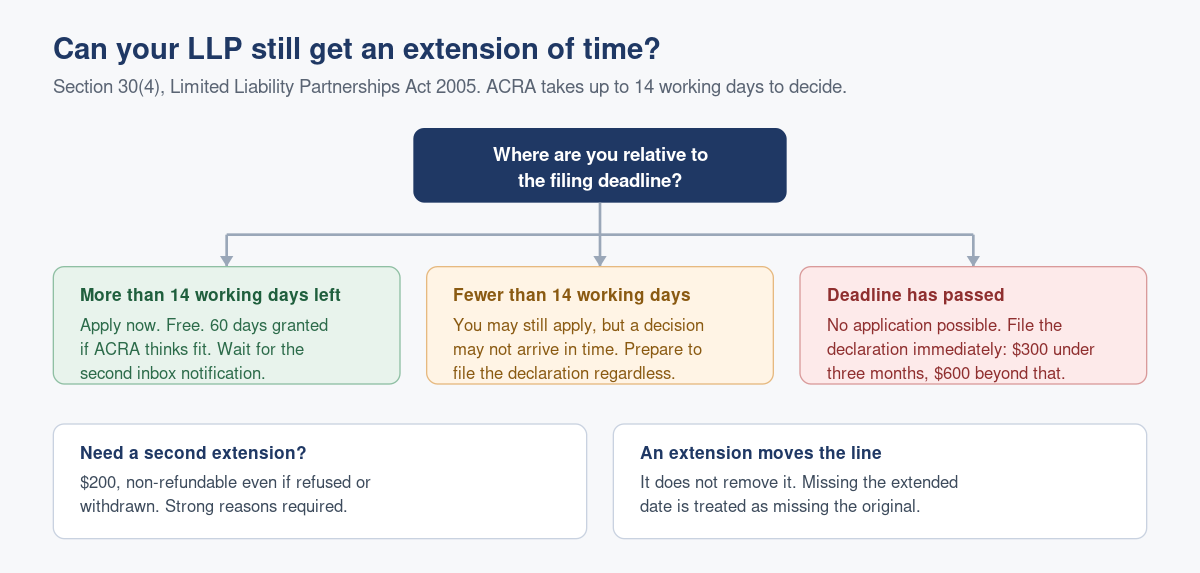
It extends the time, it does not waive the obligation. Section 30(5) penalises failure to lodge within “the time or extended time” referred to in subsections (3) and (4). An approved extension moves the line. It does not remove it, and missing the extended date is treated exactly like missing the original one.
The key facts at a glance
| Question | Answer |
|---|---|
| How long is the extension | 60 days |
| What does it cost | Free for the first application |
| Who may apply | A partner of the LLP, or a registered corporate service provider acting for it |
| What you need | The LLP’s UEN and a reason for the extension |
| How long does ACRA take | Up to 14 working days |
| When must you apply | Before the filing deadline. Not on or after it |
| Can you have two applications running | No. A new application cannot be submitted while one is pending |
| Cost of a further extension | $200, non-refundable even if refused or withdrawn |
Note the asymmetry between the last two rows and the first. The first extension is free and generally granted. A second one costs $200 which you do not get back, and ACRA is unlikely to grant it without strong supporting reasons. Treat the first 60 days as the only extension you will get.
The timing trap, stated plainly
ACRA takes up to 14 working days to decide. You cannot apply on or after the deadline. Put those two facts together and the practical rule is this:
Apply at least 14 working days before your filing deadline.
Fourteen working days is roughly three calendar weeks once you allow for weekends, and longer if a public holiday falls inside the period. An application lodged four days before the deadline is technically valid, but you will be sitting in the dark on the day the obligation crystallises, with no approval in hand and no ability to reapply.
Worse, because you cannot submit a second application while one is pending, a late application also blocks you from correcting a mistake in it.
The sensible sequence is to decide roughly a month out whether you will make the date. If the answer is anything other than a confident yes, apply then.
How to apply, in order
- Confirm the deadline first. Open Bizfile and check the annual declaration due date on your entity dashboard rather than working it out from memory. The fifteen-month interval runs from your last declaration, not from your financial year end.
- Log in to Bizfile as a Business User through Corppass. If nobody in the LLP currently has the right e-service access, that is a separate exercise and it is not quick. Our guide to logging in to Bizfile as a business user covers it.
- Check the entity name in the top menu bar. If you act for more than one entity, switch profile before doing anything else. An extension granted to the wrong LLP is a wasted three weeks.
- Open the “Apply for extension of time” eService from the Manage section of the menu and start the application.
- Select the extension type for section 30(4). This is the specific head of extension for an LLP annual declaration. Bizfile lists several extension types and they are not interchangeable.
- Give a reason. Choose from the list, or select the free-text option if none fits. Write something specific and true: a manager overseas on medical leave, a partnership dispute affecting who can sign, a change of manager mid-cycle, an accounting system migration. “Oversight” is honest but weak.
- Review, tick the declaration, and submit. There is no payment step for a first application.
- Wait for the second notification. Submission generates one message in your Bizfile inbox. Approval generates a second. Do not treat the acknowledgement as the approval.
- File the declaration. The extension buys you 60 days. Diarise the new date and file well inside it.
Reasons that tend to work, and reasons that do not
ACRA does not publish a list, so what follows is drawn from practice rather than from any rule.
Reasons that generally succeed are ones outside the LLP’s control and specific to this cycle: illness or incapacity of the only manager, a manager overseas and uncontactable, a genuine dispute about the LLP’s solvency position that needs resolving before anyone can sign, a recent change of manager where the incoming manager needs time to satisfy themselves.
Reasons that tend to struggle are ones that recur or that describe an ordinary state of affairs: being busy, waiting for accounts that nobody has chased, or a corporate service provider running behind. If you needed an extension last year for the same reason, expect more resistance this year.
The distinction matters more for a second application than a first, because that is where ACRA applies real scrutiny and where the $200 becomes non-refundable regardless of outcome.
What goes wrong in practice
Applying too late. The single commonest failure. The application is submitted inside the 14 working day window, ACRA has not decided by the deadline, and the LLP is in default while its application sits in a queue.
Applying after the deadline. Bizfile will not accept it. There is no retrospective extension. The only remaining route is to write to ACRA, and the realistic expectation is that you will file late and pay the penalty.
Confusing the extension type. Selecting the wrong statutory head means the extension, if granted, does not cover your annual declaration. Because you cannot run two applications at once, discovering this late is expensive in time.
Treating the acknowledgement as approval. Two notifications, not one. Filing behaviour should change only on the second.
Forgetting the extension is not a waiver. Sixty days pass quickly, and an LLP that needed an extension in the first place is usually an LLP with an underlying problem, not a scheduling one. Use the 60 days to fix the cause, not just the filing.
Nobody has Corppass access. If the only manager with e-service access has resigned, the extension application, the manager change and the declaration itself are all blocked until access is restored. Deciding who should hold Bizfile access before you need it avoids the whole sequence.
If the deadline has already passed
You cannot apply, so stop trying and do the following instead.
File the declaration immediately. The late lodgment penalty for an LLP annual declaration is $300 if you file within three months of the deadline and $600 if you file more than three months late. The step up is real money for doing nothing, so the day you file matters.
Understand what the default does in the meantime. Under section 30(5)(b) of the LLP Act 2005, read with paragraph 3(2)(d) of the Fifth Schedule, an LLP that fails to lodge its declaration is deemed to be unable to pay its debts until a solvency declaration is lodged. Inability to pay debts is a ground on which a creditor can apply to have the LLP wound up. This is not theoretical leverage you want to hand to a disgruntled supplier.
Then fix the cause. The full process, the fee, the deadline arithmetic and the entity information you need to clean up first are set out in our guide on how to file your LLP’s annual declaration.
Frequently asked questions
How long an extension can an LLP get for its annual declaration?
Sixty days. The Registrar’s power to grant it comes from section 30(4) of the LLP Act 2005, and ACRA administers it as a standard 60-day extension. A further extension beyond that is possible but costs $200 and is unlikely to be granted without strong supporting reasons.
Can I apply for an extension after my LLP’s filing deadline has passed?
No. Bizfile will not accept an application on or after the due date, and there is no retrospective extension. Your only course is to file the annual declaration as soon as possible and pay the late lodgment penalty, which is $300 within three months and $600 beyond that.
How much does an LLP extension of time cost?
The first application is free. A further extension applied for after the first one costs $200, and that fee is non-refundable in all cases, including where the application is rejected or withdrawn. So the second bite costs money whether or not it works.
How far in advance should I apply?
At least 14 working days before the deadline, because that is how long ACRA may take to decide. Fourteen working days is around three calendar weeks. Applying with only a few days left is valid but leaves you exposed if the decision does not arrive in time.
Who can submit the extension application?
A partner of the LLP, or a registered corporate service provider acting on the LLP’s behalf. Access is through Corppass as a Business User, so whoever applies needs the relevant ACRA e-service access assigned to them before they start.
Does an approved extension remove the penalty risk entirely?
Only for the extended period. Section 30(5) penalises failure to lodge within the time or the extended time, so missing the new date is treated exactly as missing the original one. The extension moves the deadline; it does not forgive the obligation.
The better answer is not needing one
An extension of time is a sensible instrument used once. Used twice, it is a sign that nobody owns the LLP’s compliance calendar.
Raffles Corporate Services tracks annual declaration dates for LLPs alongside company annual returns and business registration renewals, flags them a clear month ahead, and keeps entity particulars current so that the filing is never blocked by something unrelated. If your LLP has needed an extension in each of the last two years, the fix is usually structural and usually straightforward.
You can reach us through Raffles Corporate Services, or read more on Singapore corporate secretarial practice at Singapore Secretary Services.
— The Editorial Team, Raffles Corporate Services
Need help with this?
Raffles Corporate Services can handle the ACRA filings, compliance documentation and records for you, and where court proceedings or legal advice are needed, we work with a panel of experienced Singapore law firms who offer cost-effective and efficient legal service and advice.
Email: [email protected]
Call, SMS or WhatsApp: +65 8501 7133