
You can change your Singapore company’s financial year end by lodging a notice with the Registrar. It is free, and in most cases it takes effect immediately. But the right to lodge that notice expires, and once it has expired for a given financial year, that year’s end date is fixed permanently.
Raffles Corporate Services works with a panel of experienced Singapore law firms who offer cost-effective and efficient legal service and advice. This article is general information only and is not legal advice.
Most articles about changing a financial year end (FYE) explain the form. The part that costs companies money is the timing. Section 198 of the Companies Act 1967 gives you a notice right, then closes it off at three separate points, and ACRA layers a further practical bar on top. Directors who assume they can tidy up last year’s FYE “when we do the accounts” frequently discover they cannot.
If you want the full mechanics of the change itself, including how IRAS slices your profits between Years of Assessment afterwards, our companion guide on changing your company’s financial year end and the IRAS basis period rules covers that ground. This piece is about the window.
What the notice right actually is
Section 198 sets your financial year by default. The first financial year runs from incorporation to the end date you furnished at registration. Every financial year after that starts the day after the previous one ended and runs for twelve months, or for another regular interval the Registrar allows.
Section 198(4) then gives you an override: the company may, by notice lodged with the Registrar in the prescribed form, specify a new date as the last day of its financial year, and it may apply that new date to its previous or current financial year.
That is the whole entitlement. Two financial years are in play at any moment, the current one and the one immediately before it, and the mechanism is a notice rather than an application. Where no approval is required, the change lands straight away.
There is a separate rule for brand new companies. Under section 198(2), a company’s first financial year must not be longer than 18 months unless the Registrar approves it on the company’s application.
When the Registrar’s approval is required
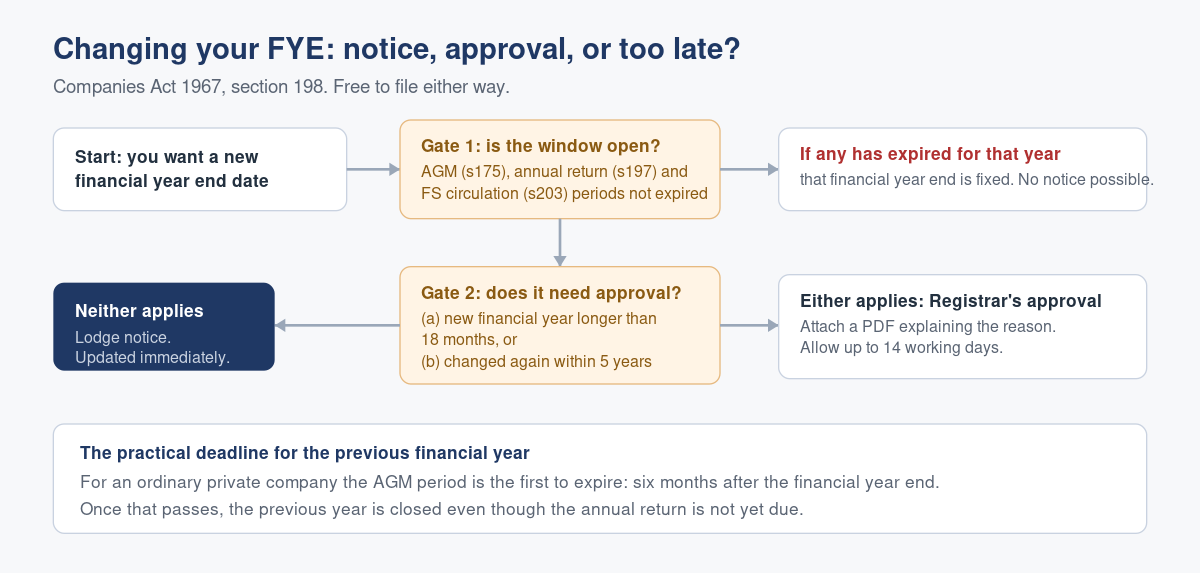
Approval is not the default. It is triggered by two specific circumstances set out in section 198(5).
The financial year would run longer than 18 months. If the new end date you specify produces a financial year of more than 18 months measured from its start, the notice needs approval. This catches most “let us just stretch the year to align with the parent” plans.
You are changing again inside five years. If your notice is lodged less than five years after the end of an earlier financial year that itself ended on or after 31 August 2018 and was changed under section 198, approval is required. In practice: change your FYE once, and a five year clock starts running from the end of that changed year. Change it again inside that clock and you are asking rather than telling.
A company that falls into neither category simply files and the register updates. A company that falls into either one submits the same transaction, attaches a supporting document explaining the reason for the change, and waits.
Notice versus approval, at a glance
| Your situation | Notice or approval | What happens |
|---|---|---|
| New FYE, financial year stays within 18 months, no change in the last five years | Notice | Updated immediately |
| New FYE produces a financial year longer than 18 months | Approval | Reviewed by ACRA, supporting document required |
| You changed your FYE before, and the earlier changed year ended less than five years ago (and on or after 31 August 2018) | Approval | Reviewed by ACRA, supporting document required |
| First financial year after incorporation, longer than 18 months | Approval | Application to the Registrar under section 198(2) |
| Foreign company registered in Singapore | Notice | Updated immediately |
The three cut-offs that close the window
This is the part that catches people. Section 198(6) says the notice cannot specify a new last day for a financial year after any of the following periods has expired for that year:
- The period under section 175 within which the annual general meeting must be held after that financial year. For a company other than a listed public company that is six months after the financial year end; for a listed public company, four months.
- The period under section 197 within which the annual return must be lodged after that financial year. Seven months after the financial year end for most companies, five months for a listed company, with an extra month where the company keeps a branch register outside Singapore.
- The period under section 203 within which the financial statements and accompanying documents must be sent to everyone entitled to notice of general meetings. That is at least 14 days before the meeting, or within five months of the financial year end for a private company that has dispensed with holding an AGM.
Read together, these mean the practical deadline for changing a previous financial year is short. For an ordinary private company, once six months have passed since that year end, the AGM period has expired and the door on that year is shut.
ACRA applies a related bar operationally: a company that has missed its deadlines for holding an AGM, filing its annual return or sending out financial statements cannot change its FYE at all until those gaps are closed. So a company in arrears is doubly stuck. It cannot use the change to fix the arrears, and it cannot change until the arrears are fixed.
Filing it, step by step
The transaction is free for both local and foreign companies. Position holders can file it directly, or you can have a registered corporate service provider do it for you.
- Decide the revised FYE date and the financial year period it applies to, and check it against the section 198(5) triggers before you start.
- If approval will be needed, prepare a supporting document in PDF explaining the reason for the change. Keep the file name free of spaces, special characters and non-English characters, because the upload is fussy about all three.
- Log in to Bizfile as a Business User through Corppass. If you have never done that, our guide to logging in to Bizfile as a business user covers the setup.
- Confirm the entity name and unique entity number in the top bar. Filing against the wrong company in a group is a real filing, and undoing it costs a second transaction.
- Open the Manage menu, choose the entity type, and select the transaction for updating the change of financial year end date.
- Key the revised date and the financial year period, attach the supporting document if required, and submit.
- If no approval is required, the new date is live when you submit. If approval is required, expect a review period of up to 14 working days, with the outcome landing in your Bizfile inbox.
Foreign companies registered in Singapore under Division 2 of Part 11 of the Companies Act 1967 use the equivalent transaction under their own entity type. They need only the unique entity number and the revised date, and the update is immediate.
What goes wrong in practice
Discovering the change is needed during the audit. A group finance team decides in month nine that last year should have ended in a different month. By then the AGM period for that year has gone, and section 198(6) closes the previous year off. The only route left is to change the current year instead and live with a stub or a long period, which is usually not what anyone wanted.
Forgetting the five year clock. Companies acquired twice in quick succession, or start-ups that align to an investor and then realign to a new investor, run straight into section 198(5)(b). The second change is not refused, but it becomes a reviewed application with a reason attached, and the timetable is no longer instant.
Treating it as an ACRA matter only. Changing the FYE changes your basis period, and IRAS apportions profits across Years of Assessment accordingly. It also moves your AGM, annual return and XBRL dates for every year that follows. The filing is free; the downstream work is not.
Assuming a long year is fine because it is under 18 months. Eighteen months is the approval threshold, not a blessing. A long financial year still has to be audited or prepared as one period, and a stretched year makes comparatives awkward for several years afterwards. If you are heading for a bank facility or a funding round, read our note on what lenders look for in your accounts before you stretch anything.
Frequently asked questions
How far back can I change my financial year end?
Only as far as the immediately preceding financial year, and only if the deadlines for that year’s AGM, annual return and financial statement circulation have not yet expired. Financial years before that are fixed and cannot be changed by notice under section 198 of the Companies Act 1967.
Does it cost anything to change my FYE?
No. ACRA charges no fee for the transaction, whether you are a local company or a foreign company registered in Singapore, and whether or not the Registrar’s approval is needed. The cost sits in the accounting and tax work that follows, not in the filing.
How long does ACRA take to approve a change?
Where approval is required, allow up to 14 working days. Where it is not required, there is no approval step at all: the new date is reflected as soon as you submit, and a confirmation appears in your Bizfile inbox. Plan on the longer timeline if your change is anywhere near the triggers.
Can I change my FYE if my annual return is late?
No. A company that has missed its AGM, annual return or financial statement deadlines cannot change its FYE until those obligations are brought up to date. Clear the arrears first, then file the change, and check that the section 198(6) window has not closed in the meantime.
Do I need a reason to change my financial year end?
Only when approval is required. A straightforward notice needs no justification. Where the new year exceeds 18 months, or where you are changing again inside five years, you must attach a supporting document explaining why, and ACRA reviews the change on that basis.
What happens to my first financial year if I incorporated recently?
Your first financial year runs from incorporation to the end date you gave at registration, and it must not exceed 18 months unless the Registrar approves a longer period on the company’s application. If the date you chose at incorporation no longer suits the business, change it early rather than at the first audit.
Getting the date right the first time
The cheapest version of this problem is the one you avoid. Choose the financial year end at incorporation with the group calendar, the seasonal cycle and the tax position already in mind, and you may never need this transaction at all.
If you do need it, the work worth paying for is not the filing. It is someone checking the section 198(5) triggers before you submit, confirming the window under section 198(6) is still open, and mapping what the new date does to your AGM, annual return, XBRL and tax timetable for the next three years. Raffles Corporate Services does that as a single piece of work, and it usually takes one conversation.
For the statutory text itself, the Companies Act 1967 is published in full on Singapore Statutes Online, and the transaction sits on Bizfile. You can also read more on Singapore corporate secretarial practice at Singapore Secretary Services.
— The Editorial Team, Raffles Corporate Services
Need help with this?
Raffles Corporate Services can handle the ACRA filings, compliance documentation and records for you, and where court proceedings or legal advice are needed, we work with a panel of experienced Singapore law firms who offer cost-effective and efficient legal service and advice.
Email: [email protected]
Call, SMS or WhatsApp: +65 8501 7133