
Every Singapore company must prepare financial statements that comply with the Accounting Standards and give a true and fair view of its financial position and performance, have them audited unless an exemption applies, attach a signed directors’ statement, and lay them before members. That duty sits on the directors, not on the accountant.
Raffles Corporate Services works with a panel of experienced Singapore law firms who offer cost-effective and efficient legal service and advice. This article is general information only and is not legal advice.
The word “prepare” does a lot of quiet work in that sentence. A set of financial statements is not the trial balance your bookkeeper produces, and it is not the management pack you look at monthly. It is a defined document with a prescribed content standard, a prescribed accompanying statement, an audit requirement that many companies escape but few escape correctly, and a sequence of deadlines that runs from your financial year end all the way to the annual return.
Here is what the law asks for, in the order you actually need it.
What counts as a set of financial statements
Section 201 of the Companies Act 1967 requires the directors of every company to lay financial statements before the company at its annual general meeting for the financial year in question. Those statements must comply with the requirements of the Accounting Standards and give a true and fair view of the company’s financial position and performance.
“Accounting Standards” is a defined term: the standards made by the Accounting Standards Committee under the Accounting Standards Act 2007 and applicable to companies for the purposes of the Companies Act. In practice, for a Singapore private company that means Singapore Financial Reporting Standards, or the simplified SFRS for Small Entities where the company qualifies for it.
If your company is a parent company at the end of its financial year, section 201(5) changes the deliverable. Instead of company-only statements, the directors must lay consolidated financial statements for the group, plus a balance sheet for the parent company itself. Both must comply with the Accounting Standards and give a true and fair view.
The directors’ statement is part of the package
Section 201(16) requires the financial statements to be accompanied, before the auditor reports on them, by a statement signed on behalf of the directors by two directors, containing the information set out in the Twelfth Schedule.
The Twelfth Schedule is short and worth reading before you sign it. Among other things, it asks the directors to say whether, in their opinion, the financial statements give a true and fair view, and whether at the date of the statement there are reasonable grounds to believe the company will be able to pay its debts as and when they fall due. That second limb is a solvency opinion. It is not boilerplate, and it is the sentence that tends to matter most when a company later fails.
Do you have to be audited?
Most Singapore private companies do not, but the exemption is narrower and more technical than its nickname suggests.
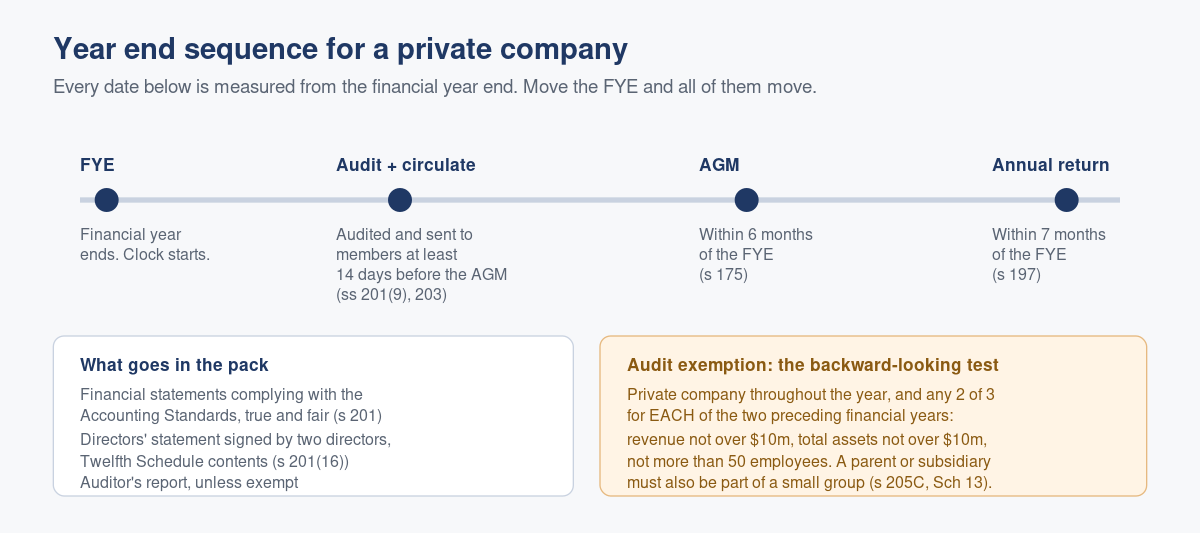
Under section 205C, a company is exempt from audit requirements for a financial year if it is a small company for that year. The Thirteenth Schedule defines it: the company must be a private company throughout the financial year, and it must satisfy any two of the following three criteria for each of the two financial years immediately preceding the year in question.
| Criterion | Threshold |
|---|---|
| Revenue for each financial year | Not more than $10 million |
| Total assets at the end of each financial year | Not more than $10 million |
| Employees at the end of each financial year | Not more than 50 |
Two points get missed constantly. First, the test looks backwards at the two preceding financial years, not at the year you are reporting on. Second, if the company is a parent or a subsidiary, being a small company is not enough on its own: it must also be part of a small group, tested on the same criteria across the group.
Newer companies are handled separately. A company that has not reached its third financial year can qualify from its first or second financial year by satisfying any two of the three criteria for that year alone.
Dormant companies get a further concession
Section 205B exempts a dormant company from the audit requirement. Section 201A goes further for a narrower group: the directors of a dormant relevant company are exempt from the duty to prepare financial statements at all, provided the company has been dormant since formation or since the end of the previous financial year, the directors lodge a statement to that effect with the Registrar, and the accounting records required by section 199 have been kept.
A relevant company for this purpose is one that is not a listed company or a subsidiary of a listed company, whose total assets at any time during the financial year do not exceed $500,000, and which, if it is a parent, belongs to a group whose consolidated total assets do not exceed $500,000. The directors’ statement has to be lodged at the same time as the annual return.
Note the trap in section 201A(3): the Registrar, or members holding at least 5% of the shares, or at least 5% of the members, can serve written notice requiring the directors to comply with section 201 anyway, provided the notice is given at least three months before the financial year ends.
The records behind the statements
You cannot produce compliant financial statements without compliant records, and section 199 makes that its own obligation. Every company must keep accounting and other records that sufficiently explain its transactions and financial position, that allow true and fair financial statements to be prepared, and that are kept in a manner allowing them to be conveniently and properly audited.
Those records must be retained for not less than five years from the end of the financial year in which the relevant transactions were completed, kept at the registered office or another place the directors think fit, and open to inspection by the directors at all times. If records are kept outside Singapore, statements and returns sufficient to allow true and fair financial statements to be prepared must be sent to and kept here.
Default under section 199 is an offence carrying a fine of up to $10,000 or imprisonment of up to 12 months, and a default penalty, for the company and every officer in default. If your bookkeeping is still running on a spreadsheet and goodwill, our note on when to move from DIY bookkeeping to professional support is the honest version of that conversation.
The sequence and the deadlines
The statutory deadlines are all measured from the financial year end, and they interlock. For an ordinary private company that holds an AGM:
| Step | Provision | Timing |
|---|---|---|
| Financial statements audited (where audit applies) | Section 201(9) | Not less than 14 days before the AGM, unless everyone entitled to notice agrees otherwise |
| Financial statements and auditor’s report sent to those entitled to notice | Section 203(1)(a) | Not less than 14 days before the AGM |
| Where the company has dispensed with an AGM | Section 203(1)(b) | Not later than 5 months after the financial year end |
| Annual general meeting held | Section 175(1) | Within 6 months after the financial year end (4 months for a listed public company) |
| Annual return lodged with the Registrar | Section 197(1) | Within 7 months after the financial year end (5 months for a listed company) |
Failing to send the statements under section 203 is an offence for the company and every officer in default, with a fine of up to $5,000 and a default penalty. A member or debenture holder who has not received a copy can also demand one, free, at any time.
Because these dates all hang off the financial year end, moving that date moves everything. Our guide on the window for changing your financial year end explains when that is still possible, and the Companies Act 1967 deep-dive FAQ covers the surrounding obligations.
When the standards do not fit
The Act does not pretend the Accounting Standards work for every company in every year, and it gives three routes out, each with conditions.
Registrar’s approval. Under section 201(12), financial statements need not comply with all or any of the requirements of the Accounting Standards if the company has obtained the Registrar’s approval to that non-compliance.
True and fair override. Under section 201(13), where compliance with a requirement would not give a true and fair view, the statements need not comply to the extent necessary to give that view. Section 201(14) then requires disclosure: the auditor’s agreement that the departure was necessary, particulars of the departure and its effect, and enough further information to give a true and fair view.
Relief from form and content. Section 202 provides relief from requirements as to the form and content of financial statements and the directors’ statement, applied for through Bizfile. Separately, section 202A allows voluntary revision of defective financial statements.
What goes wrong in practice
Reading the audit exemption forwards instead of backwards. A company crosses $10 million in revenue in the current year and assumes it must now be audited, or stays under it and assumes it need not be. Neither follows. The test looks at the two preceding financial years, so a good year does not immediately cost you the exemption and a bad year does not immediately restore it.
Forgetting the group test. A small company that is a subsidiary of a larger group is not exempt unless the group is also small. This is the single most common audit exemption error we see in holding structures.
Signing the directors’ statement without reading it. Two directors sign an opinion on true and fair view and on the company’s ability to pay its debts as they fall due. Directors sign it at the same time as everything else, often without having read the going concern note it depends on. Our companion piece on financial reporting duties and personal exposure for directors sets out what that signature can cost.
Treating dormancy as automatic. The section 201A exemption from preparing financial statements is conditional on lodging a directors’ statement with the Registrar at annual return time and on having kept section 199 records. Companies that simply file nothing are not exempt; they are late.
Frequently asked questions
Does a small company still need to prepare financial statements?
Yes. Audit exemption under section 205C of the Companies Act 1967 removes the audit, not the preparation. A small company must still prepare financial statements that comply with the Accounting Standards and give a true and fair view, accompanied by a directors’ statement, and lay them before members.
What is the difference between unaudited and exempt financial statements?
There is no separate category called exempt financial statements. A company that qualifies for audit exemption prepares an ordinary set of financial statements under section 201 without an auditor’s report attached. The content standard is identical; only the independent opinion is missing.
How long must a Singapore company keep its accounting records?
At least five years from the end of the financial year in which the relevant transactions were completed, under section 199 of the Companies Act 1967. The records must sufficiently explain the company’s transactions and financial position and be capable of being conveniently and properly audited.
Who signs the financial statements?
The directors’ statement required by section 201(16) must be signed on behalf of the directors by two directors of the company. A company with a sole director will need to address that, because the Act specifies two signatories for the statement.
Do I need consolidated accounts if my company owns a subsidiary?
If your company is a parent company at the end of its financial year, section 201(5) requires consolidated financial statements for the group plus a balance sheet for the parent, unless an exemption in the Accounting Standards applies. Consolidation also affects whether the group qualifies as small for audit exemption.
When do the financial statements have to reach shareholders?
At least 14 days before the annual general meeting, unless everyone entitled to notice agrees to a shorter period. A private company that has dispensed with holding an AGM must send them within five months after the financial year end.
Making year end boring
A well run year end is uneventful because the decisions were made months earlier: the audit exemption position was tested before the year closed rather than after, the records were kept in a form an auditor could actually use, and the directors saw a draft with time to ask questions.
Raffles Corporate Services prepares financial statements and manages the year end timetable for Singapore private companies, including the audit exemption assessment, the directors’ statement, and the annual return that follows. If you are not sure which side of the small company test you fall on this year, that is a short calculation and worth doing before the year ends rather than after.
The statutory text is on Singapore Statutes Online, and the filing transactions sit on Bizfile. You can also read more on Singapore corporate secretarial practice at Singapore Secretary Services.
— The Editorial Team, Raffles Corporate Services
Need help with this?
Raffles Corporate Services can handle the ACRA filings, compliance documentation and records for you, and where court proceedings or legal advice are needed, we work with a panel of experienced Singapore law firms who offer cost-effective and efficient legal service and advice.
Email: [email protected]
Call, SMS or WhatsApp: +65 8501 7133