
A Singapore director who fails to ensure the company’s financial statements comply with the Accounting Standards and give a true and fair view commits an offence carrying a fine of up to $250,000. The liability is personal, it is criminal, and it does not move to your accountant when you outsource the work.
Raffles Corporate Services works with a panel of experienced Singapore law firms who offer cost-effective and efficient legal service and advice. This article is general information only and is not legal advice.
That figure surprises directors, and it should. Financial reporting is the one area of company law where the Act names the director rather than the company as the offender. Section 201 of the Companies Act 1967 says the directors must lay compliant financial statements before the company. Section 204 then prices failure, director by director.
None of this depends on you being the finance person. It applies to every director on the board, executive or not, accountant or not.
Where the duty actually sits
Section 201(1) requires the directors of every company to lay the financial statements for the financial year before the company at its annual general meeting. Section 201(2) requires those statements to comply with the requirements of the Accounting Standards and to give a true and fair view of the company’s financial position and performance. For a parent company, section 201(5) substitutes consolidated financial statements plus a parent balance sheet, to the same standard.
Section 201(7) adds a preparatory duty that directors rarely read. Before the statements are made out, the directors must take reasonable steps to ascertain what has been done about bad and doubtful debts and cause adequate provision to be made, to ascertain whether current assets are unlikely to realise their carrying value and cause them to be written down, and to ascertain whether non-current assets are carried above recoverable amount and cause explanatory information to be included if no provision is made.
Those are not accounting tasks delegated to management. They are steps the directors are required to take.
The exposure, priced
| Failure | Provision | Maximum personal exposure |
|---|---|---|
| Financial statements do not comply with the Accounting Standards or do not give a true and fair view | Section 204(1), for breach of section 201(2) or (5) | Fine up to $250,000 |
| No directors’ statement, or one lacking the Twelfth Schedule contents | Section 204(1AA), for breach of section 201(16) | Fine up to $50,000 |
| Any other failure in the financial statements provisions, including failing to take all reasonable steps to secure compliance | Section 204(1A) | Fine up to $10,000 or imprisonment up to 2 years |
| Any of the above, committed with intent to defraud creditors or for a fraudulent purpose | Section 204(3) | Up to $250,000 and imprisonment up to 3 years, depending on the underlying offence |
| Accounting records not kept or not retained for five years | Section 199(6) | Fine up to $10,000 or imprisonment up to 12 months, plus a default penalty |
| Financial statements not sent to those entitled to notice | Section 203(3A) | Fine up to $5,000, plus a default penalty |
| Wilfully making or authorising a false or misleading statement in financial statements or another document required under the Act | Section 401(2) | Fine up to $50,000 or imprisonment up to 2 years, or both |
| Lodging with the Registrar a document known to be false or misleading in a material respect | Section 401(2A) | Fine up to $50,000 or imprisonment up to 2 years, or both |
| Failing to act honestly or to use reasonable diligence in the office of director | Section 157(1) and (3) | Fine up to $20,000 or imprisonment up to 12 months, or both, plus liability to the company for profit made or damage suffered |
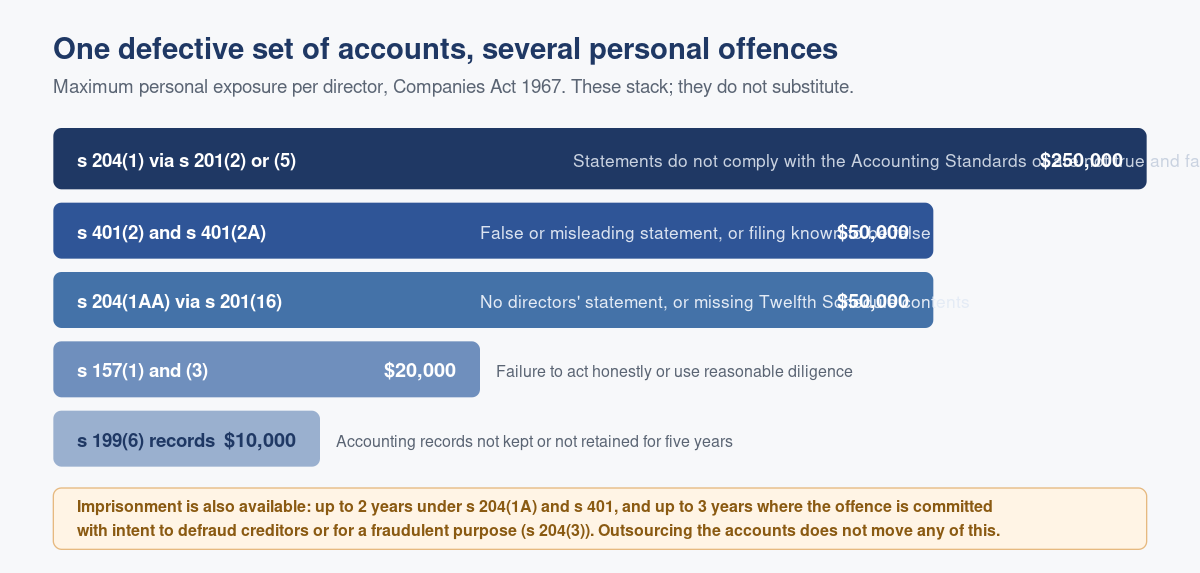
Two structural points make this list more dangerous than it looks.
First, these are per director exposures, not a single company fine divided among the board. Second, they stack. A single defective set of accounts can engage section 201, section 199 and section 401 at once, and the annual return that carries those accounts to ACRA engages section 197 as well.
The defences, and their limits
The Act does provide protection, but it is narrower than most directors assume.
The “officer in default” filter. Section 408(3) defines an officer who is in default as one who knowingly and wilfully is guilty of the offence, or who authorises or permits its commission. Where a provision is framed that way, inadvertence is not enough to convict.
The immateriality defence. Section 204(2) offers a defence where a director is charged with failing to take reasonable steps to comply with the form and content requirements by reason of an omission. The director must prove that the omission was not intentional and that the information omitted was immaterial and did not affect the giving of a true and fair view.
No imprisonment without wilfulness. Section 204(4) provides that no person is to be sentenced to imprisonment for an offence under that section unless the Court is of the opinion that the offence was committed wilfully.
Composition. Under section 409B, the Registrar may compound a compoundable offence by collecting a sum not exceeding the lower of half the maximum fine or $20,000. Many financial reporting lapses are resolved this way rather than by prosecution. That is a relief, not an entitlement, and it is at the Registrar’s discretion.
What is not a defence: that you relied on the accountant, that you are not financially trained, that you were a non-executive or nominee director, or that you signed what was put in front of you. Section 157(1) requires every director to use reasonable diligence in discharging the duties of the office, and the financial reporting duties are duties of the office.
Outsourcing moves the work, not the duty
Outsourcing record-keeping and the preparation of financial statements is normal, sensible and entirely permitted. It does not transfer the statutory duty, because the duty in section 201 is imposed on directors and nowhere in the Act is it capable of being delegated away.
Practically, that means three things.
Choose competent providers and check. The engagement letter protects your commercial position; it does not answer a charge under section 204. Our note on working effectively with an outsourced accounting firm covers what to ask for and when.
Test the advice rather than absorbing it. Where an accounting treatment does not match your understanding of what actually happened commercially, say so and get it explained. Judgements and estimates, in particular impairment, revenue timing and going concern, are where defective statements usually originate.
Read the directors’ statement before you sign it. The Twelfth Schedule requires the directors to state whether, in their opinion, the financial statements give a true and fair view, and whether there are reasonable grounds to believe the company will be able to pay its debts as and when they fall due. Two directors sign that. If the company is depending on a shareholder loan that has not been documented or a facility that has not been renewed, that sentence is the one you will be asked about later.
What goes wrong in practice
The board that never sees a draft. Accounts arrive signed-ready two days before the AGM deadline. Nobody has time to challenge anything, so nobody does. Section 201(7) and section 157 both assume the opposite sequence.
The dormant or nominee directorship. A director appointed to satisfy the residency requirement, or sitting on a group subsidiary they never visit, carries the same financial reporting duties as an executive director. Singapore’s courts have taken nominee arrangements increasingly seriously, as our note on the sentencing framework for nominee directors shows, and ACRA’s amended Form 45 disqualification declaration reflects the same direction of travel.
Assuming audit exemption reduces the duty. It does not. A small company exempt from audit still owes the full section 201 duty on the content of its statements, with no independent auditor between the directors and a defective set of accounts. If anything the exposure is higher, not lower. Our companion guide on what a Singapore company actually has to produce at year end sets out the exemption test.
Fixing it by not filing. A company that discovers a problem and quietly stops filing turns one exposure into several: section 175 for the missed AGM, section 197 for the missed annual return, and section 199 for the records. It also loses the ability to change its financial year end, because that route is closed to companies in arrears. Voluntary revision under the Act is the better route.
Frequently asked questions
Can a director be personally fined for the company’s financial statements?
Yes. Section 204(1) of the Companies Act 1967 makes a director personally guilty of an offence, liable to a fine of up to $250,000, for failing to comply with the requirement that financial statements comply with the Accounting Standards and give a true and fair view. The liability attaches to the director, not the company.
Does outsourcing the accounts protect the directors?
No. The duty in section 201 is imposed on directors and cannot be delegated away by engaging an accounting firm. Outsourcing the work is sensible and lawful, but the directors remain responsible for the resulting statements and for taking reasonable steps to ensure they are right.
Are non-executive and nominee directors exposed in the same way?
Yes. The Companies Act 1967 does not distinguish between executive, non-executive and nominee directors for financial reporting purposes. A director who does not understand the accounts is expected to acquire enough knowledge to perform a meaningful high-level review, or to get advice, not to abstain.
What is the directors’ statement and why does it matter?
It is the statement required by section 201(16), signed by two directors, containing the Twelfth Schedule information. It records the directors’ opinion that the statements give a true and fair view and that there are reasonable grounds to believe the company can pay its debts as they fall due. Failing to provide it carries a fine of up to $50,000.
Can ACRA settle a financial reporting breach without going to court?
Often, yes. Section 409B lets the Registrar compound a compoundable offence for a sum not exceeding the lower of half the maximum fine or $20,000. Composition is at the Registrar’s discretion and is not available for every offence, so it should never be treated as the planned outcome.
What should a director do before signing off the accounts?
Read the statements and the notes, challenge any treatment that does not match the commercial substance of the transaction, ask how the significant estimates were arrived at, confirm the going concern basis is supported, and check the directors’ statement says what you actually believe. Keep a record of the questions asked.
A board that can answer the question
Most directors who end up in difficulty over financial statements were not dishonest. They were busy, they trusted the numbers, and they had no process for the fifteen questions that would have surfaced the problem.
Raffles Corporate Services prepares financial statements and runs the year end timetable for Singapore private companies, and we build in the director review rather than leaving it to the last week. If you are a director who has never been given a draft with time to read it, that is worth fixing before the next year end rather than after.
The statutory provisions cited here can be read in full on Singapore Statutes Online, and ACRA publishes annual practice guidance on its financial reporting surveillance programme. You can also read more on Singapore corporate secretarial practice at Singapore Secretary Services.
— The Editorial Team, Raffles Corporate Services
Need help with this?
Raffles Corporate Services can handle the ACRA filings, compliance documentation and records for you, and where court proceedings or legal advice are needed, we work with a panel of experienced Singapore law firms who offer cost-effective and efficient legal service and advice.
Email: [email protected]
Call, SMS or WhatsApp: +65 8501 7133