
If your Singapore company is a parent or a subsidiary, it is only audit exempt if it is a small company and part of a small group. Both tests must be passed. A tiny Singapore subsidiary of a large overseas parent is not audit exempt, however small it looks on its own accounts.
Raffles Corporate Services works with a panel of experienced Singapore law firms who offer cost-effective and efficient legal service and advice. This article is general information only and is not legal advice.
That rule is in section 205C(3) and (4) of the Companies Act 1967, and it is the single most common reason a company that “obviously qualifies” turns out not to. Owner-managed groups in Singapore routinely hold three or four operating entities under a family holding company, assess each one in isolation, and conclude that all of them are exempt. The Act does not allow that.
This article covers the group side of the test. The company-level test, the three thresholds and the two-year lookback are set out in audit exemption and the small company test, and you should read that first, because a company that fails the company test is out regardless of what the group looks like.
What the small group test asks
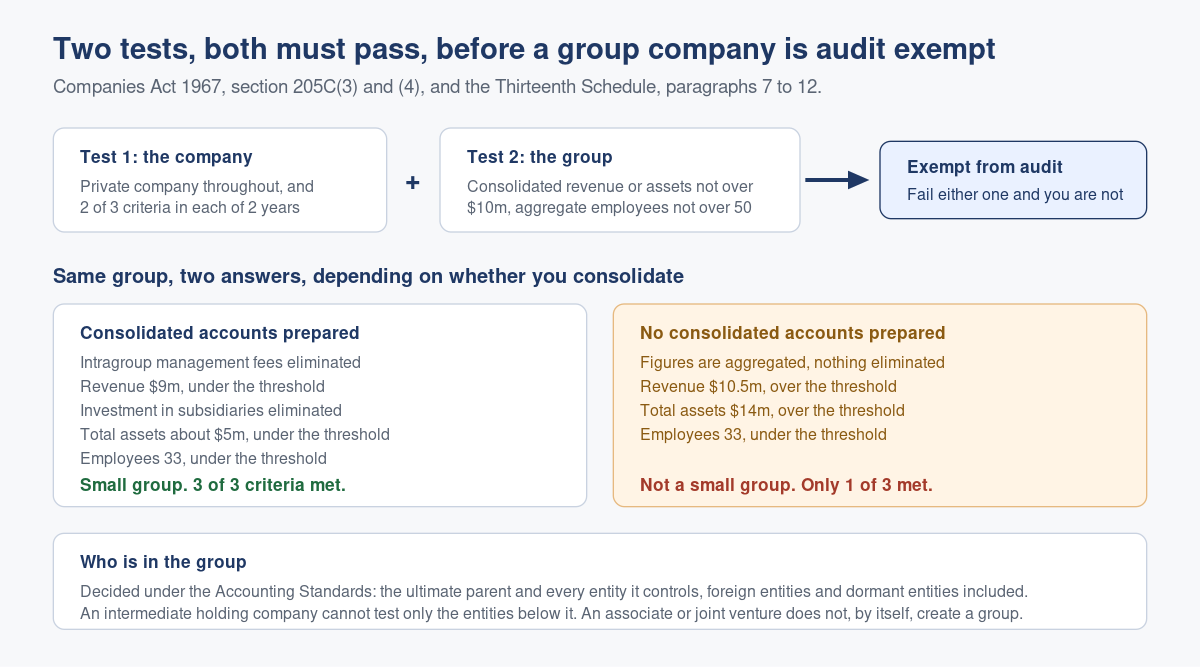
Paragraph 7 of the Thirteenth Schedule defines it. A group is a small group from a financial year if it satisfies any two of the following three criteria for each of the two consecutive financial years immediately preceding that year:
- consolidated revenue of the group for each of those financial years does not exceed $10 million;
- the value of the consolidated total assets of the group at the end of each of those financial years does not exceed $10 million;
- the group has, at the end of each of those financial years, an aggregate number of employees of not more than 50.
The shape is identical to the company test: two of three, in each of two lookback years. The numbers are identical too. What changes is the reporting entity. You are now measuring the whole group rather than the single company.
Paragraph 8 gives newly formed groups the same relief that new companies get, assessing the group on its own first or second financial year after formation. Paragraph 9 does the equivalent for groups formed before 1 July 2015. Paragraph 10 handles cessation, and mirrors the company rule: a small group stops being small only if it fails to meet at least two of the three criteria across two consecutive preceding financial years. Paragraph 11 protects groups that have not yet reached their third financial year from that cessation rule.
Which entities count as part of the group
Paragraph 12(a) of the Thirteenth Schedule answers this by reference to the Accounting Standards rather than by its own definition. Whether an entity is part of a group is decided in accordance with the Accounting Standards, which means a group is a parent and its subsidiaries, judged on control.
Three consequences follow, and each of them catches people.
Foreign entities are in
The Schedule draws no geographic line. If your Singapore company is controlled by a company in Jakarta, London or Shenzhen, that parent and everything else it controls forms the group whose figures you must test. The Singapore company’s own size is beside the point.
This is why Singapore subsidiaries of foreign groups are almost never audit exempt. It is also why the question “who ultimately controls this company” belongs in the year end file, not just in the statutory registers. Our Companies Act 1967 deep-dive FAQ covers the surrounding obligations.
The group is measured at the top, not at your level
Paragraph 12(c) defines “parent” by reference to the Accounting Standards but expressly excludes any entity which is itself a subsidiary of another entity. The relevant group is therefore the one headed by the ultimate parent.
An intermediate Singapore holding company cannot test the sub-group sitting beneath it and stop there. If that holding company is itself owned by something further up, the test runs from the top of the chain.
You must test the group even if you never consolidate
This is the provision that surprises accountants. Paragraph 12(b) contemplates both cases directly.
Where consolidated financial statements are prepared, consolidated total assets and consolidated revenue are determined under the accounting standards applicable to the group. In other words, the ordinary consolidation figures, after intragroup eliminations.
Where consolidated financial statements are not prepared, “consolidated total assets” means the aggregate total assets of all members of the group and “consolidated revenue” means the aggregate revenue of all members. No eliminations.
So a company that is exempt from preparing consolidated financial statements does not escape the group test. It simply applies a harsher version of it, in which intragroup sales, management fees, intercompany receivables and the parent’s investment in its subsidiaries are all counted rather than cancelled.
Worked example one: the same group, two different answers
A Singapore family group with a 31 December year end. Holdco owns 100% of two operating subsidiaries and charges them management fees.
| Entity | Revenue | Total assets | Employees |
|---|---|---|---|
| Holdco | $1.5m (all management fees charged to the subsidiaries) | $9m (investment in subsidiaries and intercompany receivables) | 3 |
| Sub A | $5m | $3m | 18 |
| Sub B | $4m | $2m | 12 |
If consolidated financial statements are prepared. The $1.5m of management fees is eliminated, so consolidated revenue is $9m. The investment in subsidiaries and the intercompany balances are eliminated, so consolidated total assets are around $5m. Aggregate employees are 33. The group passes all three criteria.
If consolidated financial statements are not prepared. Aggregate revenue is $10.5m, over the threshold. Aggregate total assets are $14m, over the threshold. Aggregate employees are 33, under the threshold. Only one of three criteria is met, so this is not a small group, and neither Holdco nor either subsidiary is audit exempt.
Nothing about the underlying business changed between those two paragraphs. The only difference is whether consolidated accounts exist. That is a genuinely odd outcome, but it is what paragraph 12(b) says, and it is worth knowing about before you decide not to consolidate.
Worked example two: the small Singapore subsidiary
A Singapore company with revenue of $1.2m, total assets of $600,000 and four employees. It is wholly owned by a listed manufacturer in another country with revenue in the hundreds of millions.
The Singapore company passes the small company test on its own figures without difficulty. It is a private company, and it clears all three thresholds comfortably in both lookback years.
It is still not audit exempt. Section 205C(4) says the exemption does not apply to a subsidiary unless the subsidiary is a small company and part of a small group. The group here is headed by the foreign parent and is nowhere near small. The Singapore company must be audited.
The practical trap is timing. A Singapore company that has been happily unaudited for years becomes a subsidiary the day a larger investor takes control. Audit exemption can be lost mid-stream by a transaction that nobody thought of as an accounting event.
Worked example three: the company that is not in a group at all
A Singapore private company holds 30% of an associate and a 50% interest in a joint venture, but controls neither.
Under the Accounting Standards a group is a parent and its subsidiaries. Holding an associate or a joint venture interest does not, by itself, make you a parent and does not put you in a group. Section 205C(3) and (4) speak to parent companies and subsidiary companies, so a company in this position is assessed on the company test alone.
That is a helpful outcome, but do not assume it. The line between significant influence and control is a judgement under the Accounting Standards, and a shareholders’ agreement that hands you board control over a 30% holding can move you across it.
What goes wrong in practice
Testing each company separately and stopping there. The most frequent error, and the most expensive one. Every company in a group needs both tests. Write both down.
Treating “we do not consolidate” as “the group test does not apply”. It applies. The aggregation rule in paragraph 12(b) simply removes the eliminations, which almost always makes the numbers worse. Groups that trade heavily with themselves are the ones most likely to be caught.
Forgetting overseas subsidiaries and dormant entities. Every member of the group counts, wherever incorporated and however inactive. A dormant offshore entity adds nothing to revenue but its assets are still aggregated where no consolidation is prepared.
Missing a change of control. A share transfer, a new investor, or a restructuring that inserts a holding company can change group membership and therefore audit status, with effect from a financial year that may already be under way.
Leaving no evidence. The test is applied years later by an auditor, an acquirer or a regulator. Keep a short annual memo recording the group members, the figures for each lookback year, whether consolidation was prepared, and the conclusion. It takes half an hour and settles arguments that otherwise take days. The same discipline applies to related party and key management personnel disclosures, which draw on the same group analysis.
Whatever the audit conclusion, the group still has to produce a compliant set of financial statements and file them. Our companion guides on what a Singapore company has to produce at year end and filing financial statements in XBRL cover that ground.
Frequently asked questions
Does my small Singapore subsidiary need an audit if the parent is overseas?
Almost certainly yes. A subsidiary is only audit exempt if it is a small company and part of a small group, and the group includes the foreign parent and all of its other subsidiaries. If the worldwide group exceeds two of the three thresholds in either lookback year, the Singapore subsidiary must be audited whatever its own size.
We do not prepare consolidated accounts. Do we still have to apply the small group test?
Yes. Where consolidated financial statements are not prepared, the Thirteenth Schedule tells you to use the aggregate total assets and aggregate revenue of all members of the group, without intragroup eliminations. That is usually a higher figure than a consolidation would produce, so it is a harder test rather than an escape from one.
Does a holding company have to be audited if its subsidiaries are all small?
Only if the group is not small. A parent is audit exempt only where it is a small company in its own right and the group it heads is a small group. Several individually small subsidiaries can still add up to a group that breaches two of the three thresholds.
Does an associate or a joint venture put us into a group?
Not by itself. Under the Accounting Standards a group is a parent and its subsidiaries, judged on control. Significant influence over an associate, or joint control of a joint venture, does not make you a parent. Check the control analysis carefully, because contractual rights can create control over a minority holding.
When exactly does a group lose small group status?
When it fails to meet at least two of the three criteria in each of two consecutive financial years immediately preceding the year in question. One breach year does not end it. Groups that have not yet reached their third financial year since formation are outside the cessation rule altogether.
The half hour that saves the argument
Group audit exemption is decided by facts that change quietly: a new investor, an overseas acquisition, a dormant entity nobody remembers, a decision not to consolidate. None of those arrive labelled as an audit question.
Raffles Corporate Services runs the small company and small group tests together as part of the year end file for the groups we look after, documents which lookback years were used, and flags the year in which exemption is forecast to end so that auditors can be appointed on a sensible timetable. If you hold more than one entity and nobody has written this assessment down, that is where to start.
The statutory text is on Singapore Statutes Online, ACRA’s own guidance sits on the audit exemption page, and you can read more on Singapore corporate secretarial practice at Singapore Secretary Services.
— The Editorial Team, Raffles Corporate Services
Need help with this?
Raffles Corporate Services can handle the ACRA filings, compliance documentation and records for you, and where court proceedings or legal advice are needed, we work with a panel of experienced Singapore law firms who offer cost-effective and efficient legal service and advice.
Email: [email protected]
Call, SMS or WhatsApp: +65 8501 7133