
Your Singapore company is exempt from audit for a financial year if it was a private company throughout that year and it met at least two of three thresholds (revenue not exceeding $10 million, total assets not exceeding $10 million, not more than 50 employees) in each of the two financial years immediately before it.
Raffles Corporate Services works with a panel of experienced Singapore law firms who offer cost-effective and efficient legal service and advice. This article is general information only and is not legal advice.
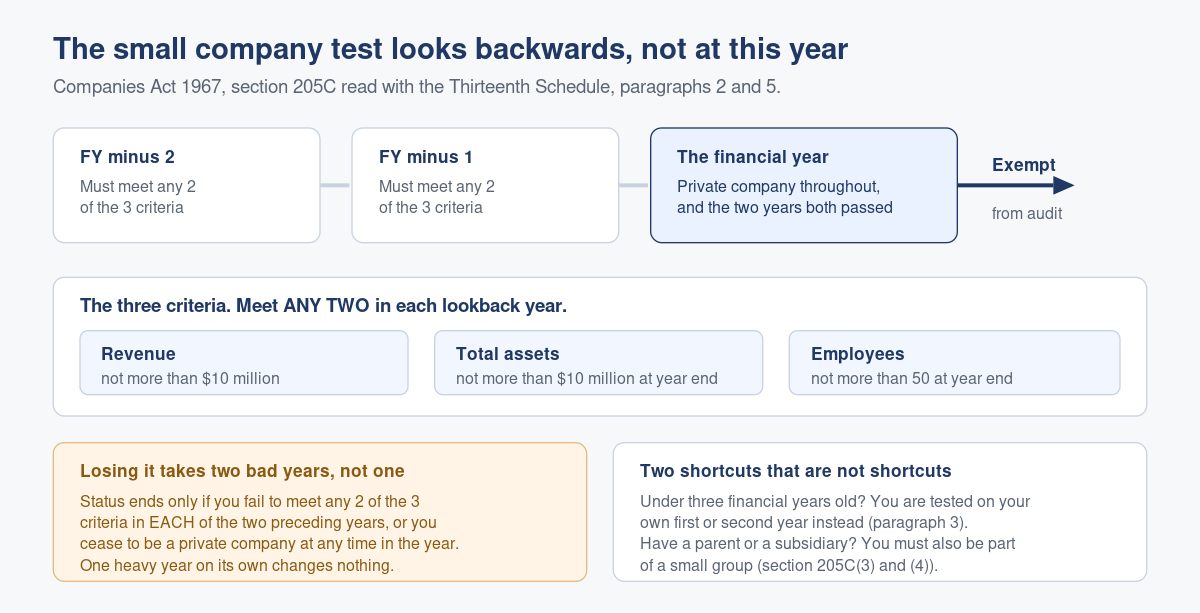
That last part is where most people go wrong. The small company test does not look at the year you are trying to exempt. It looks backwards at the two years behind it. A company that had a spectacular year and is now well over $10 million in revenue may still be audit exempt for that year, and a company that has just shrunk may still need an audit.
The exemption sits in section 205C of the Companies Act 1967, read with the Thirteenth Schedule. This article covers the small company test as it applies to a standalone company. If your company has a parent, a subsidiary or a fellow subsidiary anywhere in the world, there is a second test you must also pass, and that is covered in the small group test and how it applies to holding and subsidiary structures.
What “small company” actually means in law
A small company is not a size description. It is a defined status under paragraph 1 of the Thirteenth Schedule, and a company either has it or does not.
Paragraph 2 sets the general rule. A company is a small company from a financial year if:
- it is a private company throughout that financial year; and
- it satisfies any two of the following three criteria for each of the two financial years immediately preceding that year:
- revenue for each of those financial years does not exceed $10 million;
- the value of total assets at the end of each of those financial years does not exceed $10 million;
- it has, at the end of each of those financial years, not more than 50 employees.
Two features of that wording do a lot of work.
First, “throughout”. Private company status is tested across the whole financial year, not at the year end. A company that converted from public to private in month nine is not exempt for that year.
Second, “any 2 of the following criteria for each of the 2 financial years”. You do not need the same two criteria in both years, but you do need two in each year separately. Failing to clear any two in one of the two lookback years breaks the test for the current year, however comfortable the other year was.
The three thresholds, and how each is measured
| Criterion | Threshold | Measured how | Measured when |
|---|---|---|---|
| Revenue | Not more than $10 million | From the financial statements prepared under the Accounting Standards | For the whole financial year |
| Total assets | Not more than $10 million | Value of total assets from the same financial statements | At the end of the financial year |
| Employees | Not more than 50 | Headcount. ACRA’s published guidance refers to full-time employees | At the end of the financial year |
Three practical notes on that table.
Revenue is revenue, not profit and not turnover as you use the word. It is the revenue line your financial statements report under the Accounting Standards. Other income and disposal gains sit outside the revenue line under most standards, so a company that sold a property may be far above $10 million in cash terms and still under $10 million in revenue.
Total assets is gross, not net. It is total assets, not net assets and not equity. Companies with heavy borrowings frequently trip this criterion while thinking of themselves as small.
The Act says “employees” and does not define the term. ACRA’s own guidance frames it as full-time employees at the financial year end. That leaves a real question over part-timers, contractors and seconded staff. The sensible practice is to fix a basis, apply it consistently year to year, and record the headcount and the basis in the year end file rather than reconstructing it two years later when the auditor asks.
New companies: the first two financial years
A company that has not reached its third financial year after incorporation cannot satisfy a two-year lookback, so paragraph 3 of the Thirteenth Schedule replaces it with a current-year test.
A company in that position is a small company:
- from its first financial year, if it was a private company throughout that year and satisfied any two of the three criteria for that year; or
- from its second financial year, if it was a private company throughout that year and satisfied any two of the three criteria for that year.
The second limb matters. Missing the test in year one does not lock you out. You get a fresh assessment in year two on year two’s own figures, and qualifying then gives you small company status from year two onwards.
Paragraph 4 does the same job for companies incorporated before 1 July 2015, running the test against the first or second financial year commencing on or after that date. The small company regime itself only applies to financial years beginning on or after 1 July 2015.
How a company loses the exemption
Paragraph 5 of the Thirteenth Schedule is the disqualification rule, and it is deliberately harder to trigger than the qualification rule. Once you are a small company you stay one, for that year and every subsequent year, until one of two things happens.
You cease to be a private company at any time during a financial year. This is immediate and absolute. Exceeding 50 members, or restructuring in a way that costs you private company status, ends the exemption for that year.
You fail the quantitative test for two consecutive years. Precisely: you do not satisfy any two of the three criteria for each of the two consecutive financial years immediately preceding the year in question. Breaching in one year alone does not cost you the exemption. You need two bad years in a row before status is lost, and the loss then bites in the third year.
Paragraph 6 shields very young companies from this rule entirely. Disqualification under paragraph 5 does not apply to a company that has not yet reached its third financial year after incorporation, or, for pre-1 July 2015 companies, its third financial year after that date.
A worked sequence
Take a private company with a 31 December year end that has been trading since 2019.
| Financial year | Revenue | Total assets | Employees | Criteria met | Audit exempt? |
|---|---|---|---|---|---|
| 2023 | $8m | $6m | 42 | 3 of 3 | Yes |
| 2024 | $12m | $9m | 48 | 2 of 3 | Yes (2022 and 2023 both passed) |
| 2025 | $14m | $11m | 55 | 0 of 3 | Yes (2023 and 2024 both passed) |
| 2026 | $15m | $12m | 60 | 0 of 3 | No. 2024 passed, 2025 failed, so status survives |
| 2027 | $16m | $13m | 65 | 0 of 3 | No. 2025 and 2026 both failed, status lost |
Read across row by row and the lag becomes obvious. The company blew through every threshold in 2025 and was still audit exempt that year, and again in 2026. It only loses the exemption for FY2027, two full years after the growth actually happened.
That lag is a gift if you plan for it, and a nasty surprise if you do not. The company above should have been budgeting for a first audit, and appointing auditors, well before FY2027 began.
What audit exemption does not do
This is the part that costs companies money, because the exemption is narrower than the relief people imagine.
It does not excuse you from preparing financial statements. Section 201 still requires financial statements that comply with the Accounting Standards and give a true and fair view, together with a signed directors’ statement. Unaudited does not mean informal. Our guide on what a Singapore company actually has to produce at year end sets out the full pack.
It does not excuse you from filing. Whether you file, and in what format, is a separate question answered by your company type and size, not by your audit status. See filing your financial statements in XBRL.
It does not remove director liability. The offences in the Companies Act for non-compliant financial statements attach to directors personally and are unaffected by the absence of an auditor. If anything the exposure rises, because nobody independent is checking. We set out the exposure in what the accounts can cost a director personally.
It can be overridden by your own shareholders. Section 205C applies section 205B(6) and (7) with modifications, which means members holding at least 5% of the issued shares (excluding treasury shares), or any class of them, or at least 5% of the members by number, can serve written notice requiring an audit for a financial year. The notice must reach the company no later than one month before the end of that financial year. Once served, the exemption is gone for that year. Minority shareholders in a dispute use this, and it works.
What goes wrong in practice
Assessing the wrong years. Directors look at the year they are closing and conclude they are exempt because the figures are small. The test is the two years before it. Run the assessment when you close the file, and record which two years you relied on.
Forgetting the group overlay. A company that is a parent or a subsidiary must be a small company and part of a small group. Passing the company test alone is not enough, and this is the single most common error we see in owner-managed groups.
Treating dormancy and smallness as the same thing. They are different exemptions. Section 205B exempts dormant companies and is not limited to private companies. Section 205C exempts small companies and is limited to private companies. A dormant public company can be exempt under 205B while failing 205C outright.
Changing the financial year end without redoing the test. A shortened or lengthened financial year changes the revenue figure you are comparing against a fixed $10 million threshold. If you are contemplating a change, read the window for changing your financial year end first.
Appointing auditors too late. When the exemption goes, section 205 requires an auditor. Finding one, getting them through client acceptance and letting them observe a year end stocktake all take time you do not have if you discover the problem in month eight.
Frequently asked questions
Does my company need an audit if it made less than $10 million this year?
Not necessarily, and the question is the wrong way round. Audit exemption for a financial year depends on whether you were a private company throughout that year and met at least two of the three thresholds in each of the two preceding financial years. This year’s figures do not decide this year’s exemption.
Can a company with corporate shareholders be audit exempt?
Yes. The small company test under section 205C and the Thirteenth Schedule asks only whether you are a private company, not whether you are an exempt private company. Corporate shareholders are fine. What matters instead is whether the corporate shareholder makes you part of a group, which brings the separate small group test into play.
What happens if we exceed a threshold in one year only?
Nothing immediately. A small company only ceases to be small if it fails to meet at least two of the three criteria in each of two consecutive financial years, and the loss of status then applies from the following financial year. One heavy year does not end the exemption.
Do shareholders have any say in whether we are audited?
Yes. Members holding at least 5% of the issued shares, or at least 5% of the members by number, can require an audit by giving the company written notice at least one month before the end of the financial year. The exemption then does not apply for that year, regardless of the company’s size.
Is a newly incorporated company automatically audit exempt?
No, but it is tested differently. Before its third financial year a company is assessed on its own first or second financial year figures rather than on a two-year lookback. It must still be a private company throughout that year and meet at least two of the three thresholds for it.
Does audit exemption mean we can skip preparing proper accounts?
No. Every Singapore company must still prepare financial statements that comply with the Accounting Standards and give a true and fair view, accompanied by a directors’ statement. The exemption removes the auditor’s report, nothing else.
Getting the assessment on paper before you need it
The small company test is not difficult. It is just easy to get wrong two years after the fact, when nobody wrote down which years were relied on or how the headcount was counted.
We run this assessment for clients as part of the year end file: the two lookback years identified, each criterion tested and evidenced, the group position considered, and a note of when the exemption is forecast to end so that auditors can be appointed in good time rather than in a panic. Raffles Corporate Services prepares and files financial statements for Singapore companies across that whole range, audited and unaudited.
If you are not certain whether your next set of accounts needs an audit, that is a short conversation. You can also read more on Singapore corporate secretarial practice at Singapore Secretary Services, and the statutory text itself is on Singapore Statutes Online alongside ACRA’s guidance on the small company concept.
— The Editorial Team, Raffles Corporate Services
Need help with this?
Raffles Corporate Services can handle the ACRA filings, compliance documentation and records for you, and where court proceedings or legal advice are needed, we work with a panel of experienced Singapore law firms who offer cost-effective and efficient legal service and advice.
Email: [email protected]
Call, SMS or WhatsApp: +65 8501 7133